

Preparing Your Clients’ Expectations – Will Go A Long Way To Easing Their Fears
- They assume that they will still get medical care and medications on the inside.
- The assumption may also be that they will get the same medications that they got on the outside,
- These will likely be false assumptions.
a
a
a
a
a
a
Medication availability (~ 3500 different drugs) falls into 3 categories.
1st) On Formulary –Available:
- These medications are available for BOP healthcare providers for inmate use.
2nd) Non-Formulary – Not Available, as they require a lengthy Pre-authorization Process
- While stocked, these medications are unavailable and require lengthy pre-authorization.
- As the BOP Non-Formulary is available online, and should your medication fall into this category, this discussion should occur long before the Presentence Interview for obvious reasons.
3rd) Similar Equivalents, Therapeutic Substitutions (Page 44) – Not On Formulary (Not Available)
- Here, similar or equivalent substitutions are used. After consulting with the current treating physician of record, the defense needs to make appropriate decisions regarding this medical problem before this point and long before the PSI.
- However, it should be addressed before the PSR is complete, with the backing of the US Attorney and, finally, the court.
- Examples of medication confusion for Cholesterol Control:
- PCSK9 Inhibitors vs. Statins. Statins are a popular class of drugs that have been available since the 1980s. PCSK9 inhibitors, on the other hand, are a new class of cholesterol-lowering drugs. They were approved by the Food and Drug Administration in 2015.
- However, it should be addressed before the PSR is complete, with the backing of the US Attorney and, finally, the court.
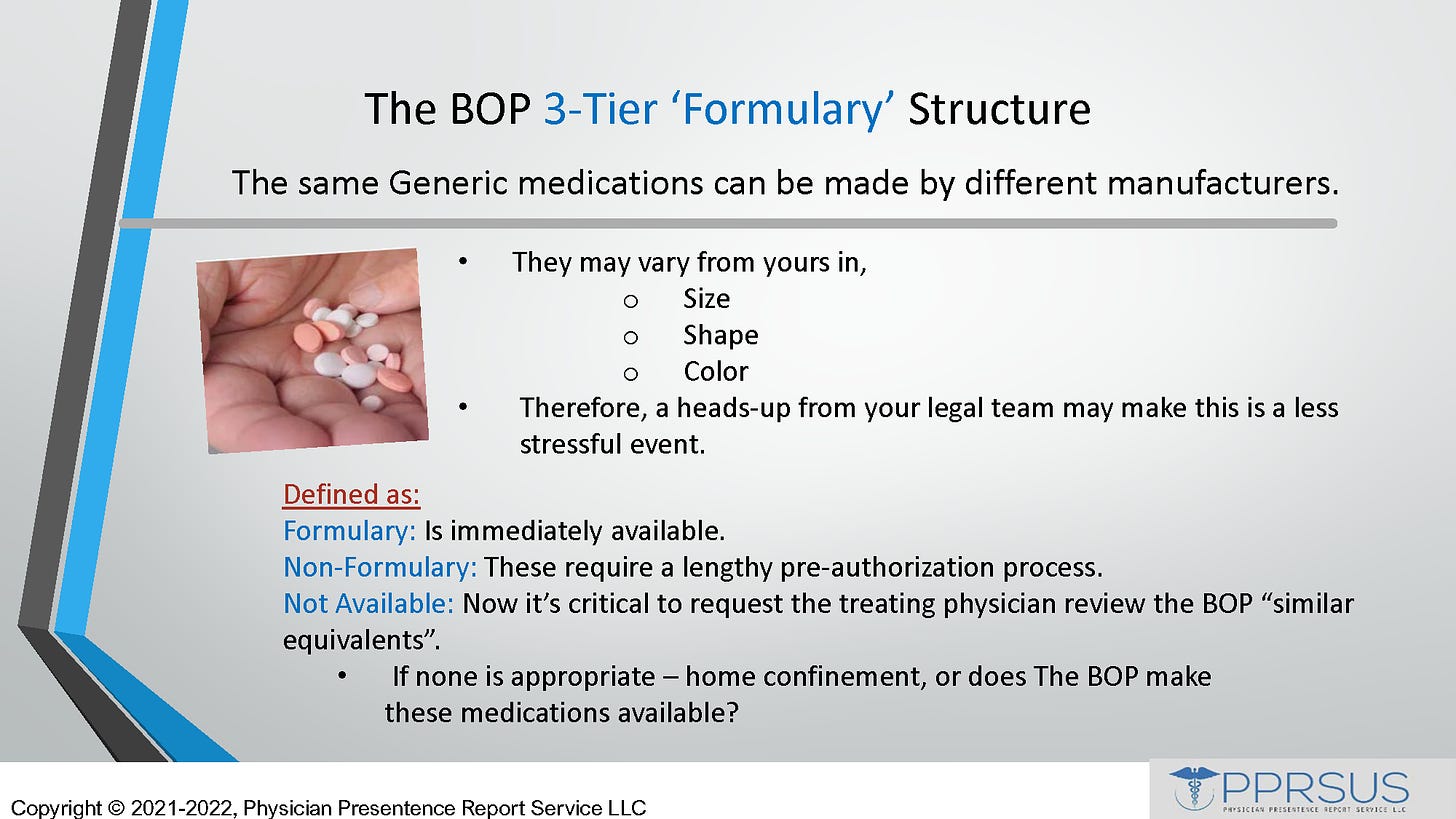
Like most insurance companies, the BOP has established a 3-tier formulary consisting of approximately 3500 medications, which are available based on cost-containment measures.
Noted above is the BOP’s 2020 Drug Formulary, which consists of approximately 3,500 medications in toto, enabling the defense team to identify medications specific to their client’s needs and check them against their client’s medications before the PSR and PSI are completed. Without detailed knowledge of these medications, the defendant could face an interruption in their medical care, which could significantly impact their life.
_____________________
The 2020 BOP Formulary (Tier I – III is how I classify their formulary)
Suppose your client was previously treated with a specific generic medication before entering the BOP. While they may receive the same generic medication, it will likely differ in color, size, and shape once incarcerated, as there are many generic manufacturers for a single-brand drug. Informing your client about how these same medications may differ before they’re incarcerated can go a long way to allaying their fears.
Tier I: On Formulary
The BOP’s first tier of drugs, considered on the formulary, is available once prescribed by a physician in the BOP after examining the inmate and reviewing their PSR medical records, which contain his initial physician prescribing records (Blatstein et al., 2021). At this point, all inmates are just a “number” to be seen, evaluated, and then moved on.
Tier II: Non-Formulary -> Not Available, as they have a lengthy Preauthorization Process
The second level of medications available in the BOP is non-formulary. While these are available, they’re only available after a lengthy preauthorization process, which could take up to 6 months or longer. For these reasons, defense counsel must ensure that a client’s medical records have been provided in full to the BOP and the current treating physician, preferably before the sentencing hearing (as well as before the PSR and PSI have both been formally been completed), has actively participated in the PSR (and Sentencing Memorandum if necessary), to ensure a smooth transition to enable the preapproval of any non-formulary medications for your client (Blatstein et al., 2021).
Should their medication be on the Non-Formulary Tier, the participation of the current treating physician before the PSR (and PSI) needs to persuade the Court and BOP Physician, thus circumventing the pre-authorization process, eliminating the waiting time, and providing the medications upon arrival at the institution (Blatstein et al., 2021).
Tier III: Not Available
The BOP third tier (“prescribing a drug that is therapeutically equivalent to, but chemically different from, the drug originally prescribed by a physician”) is meant to “reduce costs, increase workplace efficiency, enhance medication access, and improve inventory management” (Federal Bureau of Prisons Health Services [BOPHS], 2020a). Again, working with your client’s current treating physician and allowing them to review all of the medications available on the BOP’s entire list may provide you with two options:
1) They may find an appropriate substitute medication
2) Both you and the current treating physician may have to begin to include in your defense strategy a reason as to why this meets the minimum “Medical standard of care”, which is typically defined as the level and type of care that a reasonably competent and skilled healthcare professional with a similar background and in the same medical community would have provided under the circumstances that led to the alleged malpractice, or if this is not possible and the client’s life is at risk, or
3) Requesting home confinement to protect their life.
Epipen® is an example of a medication that the BOP may issue to inmates to carry on their person who has known anaphylaxis (BOP, Page 6).
Self-Surrender and Prescriptions (Documentation for all of them should be in the PSR and PSI)
a
For all prescriptions: medications (I recommend bringing a 1-2 week supply), Medical Devices (CPAP, BiPAP), Orthotics, Prosthetics, Glasses, False teeth, A Service Animal, Hearing aids, …you get the picture. If you surrender on a holiday or weekend, the BOP may keep them. Otherwise, the worst that can happen is that they throw (the meds) away, but now, at least, you and your attorney have a paper trail to work with. Note: ALL OF THIS SHOULD BE CLEARLY SPELLED OUT AND DOCUMENTED IN YOUR PRESENTENCE REPORT (PSR).