

AI Acting Independently Is the DOJ’s 24/7/365 Tool To Investigate You. Are You Prepared?
Business leaders and counsel who act now will shape how these systems operate. Those who wait will inherit rules written by regulators, courts, and opposing counsel.
K
WILL THIS BE THE DOJ IN OUR FUTURE?
DON’T BE THE LAST ONE TO RECOGNIZE THIS CHANGING LEGAL LANDSCAPE.
K
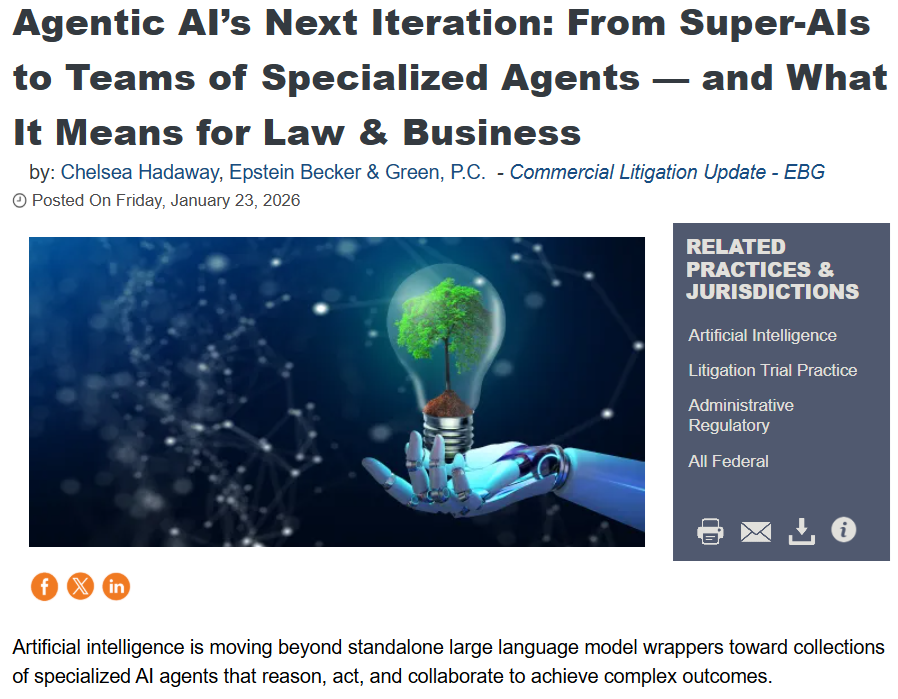
Multi-agent AI is not a future concept—it is an operational shift that businesses must prepare for now. Rather than deploying a single AI system, organizations are moving toward coordinated networks of specialized agents that can independently act, collaborate, and adapt in real time. This model promises dramatic gains in efficiency, speed, and decision quality, but it also introduces legal and governance risks that cannot be managed with legacy compliance frameworks.
When dozens—or hundreds—of autonomous agents operate across different vendors, datasets, and platforms, traditional assumptions about control, authority, and accountability break down. Agents can share data, negotiate with third parties, and make decisions without human involvement. Without clear rules, businesses risk privacy violations, contractual breaches, and regulatory exposure before leadership even realizes a problem has occurred.
The recent Amazon v. Perplexity dispute is an early warning. At issue was not innovation, but whether autonomous agents may interact with online platforms while presenting themselves as human users. The case highlights a growing reality: courts will be asked to apply existing contract and fraud doctrines to systems that act independently of their creators. Companies that have not defined agent boundaries in advance will be forced to do so under litigation pressure.
P
THIS IS WAY BEYOND JUST SHOPPING.
- HEALTHCARE (CODING, EMR), FCA, OR BUSINESS POLICIES AND PROCEDURES.
- AS YOUR INFORMATION IS ALL ONLINE, AN AI INVESTIGATOR WORKING SOLO OR IN A GROUP, SHOULD GIVE US ALL PAUSE.
H
P
Smart organizations will get ahead of this shift. That means defining what agents are permitted to do, what data they can access or disclose, which decisions require human review, and how responsibility is assigned when agents act autonomously. Contracts with AI vendors must explicitly address agent behavior, auditability, and compliance obligations. Technical systems must log and trace agent actions so decisions can be explained and defended.
P
Multi-agent AI offers enormous competitive advantage—but only to organizations that treat governance as a strategic priority, not an afterthought.