

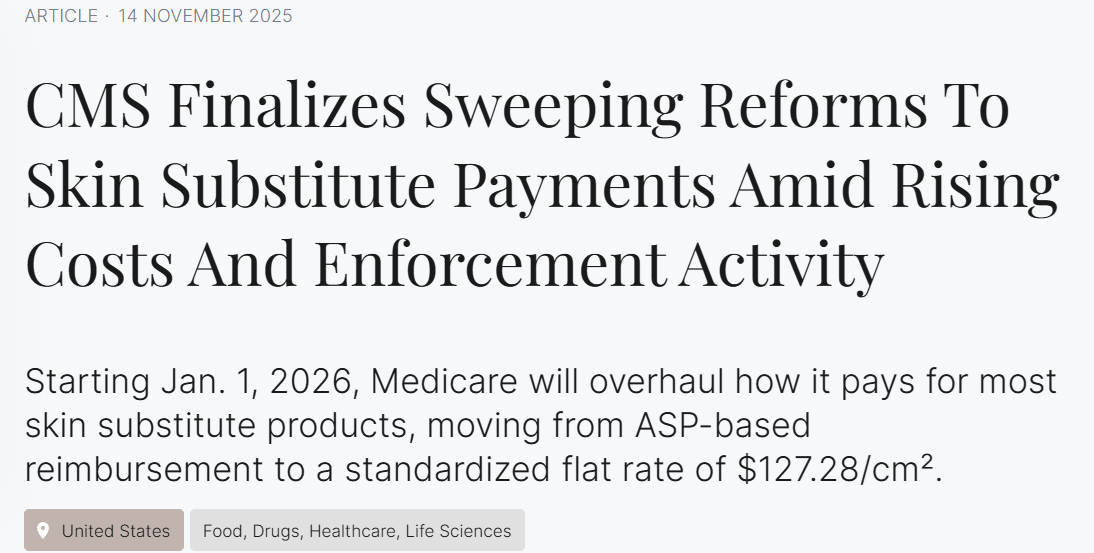
REDUCED PAYMENTS FOR SKIN SUBSTITUTES – THE DOJ IS STILL WATCHING YOUR BILLING PRACTICES
REMEMBER:
Compliant Billing Practices (Yours) Is What Government Monitors Will Focus On
Starting 1/2026, CMS will start a standardized flat payment rate of $127.28/cm².
A
Biological products licensed under Section 351 of the Public Health Service Act (PHS Act) will continue to be paid as biologicals under the ASP methodology.
The shift to a flat-rate payment model may challenge clinics in covering costs but encourages innovative inventory management to reduce waste. Rural clinics and those with lower patient volumes may find it hard to provide advanced wound care, forcing opportunities for creative solutions to enhance patient access and care.
Manufacturing, distributors, and health care providers could all become targets of enforcement by CMS, OIG, and DOJ. Companies will need to revisit pricing strategies. At the same time, continued regulatory scrutiny raises the stakes for everyone in the supply chain.
S
Providers
A
Examples of Fraudulent Wound Care
Charges were filed against seven defendants, including five medical professionals, in connection with approximately $1.1 billion in fraudulent claims submitted to Medicare and other healthcare benefit programs for amniotic wound allografts.
R
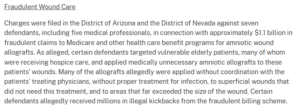
Numerous allografts were reportedly used without proper coordination with the patients’ physicians, often applied without adequate infection treatment, and to superficial wounds that didn’t need it. This reflects a concerning disregard for medical protocols and patient care standards.
It’s never too late to begin paying attention to the detailed patient documentation of your team or colleagues.
a
⇑ RISK ADJUSTMENT CODING INCLUDES DOCUMENTATION- CLEAR CHARTING- INTERNAL AUDITS ⇑
Wound Care has been in the Crosshairs: Risks Amid Skin Substitute Fraud Investigations
- Effective wound care is essential for patients recovering from surgery or managing chronic and non-healing wounds.
- Advances in treatment have led to the development of skin substitutes—bioengineered or natural materials designed to promote healing by replacing or supporting damaged skin.
- However, concerns regarding clinical efficacy, medical necessity, and appropriate use have intensified scrutiny of the agreements between healthcare providers and skin substitute distributors and manufacturers, particularly in light of potential fraud.
- Unfortunately, many healthcare providers who offer legitimate and necessary treatments for their patients have found themselves caught in the midst of this scrutiny.
- Medicare has increased its review of wound care billing, identifying it as high-risk for fraud, overpayment, and misuse.
- As a result, there has been a significant rise in government audits and investigations targeting wound care services and the use of skin substitutes.