


Administrative Remedy Guide for Federal Prisoners & Families.
But THE POSSIBILITY OF SUCCESS Is Dismal…
How to File a BOP Administrative Remedy Request (BP-8, BP-9, BP-10 & BP-11)
Protect Your Rights in Federal Prison
If you or a loved one is incarcerated in a federal prison, understanding the Bureau of Prisons (BOP) Administrative Remedy Program is critical.
The Administrative Remedy Process allows federal inmates to formally address concerns regarding:
- Medical care
- Sentence computation issues
- Good Time Credit disputes
- Conditions of confinement
- Staff misconduct
- Program eligibility
- Religious accommodations
- Visitation concerns
- Safety issues
- Other grievances involving the Bureau of Prisons
Many prisoners lose the opportunity to seek relief because they miss deadlines or fail to follow the required procedures. Proper documentation and timely filing can make the difference between preserving and losing important rights.
Need Help?
At PPRSUS, we help federal defendants, inmates, and families understand the administrative remedy process and other available options.
Schedule a Free Consultation
Whether you are:
✓ Preparing to surrender
✓ Currently incarcerated
✓ A concerned family member
✓ Holding Power of Attorney
✓ Dealing with denied medical treatment
✓ Facing sentence calculation issues
We can help you understand the process and identify potential next steps.
📞 Call: 240-888-7778
“I personally return all calls.”
What Is the BOP Administrative Remedy Program?
The Administrative Remedy Program is the Bureau of Prisons’ formal grievance process.
Before federal courts will review many complaints, inmates are often expected to exhaust administrative remedies through the following stages:
Step 1: BP-8 (Informal Resolution)
Speak with your counselor or case manager.
Attempt to resolve the issue informally and document:
- Date
- Time
- Staff member involved
- Outcome of the conversation
Step 2: BP-9 (Warden Review)
If the issue is not resolved, file a BP-9 with the institution.
Important:
- Generally, it must be filed within the required deadlines.
- Include supporting documentation.
- Clearly explain:
- What happened
- When it happened
- Who was involved
- What remedy you are requesting
Step 3: BP-10 (Regional Appeal)
If the Warden denies your request or fails to respond, appeal to the appropriate Regional Director using a BP-10.
Include:
- BP-8
- BP-9
- Responses received
- Relevant evidence
Step 4: BP-11 (Central Office Appeal)
- File the final administrative appeal with the BOP Office of General Counsel in Washington, D.C.
James Wills, AD/General Counsel, BOP Office of General Counsel, 320 First Street, NW, Washington, DC 20534, (202) 307-3198. - This completes the administrative remedy process.
The Most Important Rule
One Complaint = One Administrative Remedy
Every filing must address a single issue.
Your:
- BP-8
- BP-9
- BP-10
- BP-11
- 2241, below.
Should all concern the exact same complaint.
Changing the issue during the process can result in denial.
Documentation Can Make or Break Your Case
We strongly recommend:
✅ Keeping a calendar
✅ Maintaining a written timeline
✅ Saving copies of every filing
✅ Retaining proof of mailing
✅ Tracking all deadlines
✅ Recording staff names and responses
✅ Organizing supporting medical records and documents
Many successful administrative remedies are supported by meticulous records.
What If Prison Staff Do Not Respond?
A common problem within the federal prison system is delayed or missing responses.
If staff fail to respond:
- Document the non-response.
- Continue tracking deadlines.
- Proceed to the next level when appropriate.
- Keep copies of everything.
Always create a paper trail.
Medical Care Complaints in Federal Prison
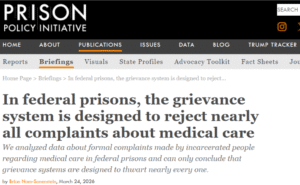
One of the most serious reasons inmates file administrative remedies involves delayed or denied medical treatment.
Examples may include:
- Cancer treatment delays
- Medication issues
- Specialist referrals
- Dental care concerns
- Mental health treatment
- Chronic illness management
Families often play a critical role in advocacy efforts.
What Families Can Do
When a loved one is incarcerated, families can help by:
1. Creating a Documentation File
Keep records of:
- Phone calls
- Emails
- Letters
- Medical concerns
- Staff contacts
- Dates and timelines
2. Writing the Warden
A professional and respectful letter should:
- Explain the concern
- Present facts
- Request assistance
- Ask for a written response
Certified Mail is recommended whenever possible.
3. Contacting Regional Officials
If the institution fails to act, families may contact:
- Regional Directors
- BOP Leadership
- Medical Administration
- Congressional Representatives
4. Contacting Your Member of Congress
Congressional offices regularly assist constituents dealing with federal agencies.
Provide:
- Inmate name
- Register number
- Institution
- Clear explanation of the problem
- Documentation of prior efforts
When to Consider a § 2241 Petition to the Court.
After administrative remedies have been exhausted, some federal prisoners may pursue relief under:
28 U.S.C. § 2241
This type of petition is generally used for issues involving:
- Sentence computation
- Good Time Credits
- Execution of a sentence
- Certain confinement conditions
Because federal court filings involve complex legal issues, legal counsel is strongly recommended.
PPRSUS does not provide legal advice and is not a law firm.
Why Preparation Matters
Most people entering the federal prison system have never navigated:
- Administrative Remedies
- First Step Act Programs
- RDAP
- Compassionate Release
- Prison Medical Systems
- Reentry Planning
Preparation reduces anxiety and helps both inmates and families make informed decisions.
Get Guidance Before Problems Become Emergencies
The Administrative Remedy Process can be confusing, time-sensitive, and frustrating.
If you or your loved one needs assistance understanding the process, preparing documentation, or identifying available resources, contact us today.
Free Consultation
📞 240-888-7778
PPRSUS
Federal Prison Preparation, Advocacy, and Reentry Support
Helping individuals and families navigate the federal prison system with knowledge, preparation, and experience.
A
A
PART II) STEPS FOR THE FAMILY, LOVED ONE, OR S

To find your U.S. congressional representative, visit www.house.gov[xii] and enter your zip code. The name of your member will appear.
- Call your congressional representative’s local office. Ask the staff member to whom you should send your letter.
- Present the problem, stating the facts and your concern.
- Describe the efforts you and your loved one have taken to resolve the problem and ask that your congressional representative investigate the issue.
- Ask your Congressional Representative (or Assistant to ask for you) to write to your Warden directly—as you have been told that BOP Wardens pay attention to these emails. Have the Warden’s Name, Phone number, Email, and Address ready, and be specific about what help you need your representative to ask for or inquire about.
- Congressional Representatives (you can provide a sample letter, if helpful),
- …from the writer’s district,
- …of the district where the prison is located,
- …office in Washington, DC
- Then, follow up with a pre-set phone call or appointment.
A
A
File a Formal Complaint Directly with the Facility and look up the prison contact information.

1) Find Your Prison Warden, or Warden Assistant or secretary,
2) Search for a location:[xiii] Inmates → Find an Inmate, or Locations: List of Our Facilities
3) Include the Patient /Inmate Number and Location
4) You can both call and write respectfully.
- Include that you’re concerned about your loved one’s medical needs and their lack of care, sending a letter to the Warden.
- Attaching a letter from their current treating physician to provide additional context may be helpful. Certified—Return Receipt.
5) The BOP is a vast government agency. The new BOP Director, Peters, is doing her best to change its culture, so continue your advocating efforts.
A
Contact The BOP Regional Directors (Including The Current BOP Director)
If the prison does not resolve your complaint, you can file it with the Bureau of Prisons (BOP) Regional Office (Above) that oversees the facility.
This goes to the appropriate Region (identified above)
Include the Patient /Inmate Number and Location
- If you’re concerned about your loved one’s medical needs and the lack of care, consider sending a letter to the Warden.
- Attaching a letter from their physician to provide additional context may be helpful. Certified – Return Receipt.
BOP HQ:
If you cannot resolve your issue, contact BOP Headquarters or the Department of Justice’s Office of the Inspector General.
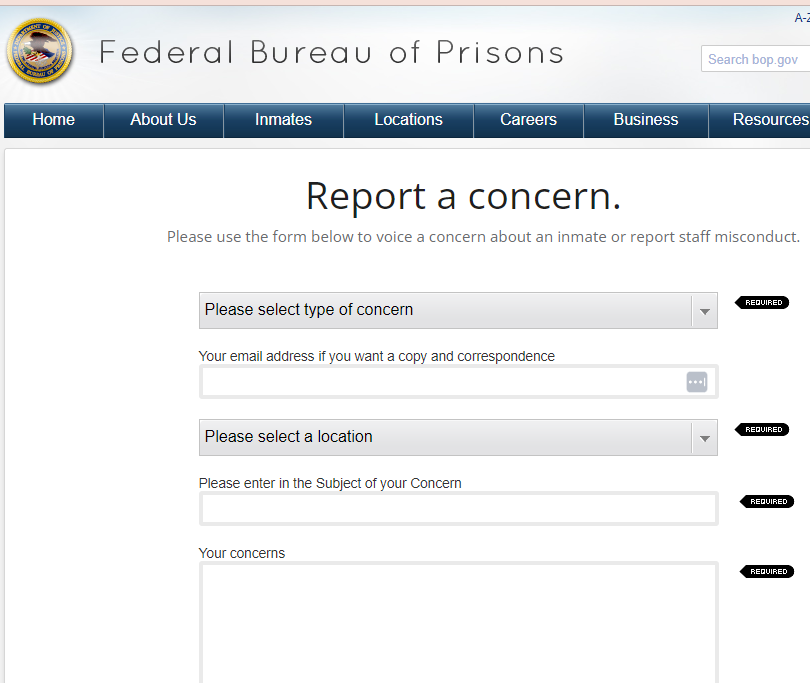
GO HERE FIRST: To Report a Concern[xiv].
BOP LEADERSHIP CONTACT LIST, 2023/2024[vi]
Bureau of Prisons, Headquarters, or the Department of Justice – Office of the Inspector General (2 contacts)
- James Wills, AD/General Counsel, BOP Office of General Counsel, 320 First Street, NW, Washington, DC 20534, (202) 307-3198, Certified – Return Receipt.
- Rear Admiral Chris Bina, BOP Assistant Director, Health Services Division, 320 First Street, NW, Washington, DC 20534, (202) 307-3198, Certified – Return Receipt.
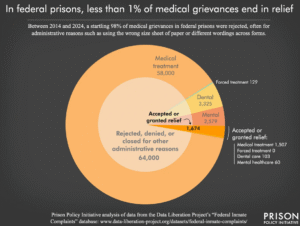
The possibility of success is dismal…
A
A
A
The Federal Bureau of Prisons Track Record of NOT Providing Medical Care – When It’s Needed

October 10, 2022, Judge[i] Holds Federal Bureau of Prisons in Contempt for Allowing Man To Waste Away From Untreated Cancer[ii]
- In November 2020, Bardell filed a motion[iii]requesting a Compassionate Release. He followed up with a Second Motion in February 2021[iv], accompanied by an Affidavit from an Oncologist. Despite the government’s opposition, Judge Dalton ordered Bardella’s release, expressing disgust at the situation.
- However, upon his release, the BOP brought Bardell in his wheelchair to the Dallas/Fort Worth airport in a van, only to drop him off without his wheelchair, bleeding and soiling himself.
A
A
September 23, 2023, 1 IN 4 INMATE DEATHS HAPPENED IN THE SAME PRISON. WHY?
- …a 47-year-old with a family history of breast cancer discovered lumps in her left breast while in federal prison. Treatment was denied until it was too late to treat – a judge released her on compassionate release.
- …a 70-year-old was denied care for so long that he lost an eye, and a judge released him on compassionate release.
- …for 7 months, another begged to see a doctor until it was too late, and he died of cancer.
- …a 50-year-old male complaining of headaches, but the doctors said he was faking it, was eventually diagnosed with a cancer tumor the size of an egg and died.
A
March, 2023, The New England Journal of Medicine,[v]
On a deeper dive into the availability of medical care in prisons, there is a real possibility that the minimum standard for inmate healthcare, established in 1976 by a Supreme Court ruling, could be halted or overturned using the same legal framework that led to the Overturning of Roe v. Wade in June.
- Deliberately withholding treatment from prisoners with serious medical needs is considered “Cruel and Unusual Punishment⚖️” under the Constitution’s Eighth Amendment.
ADVOCATING FOR MEDICAL CARE WHEN IT’S DENIED
The SEICHE Center for ‘Health and Justice,’ Between Yale’s School of Medicine and Law School,“My dad was ill. Could he survive the prison healthcare system?”
“We know when:
- Family members stay engaged, like when kids are still close to their moms or dads who are incarcerated,
- When there is a family support system when people return home or even when they’re inside, that
- That the health of the incarcerated person is better,”–Professor Emily Wang, MD, MAS.
A
A
The Administrative Remedy
- Understanding the importance of the Administrative Remedy is just a part of the Preparation and Knowledge Process. Knowing what to expect in prison before their first day helps reduce the fears they and their loved ones naturally experience. Having been through this, please prepare them because it will benefit them in many ways.
- Realizing that there are no guarantees, preparation provides them with the information needed to stay out of trouble, as well as how to navigate and work to gain the maximum benefit from the First Step Act Programs (should there be enough support staff), RDAP, Second Chance Pell Grants for College Courses, and overall work on their personal development. All of this is helpful as they approach their early release date.
A
ENCOURAGE FAMM-VAP-Family-Visit Prison Guide

A
V. WE ALSO HAVE OTHER RESOURCES – CONTACT US
[i] https://reason.com/2022/10/10/judge-holds-federal-bureau-of-prisons-in-contempt-for-allowing-man-to-waste-away-from-untreated-cancer/#:~:text=Bardell%20had%20cancer%E2%80%94let%20alone,and%20instead%20immediately%20released%20Bardell.
[iii]https://storage.courtlistener.com/recap/gov.uscourts.flmd.265888/gov.uscourts.flmd.265888.77.0.pdf
[iv]https://storage.courtlistener.com/recap/gov.uscourts.flmd.265888/gov.uscourts.flmd.265888.86.0.pdf
[v] https://news.harvard.edu/gazette/story/2023/03/supreme-court-may-halt-health-care-guarantees-for-inmates/
[vi] https://www.pprsus.com/wp-content/uploads/2023/09/BOP_-Leadership-2023.pdf
[vii] https://www.pprsus.com/wp-content/uploads/2023/09/1330.18_Administrative-Remedy-2014.pdf
[viii] https://www.pprsus.com/wp-content/uploads/2023/09/NACDL-bp-9-11-forms.pdf
[ix] https://www.law.cornell.edu/uscode/text/28/2241
[x] https://www.pprsus.com/wp-content/uploads/2023/09/Pro-Se-Handbook-Representing-Yourself-in-Federal-Court.pdf
[xi] https://www.pprsus.com/wp-content/uploads/2023/09/Regional-Counsel-and-Consolidated-Legal-Center-Offices.pdf
[xii] https://www.house.gov/
[xiii] https://www.bop.gov/locations/
[xiv] https://www.bop.gov/inmates/concerns.jsp