SUPREME COURT ≠ COMPASSIONATE RELEASE
Supreme Court ‘Compassionate Release’ Ruling Could Send Ex-Inmates Back Behind Bars
- At 61, Bailey is facing a possible return to prison after a Supreme Court ruling and Justice Department action. “I hope everything turns out and I get my life back,” he said. “I’m a better person now — a productive citizen.”
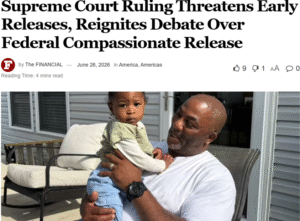
The that federal judges cannot consider extreme sentence disparities or outdated laws when deciding on compassionate release, which allows for shortened prison terms under “extraordinary and compelling reasons.” This decision undermines efforts to reform federal sentencing fairness. Although the compassionate release statute, enacted in the 1980s, originally permitted only prison wardens to file motions, the First Step Act of 2018 authorized incarcerated individuals to file such motions.
- While the COVID-19 pandemic saw increased use of this statute, fewer than 17% of motions were granted from 2020 to 2022. Courts have been divided on whether changes to nonretroactive sentencing law could qualify as “extraordinary and compelling reasons” for a reduction.
- The Sentencing Commission issued a policy statement in November 2023 that aimed to clarify these grounds, but federal prosecutors contested its legality. The cases of Daniel Rutherford and Johnnie Markel Carter, who faced disproportionate sentences under outdated laws, reached the Supreme Court, which ultimately affirmed the strict limitations on compassionate release.
- A legal debate arose regarding whether nonretroactive sentencing reforms, which would yield shorter sentences today, could qualify as “extraordinary and compelling reasons.” The Sentencing Commission introduced a policy statement addressing this issue, but federal prosecutors contested its legality.
Then there is:

AND,
L
L
1/3; The Supreme Court Is Restricting Early Prison Release
- In recent decisions, the justices restricted the bipartisan First Step Act that President Donald Trump signed in his first term.
What counts as an extraordinary and compelling reason for early prison release?
- A terminal illness, advanced age, or a family emergency? In the federal system, the answers are often “perhaps” or “probably not.” However, concerns about harsh sentences or wrongful convictions have also been considered. Recently, the Supreme Court ruled that compassionate release cannot be used to question a conviction or to reduce sentences deemed excessive by current standards.
l
CURRENT CASES
- Pulsifer v. United States22-340
- Fernandez v. United States 24-556 Charged with killing two gang members and received two life sentences. 3582, denied by the Supreme Court. 2255 to challenge the conviction – per Congress.
- Rutherford v. United States24-820
- Maxwell v. Thomas25-5930
In 2018, Congress passed the bipartisan First Step Act to reform harsh federal sentencing and address racial disparities. It aimed to reduce overcrowding and costs by offering second chances to those serving long sentences. President Trump highlighted its potential for political unity and crime reduction.
j
Since then, the Supreme Court has done what it can to limit the First Step Act.
- In Pulsifer v. United States, the court narrowed the act’s expansion of the federal “safety valve,” a provision that allows sentencing courts to forgo imposing mandatory minimum sentences if defendants meet certain criteria. Gorsuch noted that the court’s reasoning stemmed from a policy-driven argument for a narrower interpretation, thereby restricting district courts’ ability to grant relief and diminishing the act’s overall impact.
Elimination of mandatory ‘stacking’ under 18 U.S.C. § 924(c).
- In Rutherford v. United States, the court addressed whether prisoners under the old “stacking” regime could seek compassionate release due to reduced sentencing guidelines. Rutherford’s sentence would be 14 years shorter today, and Carter’s 21 years shorter. The court ruled that this disparity could not justify compassionate release, interpreting it as an improper retroactive application of the First Step Act, which was intended to apply prospectively only.
l
l
Justice Amy Coney Barrett argued that Congress’s choice to exclude new sentencing laws for older cases was logical. However, this overlooks the U.S. Sentencing Commission’s authority to define “extraordinary and compelling” circumstances. In 2023, the commission suggested that unusually long sentences might qualify for compassionate release under certain conditions, highlighting the ongoing debate within the Commission about flexibility in the justice system.
h
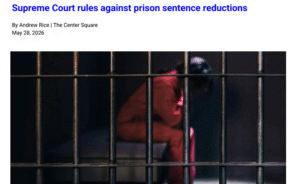
2/3; Supreme Court rules against prison sentence reductions
O
3/3; DURBIN RESPONSE