

DOJ NEW FRAUD DIVISION TARGETING HEALTHCARE, TAX, TRADE AND TARIFFS
DOJ’s New Fraud Division Signals More Aggressive Enforcement – Documentation Is Your Lifeline.
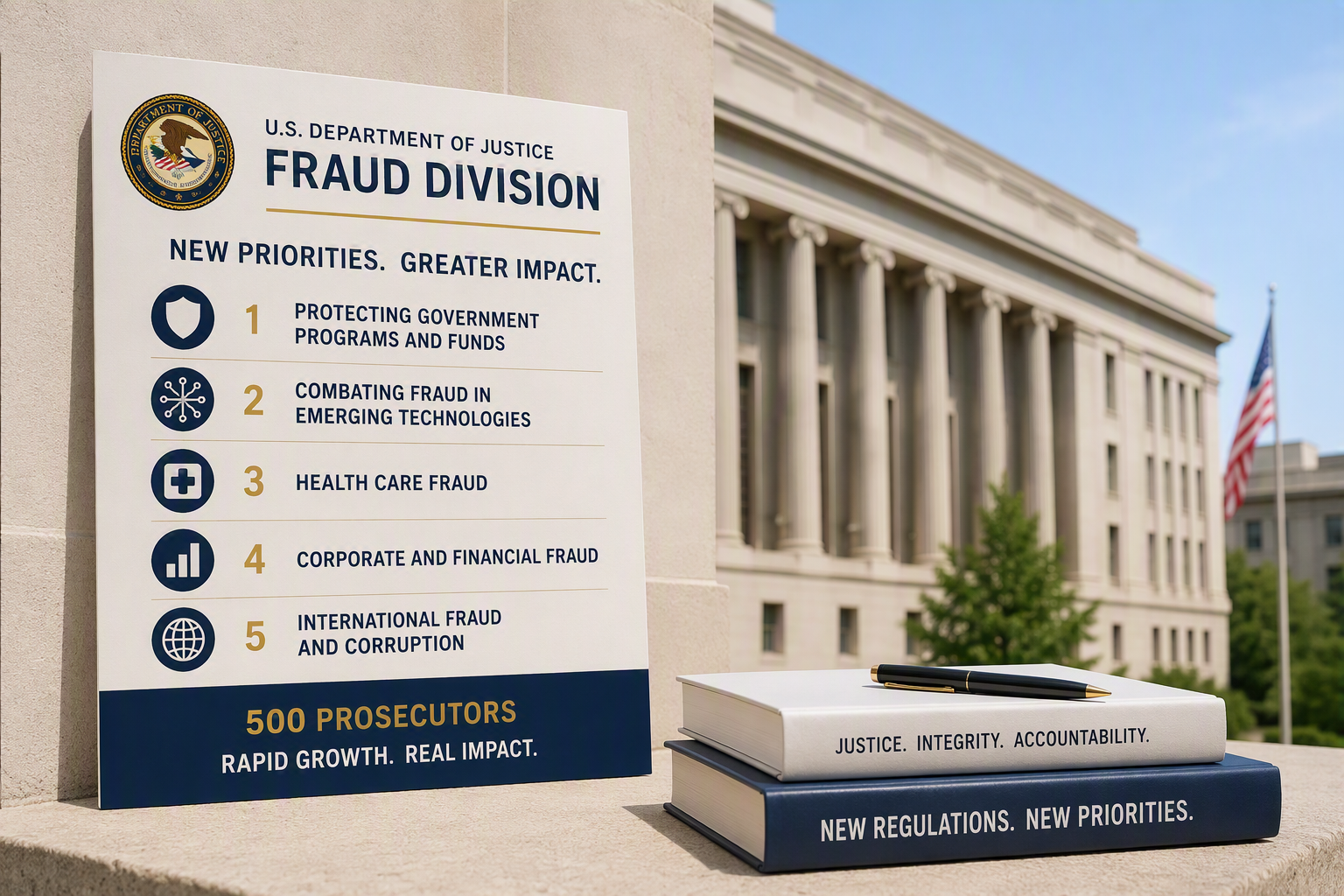
The DOJ’s newly established National Fraud Enforcement Division (Fraud Division) marks a significant shift toward more centralized, technology-driven, and aggressive federal fraud enforcement. Under Assistant Attorney General Colin M. McDonald’s August 13, 2026 memorandum, the Division will concentrate on five areas:
- Public trust and financial integrity — procurement, government-benefit, grant, and taxpayer fraud. (Trust, Integrity; hmm.)
- Healthcare — Medicare/Medicaid, telemedicine, hospice, controlled substances, and deceptive healthcare practices.
- Tax — false returns, concealed income, and abusive tax schemes.
- Global trade and commerce — customs fraud, transshipment, undervaluation, sanctions evasion, and forced-labor violations.
- Corporate misconduct — continued prosecution of fraud-related corporate wrongdoing.
The Division is expected to rapidly expand to approximately 500 attorneys and staff, supported by investigators, data scientists, asset-recovery specialists, and advanced technology.
A DOJ rule published August 18 and effective August 24 formally transferred broad criminal-fraud authority from the Criminal Division to the new Fraud Division. Its authority covers fraud involving government funds, healthcare, taxes, trade, and health plans—and can extend to related offenses uncovered during investigations.
What This Means: AI IS RUNNING IN THE BACKGROUND 24/7/365.
DOJ is moving beyond traditional, siloed fraud investigations toward centralized, data-driven enforcement and greater interagency coordination. Healthcare providers, government contractors, federal-program recipients, companies with international supply chains, and tax professionals face increased scrutiny.
The shift is particularly evident in trade enforcement. DOJ’s Trade Fraud Task Force has already reported more than $1 billion in recoveries, penalties, and forfeitures, while emphasizing criminal prosecution and False Claims Act enforcement for customs and supply-chain violations.
For businesses and individuals operating in these high-risk areas, compliance, documentation, internal controls, and early identification of potential problems are more important than ever. DOJ also continues to encourage voluntary disclosure, cooperation, and remediation when misconduct is discovered.
Bottom line: The new Fraud Division provides the DOJ with greater resources, broader authority, and sophisticated data tools to identify and prosecute fraud. For healthcare, government-funded programs, tax, trade, and corporate activity, the enforcement environment is becoming significantly more aggressive.
Law 360: Where DOJ’s Fraud Priorities Memo May Actually Matter
Mayer Brown: DOJ’s New Fraud Division Issues Plan to Rapidly Grow and to Focus on Five Priority Areas
MONDAQ: 500 Prosecutors And Five Priorities: Inside DOJ’s Aggressive New Fraud Push
National Law Review: DOJ Signals Shift to More Aggressive Trade Enforcement as New Trade Fraud Task Force Seizes Over US$1 Billion