

Federal Prison News 2026: First Step Act Credits, And…
…BOP Medical Care and Prison Updates
*
KEY TAKEAWAYS
Supreme Court reviews First Step Act credits, BOP halfway house placement, home confinement, federal prison medical care, and prison updates for 2026.
Federal prison policies continue to affect First Step Act (FSA) earned time credits, halfway house placement, home confinement, medical care, and daily prison life. Here are important developments for federal prisoners, their families, and defense attorneys.
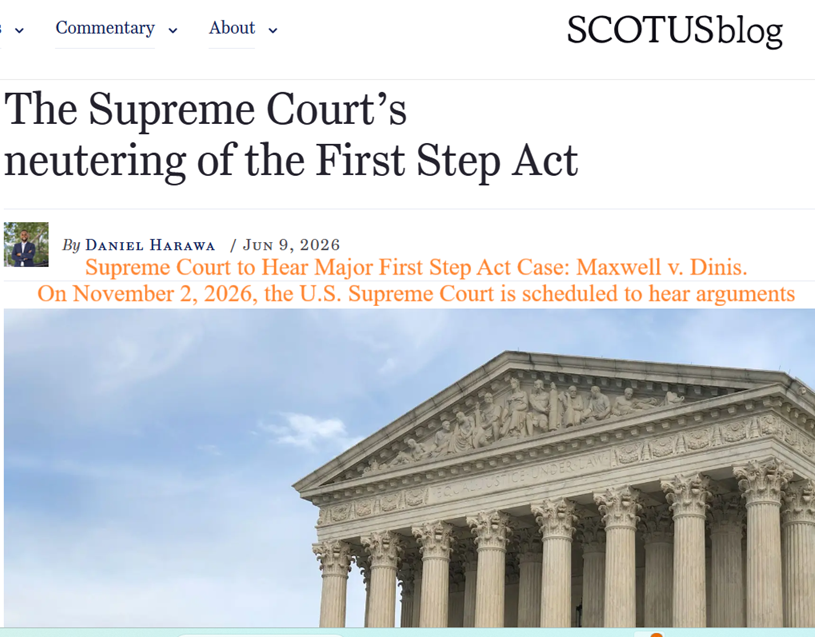
1. Supreme Court to Hear Major First Step Act Case: Maxwell v. Dinis
On November 2, 2026, the U.S. Supreme Court is scheduled to hear arguments in Maxwell v. Dinis, No. 25-5930.
The case could clarify whether federal prisoners may use a habeas corpus petition under 28 U.S.C. § 2241 to challenge the Bureau of Prisons’ (BOP) refusal to apply earned First Step Act credits toward halfway house placement or home confinement.
William Maxwell, serving a 20-year sentence at FCI Beaumont Low, argued that the BOP improperly denied him credits that could advance his transfer to prerelease custody. The Fifth Circuit rejected his petition, ruling that habeas relief was unavailable because the requested placement would not directly accelerate his release from federal custody.
Federal appeals courts disagree on this issue. The First, Second, and Third Circuits have permitted certain challenges involving less restrictive custody. The Fifth and Eighth Circuits have adopted a narrower approach.
The federal government supports overturning the Fifth Circuit’s decision and agrees that Maxwell’s claim may proceed through habeas. Several criminal defense organizations, legal scholars, and members of Congress have also filed supporting briefs.
Why Maxwell Matters to Federal Prisoners
- A favorable Supreme Court ruling could make it easier for prisoners to challenge improper FSA credit calculations and prerelease placement decisions in federal court.
- Habeas petitions generally have a $5 filing fee, compared with $405 for a standard federal civil action. The procedural requirements also differ. However, a successful petition would not automatically guarantee immediate halfway house placement or home confinement.
What prisoners should do now:
- Request a written explanation of disputed FSA credits.
- Keep copies of sentence calculations, credit records, and BOP correspondence.
- Follow the BOP administrative remedy process: BP-8, BP-9, BP-10, and BP-11, as applicable.
- Consult qualified counsel about filing a § 2241 petition, exhaustion requirements, and the law governing the relevant federal circuit.
The Supreme Court could decide this in 2027.
2. First Step Act Credits: When Does Earning Begin?
The distinction matters for prisoners held in local jails after sentencing while awaiting transfer to their designated federal institutions.
Under 18 U.S.C. §§ 3585(a) and 3632(d)(4), the sentence commencement date is not necessarily the date a prisoner arrives at a designated BOP facility. Eligible prisoners may therefore have grounds to request a review of credits associated with qualifying programs or productive activities completed during the earlier period.
Potentially relevant documentation includes:
- Jail employment and work records.
- Certificates for qualifying classes or programs.
- Records of evidence-based recidivism reduction programming.
- Written confirmation from jail personnel.
Practical step: Request a written credit recalculation and preserve supporting records. Eligibility depends on the governing law, applicable BOP rules, and the specific activities completed.
3. Ninth Circuit: Can Unused FSA Credits Reduce Supervised Release?
In Gonzalez v. Herrera, 151 F.4th 1076 (9th Cir. 2025), the Ninth Circuit considered whether unused First Step Act credits could reduce supervised release rather than being limited to prerelease custody.
The court interpreted 18 U.S.C. § 3632(d)(4)(C) as allowing earned credits to be applied toward supervised release. It directed further action on Gonzalez’s petition, including recalculation of his credits.
This ruling may be significant for eligible prisoners in the Ninth Circuit who have unused FSA credits after their custodial placement calculations.
Important: The decision applies within the Ninth Circuit and should not be assumed to establish the same rule nationwide. Prisoners should obtain advice about how the ruling applies to their individual circumstances.
4. Federal Prison Medical Care: BOP Spending and Oversight Concerns
Federal budget figures for fiscal year 2024 reportedly show that the BOP spent approximately $10,155 per prisoner on medical care, compared with $11,800 per ICE detainee.
These figures raise questions about federal correctional healthcare resources, particularly because many BOP prisoners serve lengthy sentences and require continuing treatment for chronic conditions.
Spending figures alone, however, do not establish the quality of care or permit a direct comparison of medical outcomes.
Concerns about access to treatment, staffing, outside specialist appointments, medication management, and medical record accuracy remain important issues for prisoners and their families.
The BOP issued revised medical-care guidance, Program Statement P6031.06, in June 2026. Its practical impact will depend on implementation, staffing, and oversight.
How Federal Prisoners Can Protect Their Medical Records
Maintaining an accurate medical record is important for ongoing treatment and may also help support a future compassionate release request or other legal claim.
Prisoners should:
- Request copies of their medical records periodically.
- Keep a dated log of sick-call requests and responses.
- Document delays involving specialist appointments, tests, medications, or prescribed medical devices.
- Retain outside medical records, diagnostic reports, and treatment recommendations.
- Use the administrative remedy process when appropriate and preserve copies of all submissions.
For prisoners with serious or worsening medical conditions, organized documentation can help attorneys evaluate available legal options.
5. Federal Prison Commissary Shortages
Reports from several institutions describe prolonged shortages of commissary products. The reasons and duration may vary by facility.
Prisoners experiencing recurring shortages can submit a written inquiry to the institution’s Trust Fund Supervisor asking which products are unavailable, why supplies are delayed, and when restocking is expected.
Documenting repeated shortages may help identify whether a problem is isolated or more widespread.
6. FCI Phoenix: Reported Phone and TRULINCS Outage
A family report described an extended interruption of inmate telephone service and TRULINCS computer access at FCI Phoenix.
An outage can interfere with family contact, legal communications, and other essential activities. The reported duration and current status should be confirmed with the institution.
Families seeking answers can contact the institution’s administration and the BOP’s Western Regional Office in writing. They may also contact their congressional representatives.
Prisoners facing court deadlines should promptly notify their unit team and attorney of communication problems and document attempts to obtain necessary legal access.
Readers at other institutions experiencing similar disruptions are encouraged to report the facility and the nature of the outage.
7. What These BOP Developments Mean for Prisoners and Families
First Step Act credit disputes, prerelease placement decisions, medical-care delays, and institutional service interruptions can have significant consequences for federal prisoners.
Preparation and documentation remain essential. Prisoners should understand their applicable rights, maintain copies of relevant records, and pursue available administrative or judicial remedies when appropriate.
For information about federal sentencing preparation, First Step Act earned time credits, BOP placement, and correctional healthcare, visit PPRSUS — Physician Prison Consultants.
This article provides general information, not individualized legal advice. Laws, regulations, and BOP policies may change. Consult qualified counsel about your specific circumstances.