

DOJ Corporate Fraud Directive 2026: Key Prosecution Risks for Companies.
On October 1, 2026, the U.S. Department of Justice (DOJ) issued Directive 26-12,
Outlining an intensified approach to corporate fraud investigations. Enforcement priorities include healthcare fraud, government contracting, tax evasion, and trade violations.
The directive also strengthens coordination between Fraud Division prosecutors and DOJ’s Corporate Enforcement Section, increasing oversight of corporate investigations.
DOJ Corporate Fraud Enforcement Priorities
Prioritizing Investigations Involving:
-
- Healthcare fraud: Controlled-substance distribution and federal food and drug law violations.
- Government fraud: Misconduct involving government contracts, public funds, and government operations.
- Tax evasion: Significant schemes to avoid federal tax obligations.
- Trade fraud: Tariff evasion, import violations, and forced labor offenses.
Factors That May Influence Criminal Charges and Fraud Enforcement
Prosecutors are directed to give significant weight to factors when evaluating corporate criminal charges and plea agreements:
-
- Concealment or obstruction: Efforts to hide misconduct or interfere with government oversight.
- Duration: Fraudulent conduct continues for three years or longer.
- Executive involvement: Management with knowledge of or participation in fraud.
- Financial harm: Substantial damage to taxpayer-funded programs or government operations.
- Financial losses or victims: Losses of $25 million or more, or at least 25 victims.
- Foreign adversaries: Diversion of U.S. funds to benefit foreign adversaries.
- Geographic reach: Misconduct spanning at least three federal judicial districts.
- Immigration offenses: Conduct directly involving or advancing immigration violations.
- Multiple programs affected: Fraud involving several government programs or functions.
- National security: Threats to public safety, national security, or military readiness.
These factors guide prosecutorial decisions but do not prevent prosecutors from considering other relevant circumstances.
AI, Data Analytics, and Corporate Whistleblowers
DOJ plans to use advanced technology and data analytics to identify potential fraud, develop investigative leads, and strengthen enforcement efforts. They work 24/7/365, with no raises, no lunch hours, and no HR Complaints.

What Businesses Should Do
Companies operating in healthcare, government contracting, taxation, and international trade should review their compliance programs and assess potential exposure under DOJ’s enforcement priorities.
Bottom line: DOJ’s 2026 corporate fraud directive emphasizes data-driven investigations, insider cooperation, and specific factors that may influence criminal prosecution. Businesses should identify compliance weaknesses early and respond promptly to potential violations.
WALL STREET JOURNAL
DOJ Fraud Enforcement Shift Raises Concerns Over Market Integrity Cases
Bloomberg Law News
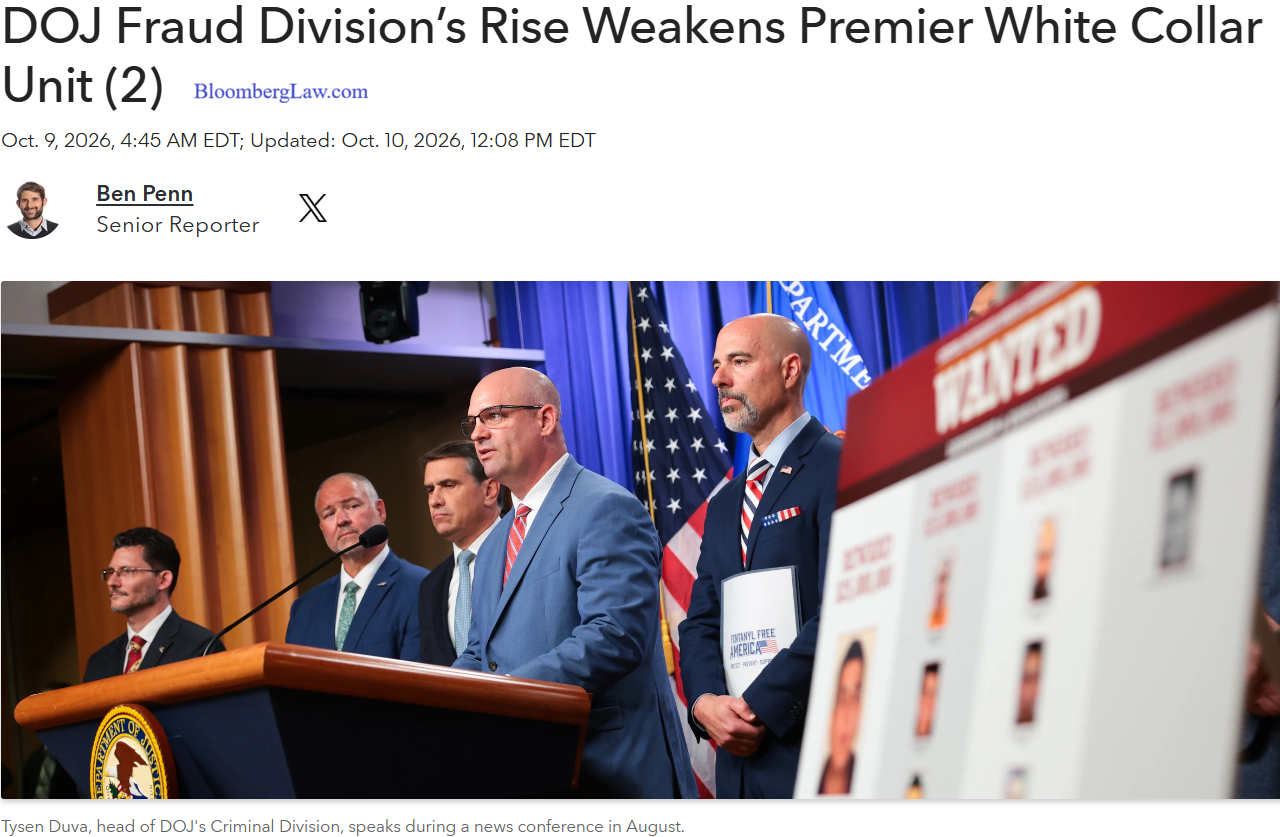
The White House shifted enforcement priorities in 2026 toward public benefits and government fraud cases after Vice President JD Vance launched the DOJ’s National Fraud Enforcement Division. According to former Justice Department officials, the move has reduced resources for the Criminal Division’s long-standing market integrity and financial fraud team, which has historically focused on investor protection and complex financial misconduct.
Recent personnel changes have accelerated that transition. Several senior leaders from the market integrity unit, including its chief and two deputies, reportedly moved to the new fraud division. The reshuffle follows the dismissal of another unit manager after a dispute over how the unit handled securities fraud charges against Indian businessman Gautam Adani.
The market integrity unit previously secured major convictions involving traders at large financial institutions, including JPMorgan and Deutsche Bank. However, former DOJ officials say the team has contracted significantly, raising concerns about its ability to pursue sophisticated investigations involving insider trading, spoofing, and other forms of market manipulation.
Legal observers note that a smaller workforce and loss of institutional experience could make it more difficult for the unit to advance large-scale financial fraud cases while managing its existing caseload.