

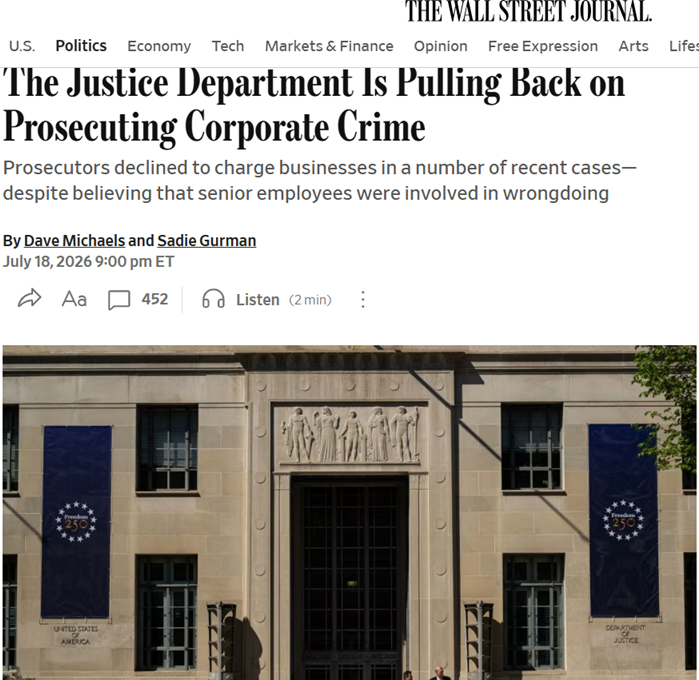
Justice Department Is Pulling Back on Prosecuting White-Collar Corporate Crime
WSJ
- Prosecutors declined to charge businesses in a number of recent cases—despite believing that senior employees were involved in wrongdoing
The Justice Department has significantly decreased its use of criminal charges against corporations, opting instead for nonprosecution agreements or closing cases without charges. This shift reflects a focus on holding individuals accountable rather than prosecuting businesses. Notable cases include Alibaba, which paid $325 million and admitted to facilitating illicit sales, and EagleBank, which acknowledged compliance failures but avoided charges.
- DOJ officials argue that they are still addressing corporate misconduct through public settlements and financial penalties. Acting Attorney General Todd Blanche emphasizes that prosecuting individuals serves as a stronger deterrent. However, experts note that the expected rise in individual prosecutions hasn’t occurred, leading to perceptions of more lenient treatment for both companies and individuals.
- This policy marks a departure from previous years, where many companies faced guilty pleas or deferred prosecution agreements for misconduct. The Justice Department maintains that decisions are driven by the facts, but the shift indicates a focus on negotiated settlements over criminal prosecutions.
Former Justice Department officials and public-interest groups have expressed worries about the choice to halt several investigations. They contend that this could deter future whistleblowers and cause companies to view the threat of criminal prosecution as diminished, as enforcement focuses less on corporate wrongdoing. The main concern for consumers, workers, investors, and whistleblowers is whether a decline in corporate prosecutions will result in less accountability for influential organizations, or if resources are simply being shifted to cases with greater potential.