


FEDERAL CHARGES, BOP NEWS: UPDATED WEEKLY. 2025
*
EARLY RELEASE TO HOME CONFINEMENT, ARE YOU ELIGIBLE?
*
THE DEVIL IS IN YOUR PRESENTENCE INTERVIEW PREPARATION.
FSA-ETC CREDITS AND SCA, COUNT TOWARD EARLY RELEASE.
D
12/28/2025
TO ALL, I’M GRATEFUL FOR YOUR SUPPORT.
WISHING YOU A HAPPY,
AND HEALTHY
2026.
*
ABOVE THE LAW: Finance
Looking Back: 2025 Was A Record-Breaking Year For Greed
Greed will keep you in its thoughts and prayers in the new year.
D
“Greed, for lack of a better word, is good.” This line was delivered by Gordon Gekko, played by Michael Douglas, in the popular 1987 film “Wall Street.” He stated, “Right now, our country is flirting with autocracy. The disappointing aspect is that politics now appears to be driven by profit.”
D

F
This December, Elon Musk became the first person ever worth at least $600 billion. Just four days later, Musk became the first person worth more than $700 billion. No other person has ever been worth even a paltry $500 billion.
Donald Trump Monetizes The Presidency Like Never Before. An analysis showed that Donald Trump and his family made about $3.4 billion during his presidency. Additionally, a report from October indicated they collectively earned over $1.8 billion from leveraging the presidency since his 2024 reelection campaign began.
World’s Largest Country Likely Surpasses 1 Million Casualties In Quest To Steal Even More Land. Russia is by far the largest country in the world. It’s almost twice the size of the second-largest country, Canada.
- Russia is waging the largest war in Europe since World War II to seize land from Ukraine. While territorial wars are common in history, Russia’s unprovoked conflict is especially notable in modern times. In December 2024, Trump estimated that 600,000 Russian servicemen had been killed or injured, later revising that figure to 1 million within a month.
><
V
USSC: SUPERVISED RELEASE IS UP TO THE COURT, AND SHOULD NOT INTERFERE WITH THE EARLY RELEASE DATE.
*
P
P
The 2025 Guidelines revise supervised release provisions to focus on individualized sentencing and reduce unnecessary post-incarceration supervision. Courts are now directed to assess whether supervised release is warranted for defendants sentenced to over one year, using § 3553(a) factors, and must explain their reasoning.
L
L
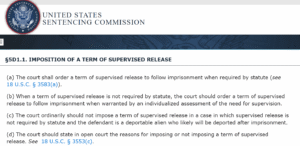
The revised U.S.S.G. §5D1.1 eliminates automatic terms of supervised release and removes recommended minimum terms, allowing courts to tailor conditions while eliminating lifetime supervision for sex offenses. §5D1.3 requires that conditions be based on the offense’s nature and the defendant’s background, with an option for early termination after one year if appropriate.
K
D
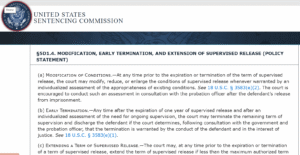
A new U.S.S.G. §5D1.4 encourages early post-release check-ins, supporting modifications and extensions of terms rather than revocations when fitting. The 2025 Guidelines also differentiate probation and supervised release. A new “Part C” promotes case-specific responses to violations, considering the severity of each violation in revocation proceedings.
F
P
P
><
C
S
 December 23, 2025
Something for the Ladies-More Dublin Lawsuits
First, 103 women won an unprecedented $116 million from the agency exactly one year ago.
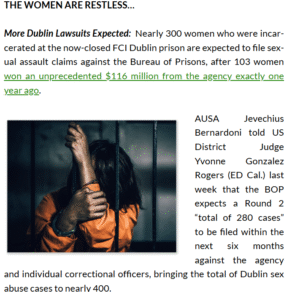
The BOP expects a Round 2 “total of 280 cases” to be filed within the next six months against the agency and individual correctional officers, bringing the total of Dublin sex abuse cases to nearly 400.
Deborah Golden, an attorney representing dozens of the women claiming abuse at FCI Dublin, said, “There could even be a Round 3.”
KTVU-TV, FCI Dublin: Nearly 300 more women expected to file sex assault claims vs. BOP (December 17, 2025)
Associated Press, US to pay nearly $116M to settle lawsuits over rampant sexual abuse at California women’s prison (December 17, 2024)
December 23, 2025
TRUMP DOES THE ‘WEAVE’ ON DRUG CRIMES
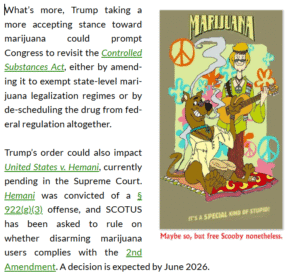
POT GOOD, FENTANYL (WMD?)

But, The Atlantic last week reported,
- While the recent developments may not have immediate legal implications for Trump’s military powers, they could influence the prosecution of domestic drug cases. Using a weapon of mass destruction (WMD) in the U.S. can result in a life sentence or even the death penalty if there’s a fatality. This could affect anyone using or distributing drugs laced with illicit fentanyl. The Trump administration has not yet provided guidance here.
-
In September, Trump claimed that “300 million people died … from drugs” in 2024, which would be almost the entire US population. Fentanyl was involved in 42,233 deaths from April 2024 to April 2025, according to CDC numbers. Drug defendants with fentanyl in their cases likely won’t see leniency from this Administration soon.
F
Executive Order, Designating Fentanyl As A Weapon Of Mass Destruction (December 15, 2025)
Executive Order, Increasing Medical Marijuana and Cannabidiol Research (December 18, 2025)
The Atlantic, The New ‘Weapon of Mass Destruction’ (December 16, 2025)
Centers for Disease Control and Prevention, Provisional Drug Overdose Death Counts (September 17, 2025)
U.S. Sentencing Commission, Quick Facts – Marijuana Trafficking (FY 2024) (May 2025)
Roll Call, Press Gaggle: Donald Trump Speaks to Reporters Before Air Force One Departure – September 14, 2025
The Hill, Trump signs executive order to expedite marijuana rescheduling (December 18, 2025)
CNN, Trump signs executive order expediting marijuana reclassification after lobbying from cannabis industry (December 18, 2025)
The Reload, Analysis: Trump’s Marijuana Moves Unlikely to Immediately Impact Gun Owners (December 21, 2025)
~ Thomas L. Root
F
First Step Act Reform Coming Around Again in the Senate? – Update
Senate Committee on the Judiciary, Durbin, Grassley Introduce Criminal Justice Reform Bills (December 16, 2025)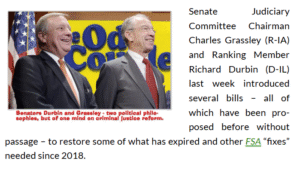
First Act Implementation Act of 2025 (S. —) (submitted December 16, 2025)
Safer Detention Act (S. —) (submitted December 16, 2025)
Prohibiting Punishment of Acquitted Conduct Act of 2025 (S. —), (submitted December 16, 2025)
~ Thomas L. Root
s
><
FEDERAL LEGAL NEWS. 12/22/2025
DIRECTOR MARSHALL’S EFFORTS TO IMPLEMENT EARLY RELEASE TO HOME CONFINEMENT – IGNORED?
When will the Central Office address case managers changing inmates’ home confinement dates? Many inmates are stressed because instead of being released on time, they are sent to halfway houses much later, despite having homes to return to. This alters their confinement dates and keeps them in prison longer.
G
MARIJUANA.
- President Donald Trump recently signed an executive order directing the U.S. Attorney General to expedite the reclassification of marijuana from Schedule I to Schedule III under the Controlled Substances Act. While this does not legalize marijuana, it indicates a policy shift in the Department of Justice to focus on more serious drugs like fentanyl.
ACCESSING HEALTHCARE IS STILL A CHALLENGE.
- Prisoners report that signs of serious health issues, such as advanced heart disease, cancer, and organ failure, are often ignored by medical staff, who may manipulate records to downplay these conditions. Delays and cancellations of medical appointments at outside facilities lead to unnecessary suffering and even death, and Clinical Directors are not obligated to heed specialists’ recommendations.
- Prisoners with manageable medical conditions, like diabetes, are facing medical neglect at FCI Bastrop. The medical director has moved the evening diabetic line to 2:30 PM instead of the original 5 PM, forcing us to wait over two hours before we can eat.
- Insulin, including regular insulin and Humalog, takes effect 15 to 30 minutes after injection, so diabetics should eat after administering it. However, if we do not attend the 2:30 PM insulin line, we do not receive our insulin. This prolonged wait is dangerous, as it can cause our blood sugar levels to drop too low, risking severe health issues like diabetic coma or death.
- The Bureau of Prisons (BOP) promotes the illusion that its rehabilitation programs are effective. It fails to document inmates’ positive activities in prison employment and essential rehabilitation programs like drug education. Drug education is often taught by untrained correctional officers, leading to misrepresentation of attendance and program completion, even when classes don’t actually occur.
“GHOST JOBS”
- At Pekin FCI in Pekin, IL, many of us hold “ghost” jobs, meaning we are not actually paid for them, even though we are part of the administration. The staff gives the impression that we receive training and pay, but this is not true. Most of us struggle financially and need funds for commissary items. We want the opportunity to earn certifications that could help us get real jobs. For example, I am listed as an HVAC worker, but I do not receive any pay or training for this role.
NON-CITIZENS IN THE BOP
- A quick way to reduce the federal prison population is to address the large number of non-citizens incarcerated for illegal entry. With the border secure, we could consider treaty transfers to return these individuals to their home countries, potentially saving hundreds of millions.
- Additionally, non-citizens who are permanent U.S. residents or on long-term visas are entitled to sentence-reducing credits under the First Step Act, yet prison staff often deny them.
- For those with immigration issues, there are countries, like Cuba, Laos, Vietnam, and Iran, to which they cannot be deported. Why are these individuals still in prison, costing taxpayers?
“MOUSE-CLICKING,” NON-CONTACT, SEX-OFFENDERS.
- Imprisoning individuals in federal prisons exposes them to persecution, rendering this approach ineffective. The “War on Sex,” like the “War on Drugs,” is set to fail. Additionally, case managers and halfway houses are delaying the release of sex offenders. How can a federally funded halfway house deny federal inmates access?
-
THREE SEX-OFFENDER DEATHS FROM SEPTEMBER TO NOVEMBER, 2025. AVOIDABLE?
Derek Gilna, Director of Research, JD, (De Paul Law School, 1975), MARJ, (Vermont Law School, 2020), Federal Legal Center, 133 W. Market, #171, Indianapolis, IN 46204; flcjustice@yahoo.com or flctruth@yahoo.com. Inquiries in Spanish; federallc_esp@yahoo.com
V
><
JUST A FEW,
Priced Out of Phone Calls Home, Bolts
- Peter Wagner, Executive Director, says:Phillip Vance Smith, writing from Neuse Correctional Center in North Carolina, criticizes the FCC’s suspension of its 2024 caps on prison phone and video calling rates. This reversal undermines an important economic justice victory for families, forcing many to spend hundreds monthly to stay in touch with loved ones, risking valuable family connections due to the high costs.
Reported Crime May Be Falling At A Historic Rate In The US, Jeff-Alytics
- Sarah Staudt, Policy and Advocacy Director, says: In 2025, despite historic low crime rates, we’re seeing an expansion of the carceral state with ICE raids, new jails, and increased electronic monitoring. Jeff Asher’s Substack highlights significant drops in several crime categories, countering claims from retail stores and the Trump administration that rising crime justifies more incarceration investments.
Scorching Cells, Reuters
- Regan Huston, Digital Communications Strategist, says: Summer heat can be intense, but few have experienced the sweltering conditions of prison cells. This immersive piece offers a glimpse into this dire situation, using scroll-through animations and storytelling to shed light on an often-overlooked issue.
In North Carolina Prisons, a Missed Opportunity in the Battle Against Opioids, Prison Journalism Project
- Danielle Squillante, Development and Communications Associate, says: Prison administrations often prioritize punitive measures for drug use over treatment options, as highlighted in our article “Addicted to Punishment.” Many incarcerated individuals struggle with substance use disorders, and prisons fail to provide necessary treatment or control drug influx, leading to a dangerous environment and a heightened risk of overdose.
Reporting on cities’ and counties’ collaborations with ICE
- Jacob Kang-Brown, Senior Researcher, says: Writers and reporters have emphasized the Trump administration’s mass-deportation agenda, often conflicting with local sanctuary policies. Key examples include Glendale City Jail’s canceled ICE contract, WTTW’s exposé on 17 Illinois jails working with ICE, Chicago Police providing crowd control at raids, and Judah Schept and Jack Norton in n+1 discussing rural jail expansion’s support for ICE.
><
FAMM. A STORY OF REDEMPTION AND HOPE
A
*
12/22/2025
MEDETOMIDINE: A DANGEROUS VETERINARY SEDATIVE NOW IN THE US DRUG SUPPLY.
D
A Powerful New Drug Is Creating a ‘Withdrawal Crisis’ in Philadelphia, The New York Times.

O
IT’S DANGEROUS TO YOUR LIFE
IT DEFINITELY WILL BE PURSUED BY THE DOJ
C
D
><
*
ACCESS TO MEDICAL AND MENTAL HEALTHCARE
- THE BOP CANNOT PROVIDE ALL TYPES OF MEDICAL AND MENTAL HEALTHCARE.
- PSI PREPARATION IS CRUCIAL TO AT MINIMUM, ESTABLISH A BASELINE FOR LEGAL ACTION LATER.
SOLITARY WATCH.
F

HEALTHCARE ACCESS, AND BOP PLACEMENT: ALL MATTERS.
S
MEDICAL CARE
TO BEGIN, EVEN THE BOP FMC HOSPITAL’S MEDICAL CARE IS NOT THE QUALITY THAT YOU’RE USED TO. DO YOU HAVE A MEDICAL HISTORY?
- YES? THIS EMPHASIZES THE NEED FOR YOUR COMPLETE MEDICAL RECORD TO BE PROVIDED BEFORE YOUR PSI.
- MEDICATIONS? VERIFY THAT THE MEDICATIONS YOU ARE TAKING WILL BE AVAILABLE (BEFORE YOUR PSI). PLEASE DO NOT ASSUME!
- THE BOP USES GENERIC MEDICATIONS. THEY ARE PROVIDED THOUGH THEIR “FORMULARY,” AND “NON-FORMULARY” LISTS. NON-FORMULARY DRUGS ARE LIKELY NOT TO BE AVAILABLE.
- ACCESS AT MINIMUM DEPENDS ON INCLUDING YOUR MEDICAL RECORD IN YOUR PSR. EVEN THEN, IT MAY BE DELAYED, CHANGED, OR DENIED.
LIFE INSIDE.
- Do your best to stay under “the radar” of correction staff, and No Cell Phones.
- Don’t count on timely healthcare.
BOP PLACEMENT MATTERS. EXAMPLE,
I) 3 SEX-OFFENDER DEATHS IN THREE MONTHS. AVOIDABLE?
- USP COLEMAN II
- MIAMI FDC
- GREENVILLE FCI
The Sex Offender Management Program (SOMP) provides specialized treatment and oversight across various security levels: administrative, low, medium, and high.
Administrative services are offered at FMC Carswell in Fort Worth, Texas, and FMC Devens in Ayers, Massachusetts, combining medical treatment with secure housing.
Low-security placements include FCI Elkton in Ohio and FCI Seagoville in Texas, designed for individuals eligible for lower-level custody.
Medium-security SOMP programming is available at FCI Marianna in Florida, USP Marion in Illinois, and FCI Petersburg Medium in Virginia, offering structured supervision alongside clinical treatment.
For those needing high security, USP Tucson in Arizona serves as the primary facility for high-security SOMP services.
- 11-19-2025: A 67-year-old male received a 365-month sentence for Transportation with intent to engage in [#1]criminal sexual activity with a minor, Mailing Threatening Communications, and Threatening a Law Enforcement Officer. He has been in custody at FCI Greenville since August 6, 2025.
- 11-19-2025: 58-year-old male who arrived at FDC Miami on March 20, 2025, under pretrial status after being indicted for [#2] Exploitation of a Minor. Mr. Edwards was not yet sentenced.
- 09-22-2025: 31-year-old male who was sentenced in the Eastern District of Michigan to a 600-month sentence for [#3] Conspiracy to Sexually Exploit Children and Sexual Exploitation of Children. He had been in custody at USP Coleman II since March 3, 2025.
F
2) YOU HAVEN’T BEEN SENTENCED, ONLY TO FIND YOURSELF IN PRISON (Pre-Trial Status). TAKE CARE OF YOURSELF.
- 09-25-2025: a 29-year-old male who arrived at FCI Englewood on Thursday, March 28. 2024, under pretrial status after being indicted for possession of a weapon.
H
NATURAL CLASSIFIED DEATH IN PRISON: NATURAL (NO AUTOPSY), OTHERS SHOULD GET AN AUTOPSY.
L
SUPERVISED RELEASE VIOLATION
12-09-2025: 57-year-old male who was sentenced in the District of Western Pennsylvania to a 13-month sentence for Supervised Release Violation. He had been in custody at USP Florence since September 29, 2025
OTHER
12-9-2025: A 49-year-old was found unresponsive on Dec. 7, serving a 188-month sentence for the distribution of methamphetamine. He had been held at the Yazoo City prison since Feb. 12.
11-19-2025: 46-year-old male sentenced in the Western District of Michigan to 360 months for drug offenses, including Possession with Intent to distribute cocaine and maintaining a drug-involved premises. He has been in custody at USP Beaumont since January 11, 2024.
09-25-2025: 39-year-old male sentenced to 270 months in the Eastern District of North Carolina for Conspiracy to Distribute Methamphetamine, Heroin, and Possession of a Firearm in Furtherance of Drug Trafficking. In custody at FCI Petersburg Low since September 23, 2025.
09-18-2025: 60-year-old male sentenced in the Northern District of Iowa to 60 months for Attempt and Conspiracy to Distribute Methamphetamine. He has been in custody at FPC Duluth since September 16, 2024.
H
><
FEDERAL LEGAL NEWS. 12/15/2025
NEEDING MEDICAL CARE IN THE BOP IS A CONSTANT CHALLENGE. A 36-year-old man at the Federal Medical Center in Springfield, Missouri, died painfully, reportedly while correctional staff ignored his suffering.
- 7-19-2025: 34-year-old male who was sentenced in the District of Montana to a 320-month sentence for Murder, 2nd Degree, and Kidnapping. He had been in custody at MCFP since November 6, 2024.
On Thanksgiving, he experienced severe pain in his left thigh during hemodialysis, leading to an early treatment end. By afternoon, he could not sit up and was heard crying out in pain. Fellow inmates alerted a nurse, who checked his vital signs but provided no further assessment. Despite his screams throughout the night, the staff only made brief rounds without offering meaningful help.
f
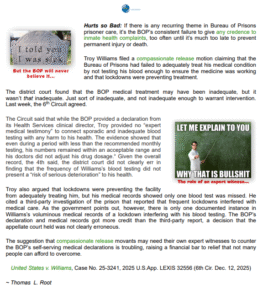
COMPASSIONATE RELEASE DENIED—my Opinion.
The article suggests that a person in need should wait until conditions worsen, and they have the funds to pay an expert, but they’ll now need to find one. Their need or concern (for their life) is, in part, based on the care currently available in the news. For example,
FMC CARSWELL – MEDICAL CARE: DELAYED DIALYSIS RESULTS IN INMATE DEATH. As the only hospital in the BOP for women, FMC Carswell highlights access-to-care issues. If this is your client, consider exploring better options.
Menstruating in Correctional Facilities, Sometimes Ending in Mistreatment, Infractions (or Charges). Prison Policy Initiative (PPI).
BOP staffing shortages are nationwide, with lockdowns at their facility.
United States v. Williams, Case No. 25-3241, 2025 U.S.App. LEXIS 32556 (6th Cir. Dec. 12, 2025)
n
From Bastrop: “We’re told the Trust Fund is broke, leading to constant shortages in the Commissary. The Trust Fund is believed to be self-sustaining with a 30-40% markup. Its financial issues suggest that inmate funds are being misused.
We are disappointed that, six months after BOP Director William Marshall III’s directive to “stack” all available sentence credits for all prisoners, we continue to receive reports of Case and Unit Managers not complying. Many are even threatened with retaliation, such as reduced halfway house time, for mentioning the memo or seeking timely release. As a result, you should initiate the remedy process early with a well-drafted 2241 petition (below) to enforce the law.
The §2241 Petition Form pdf.
n
According to reliable sources within the BOP, wardens nationwide have been alerted that commissary operations are under scrutiny amid reported inventory shortages, despite sufficient funds in prisoner trust accounts. Elkton officials expressed surprise over complaints about empty shelves, especially since prisoners depend on the commissary for essential items and toiletries, which can lead to frustration when they are unavailable due to staff actions or inactions.
DE
The First Step Act (FSA) empowers federal prisoners to earn time credits by actively participating in recidivism-reduction programs, paving the way for earlier release to prerelease custody or supervised release. The Warden holds a crucial role in the process, with the authority to grant exceptions for transfers to prerelease custody. To qualify, inmates must prove they pose no danger to society, have actively participated in programs, and are unlikely to reoffend. This authority is firmly established under 18 U.S.C. § 3624(g)(1)(D)(i).
Post-offense rehabilitation adjustment. “The Commission has identified a policy priority for the amendment cycle ending May 1, 2026, to examine whether the guidelines adequately adjust for good behavior. Commenters have indicated that the guidelines do not sufficiently reward positive post-offense conduct and rehabilitation efforts prior to sentencing, despite existing provisions like §3E1.1 (Acceptance of Responsibility) and §5K1.1 (Substantial Assistance to Authorities). In response, the proposed amendment would introduce a new adjustment at §3E1.2 (Post-Offense Rehabilitation, BELOW 5/2026) to provide a reduction for demonstrated positive post-offense behavior or rehabilitative efforts, outlining two options for this adjustment.”
f
Derek Gilna, Director of Research, JD, (De Paul Law School, 1975), MARJ, (Vermont Law School, 2020), Federal Legal Center, 133 W. Market, #171, Indianapolis, IN 46204; flcjustice@yahoo.com or flctruth@yahoo.com. Inquiries in Spanish; federallc_esp@yahoo.com
j
><
a
FMC CARSWELL – MEDICAL CARE: DELAYED DIALYSIS RESULTS IN INMATE DEATH.
FMC CARSWELL is the only hospital in the system for women. This December 16, 2025, article is a stain on access to medical care and an obstacle to Deputy Director Smith and Director Marshall’s efforts to make the necessary changes. If this is your client, and as the only hospital in the BOP that treats women is FMC Carswell, you may need a better option.
S
H
><
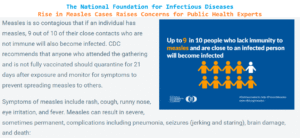
MEASLES IN CORRECTIONAL SETTINGS
- We all learned that during COVID-19, being properly quarantined in a prison setting was nearly impossible.
j
US Exceeds 1,900 Measles Cases as Outbreaks Expand.
Stephanie Soucheray, MA., 12/10/2025
b
l
Receiving two doses of the MMR vaccine provides 97% protection and lifelong immunity. Although measles was declared eliminated in the US in 2000, cases still occur due to global transmission. The CDC reported an increase in measles cases from 49 in 2021 to 121 in 2022, primarily among unvaccinated children. Recently, around 20,000 attendees of a religious gathering in Kentucky may have been exposed to an unvaccinated person with measles.
D
y
K
Utah-Arizona outbreak grows to 254 cases.
- In South Carolina, 281 students from eight Upstate schools are in quarantine, with 114 total COVID-19 cases reported, 111 of which are tied to this outbreak.
- In Utah, the latest case was found in a school setting near Salt Lake City, but the highest activity remains in the southwestern region bordering Arizona. The Utah-Arizona outbreak, which began in Colorado City, Arizona, and Hildale, Utah, has reached 254 cases, making it the second-largest outbreak in the U.S. this year, after West Texas.
p
The Cleveland Clinic: Measles
- Measles is a highly contagious disease that causes a high fever, rash, cough, and watery red eyes. It can lead to life-threatening complications, like brain inflammation and pneumonia.
d
s
g
12/15/2025
Presidential Pardons and Clemency: A Strategic Consideration for Defendants Facing Federal Prison.
*
Fraudster’s Victims Are Seething After Trump Commuted His Sentence. 12/15/2025

GPB Capital, which marketed itself as private equity for Main Street, raised nearly $2 billion from everyday Americans to boost their retirement portfolios, while executives allegedly used the funds for extravagant lifestyles. The recent commutation of David Gentile’s seven-year sentence by President Trump, just days after he began serving time for fraud, has frustrated thousands of victims trying to recover their investments. Many, including senior citizens like 66-year-old Catherine Kominos, who invested $50,000, are left questioning why Gentile received a second chance.
Gentile, 59, was convicted of securities and wire fraud in August 2024 and reported to prison on Nov. 14, only to be released 12 days later due to Trump’s commutation. This decision raises questions about Trump’s clemency practices, which often overlook Justice Department guidelines favoring those who have served time or shown remorse. Trump’s use of his pardon power has primarily benefited allies facing white-collar crime charges, framing prosecutions as political witch hunts. It’s unclear if Gentile had any ties to Trump or who advocated for his commutation.
l

David Gentile no longer required to pay $15.5M in restitution after Trump’s commutation
F
><
b
Flattery, Politics, Money – It’s What a Pardon Requires
12/11/2025
l
“Trump’s approach to pardoning is anything but conventional,” stated Margaret Love, former U.S. pardon attorney. “It’s unclear whether he has a personal stake in the case or if his decisions stem from concerns about specific offenses, particularly those related to bribery and financial crimes.”
l

l
So how does an inmate get a leg up?
Axios recently noted that the gravity of criminal conduct often mattered less than public loyalty, praise, or ideological alignment with Trump. For example,
- Honduran president Juan Orlando Hernández—pardoned shortly before—sent an effusive letter lauding Trump’s “historic” achievements and emphasizing shared patriotism and faith.
- Trump also deflected blame to Biden, claiming prosecutions stemmed from opposition to Biden’s policies, particularly on immigration. Hernández similarly argued his case resulted from a politically motivated Biden-Harris Justice Department.
- Strategic connections played a role as well. Hernández enlisted Trump associate Roger Stone to advocate for a pardon, while others secured representation from well-connected law firms.
Finally, financial influence appeared to matter. In one instance, Trump pardoned Paul Walczak for tax offenses after Walczak’s mother attended a $1 million-per-person fundraiser at Mar-a-Lago.
l

p
Politico, Henry Cuellar will seek reelection as a Democrat after Trump pardon (December 3, 2025)
Wall Street Journal, A Round of Golf Changed Trump’s Tone on the Concert Industry (December 6, 2025)
Wall Street Journal, Trump’s Pardon for Cocaine Juan (December 2, 2025)
Axios, Trump wields pardons as purest form of power (December 3, 2025)
Financial Times, ‘Why are we letting this guy go?’ Donald Trump’s pardons upend US justice system (December 5, 2025)
New York Times, Who Gets a Presidential Pardon? (December 4, 2025)
~ Thomas L. Root

><
s
FEDERAL LEGAL NEWS (FLN)
l
Maximizing sentence credits for qualified prisoners is crucial as it rewards participation in rehabilitation programs and reduces financial strain on the agency. Fewer prisoners mean more resources for those remaining, enhancing family reunification and increasing the likelihood that individuals will become tax-paying citizens. However, some case managers have not fully embraced this message and have misinterpreted the Director’s memos.
p
Refusal to follow policy.
FCI Allenwood: “My FSA conditional placement date is July 2027, but due to the Second Chance Act’s year-off provision, it would move to July 2026. They have stated that they only need to transfer individuals to the halfway house 60 days before this date. Their policy suggests a placement 17-19 months in advance, which would be December 2025. Recently, they claimed they could bypass this policy and delay my placement until May 2026. They initially offered a transfer on November 18, 2025, if I signed backdated paperwork to avoid the full benefits from changes made on October 21, 2025. After the Central Office intervened, the staff’s stance seems retaliatory.”
c
Case managers are misinterpreting the Director’s memos, resulting in reduced sentence credits. They had received anticipated dates for halfway house time, but following Director Marshall’s June 17, 2025, memo, those dates were canceled. Now, those with a residence face up to six additional months in secure custody before being eligible for home confinement. The prisoner, who has served over 14 years, received no halfway house time and questioned how the memo expands home confinement. Their Unit Manager stated he could only grant up to six months or 10% for home confinement, but didn’t explain why there was no transitional placement by the expected date of June 22, 2026. The home detention eligibility date is now set for December 22, 2026, which is six months later than initially expected.
h
“Passive-Aggressive” Retaliation at Elkton. Our commissary has been largely out of stock on staple items like coffee since September, following an incident with inmate workers that was mishandled in the report. We’re told that restocking is delayed until January, and no specialty holiday items are being offered. When we ask about the shortages, we hear excuses like ‘it’s a budget issue’ or ‘we can’t use the credit card.’ If inmates fund the commissary, how can there be a budget issue?”
h
The Terminal Island’s target date for the final prisoner’s departure is April 1, 2026. Which Institution Will Close Next?
c
First, there was the Director’s June 17 Memo Mandating “Stacking” of Sentence Credits; Why So Few FSA “Warden Exceptions” Given for Deserving Higher-Security Prisoners?
- Why are wardens rarely granting the First Step Act’s “Warden’s Exception” to otherwise deserving medium-security inmates?
The First Step Act permits federal inmates to earn time credits through recidivism-reduction programming and allows wardens, under 18 U.S.C. § 3624(g)(1)(D)(i), to authorize prerelease custody when an inmate poses no danger, has meaningfully participated in programming, and presents a low risk of recidivism. Given the FSA’s rehabilitative purpose, why is this discretionary authority so infrequently exercised?
p
COMPASSIONATE RELEASE. In Fernandez, the petitioner was involved in the shooting deaths of two men collecting a $6.5 million drug debt for 274 kilograms of cocaine. A decade after his 2011 trial conviction, the district court reduced his mandatory life sentence to time served under the compassionate-release statute, citing “extraordinary and compelling reasons.” These included doubts about the evidence, particularly witness credibility, and the lower sentences of his codefendant’s who cooperated with the government.
k
Inadequate representation by private panel attorneys, chosen by the presiding judge, at times fails to provide a vigorous defense, risking future appointments and fees. Similarly, the limited resources available to federal public defenders for aiding indigent defendants deserve greater attention. Since his election, the President has successfully negotiated agreements with leading law firms, securing up to $500 million in pro-bono legal services. Using those funds, he now has the opportunity to ensure that criminal defendants receive legal representation on par with that of the Department of Justice.
- Should you have inadequate representation, act quickly, as you are generally barred from filing such a petition more than one year after your case is final.
- Consider filing a 2255 habeas petition based on ineffective assistance of counsel. Use the two-prong test from Strickland v. Washington and Wiggins v. Smith to support your claim: (1) Did defense counsel’s performance fall below an objective standard of reasonable professionalism? (2) Would the outcome have been different if not for this deficiency?
h
Trials have not been fully utilized because of the range of penalties under likely guideline-scoring scenarios, considering the information available to the defendant and their lawyer at the time. ”United States v. Day, 969 F.2d 39, 43 (3d Cir.1992) (observing that “the Sentencing Guidelines have become a critical, and in many cases, dominant facet of federal criminal proceedings” such that “familiarity with the structure and basic content of the Guidelines …has become a necessity for counsel who seek to give effective representation.”)
Derek Gilna, Director of Research, JD, (De Paul Law School, 1975), MARJ, (Vermont Law School, 2020), Federal Legal Center, 133 W. Market, #171, Indianapolis, IN 46204; flcjustice@yahoo.com or flctruth@yahoo.com. Inquiries in Spanish; federallc_esp@yahoo.com
><
k
12-11-2025
FMC CARSWELL, PROVIDING MORE THAN JUST HEALTHCARE
j
*
S
S
PPI 12/11/2025
MASS INCARCERATION, A LOOKBACK ON 2025
M
The report Mass Incarceration: The Whole Pie provides a comprehensive overview of nearly 2 million people incarcerated in the U.S., detailing the types of facilities and reasons for their confinement. It highlights states driving incarceration growth and includes an update on “Youth Confinement: The Whole Pie,” showcasing the ongoing overincarceration of Black and Indigenous youth, despite overall reductions in youth confinement in recent decades.
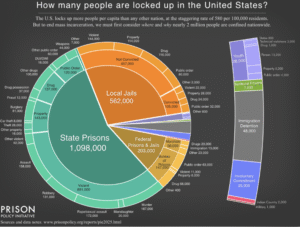
Since taking office, the Trump administration has issued numerous executive orders and used its bully pulpit and control over federal spending to coerce state and local governments into expanding the size and brutality of their criminal legal systems.
Hiding in Plain Sight: Local jails, even in sanctuary areas, are crucial to President Trump’s detention and deportation efforts. This report highlights the complex relationship between local criminal and immigration systems, showing how the administration is bypassing sanctuary policies by referring immigrants to the U.S. Marshals Service, which has overlooked contracts with jails for holding pretrial detainees.
WOMEN’S INCARCERATION ISSUES
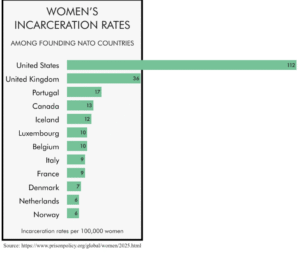 States of Women’s Incarceration: The Global Context 2025
This report highlights the criminalization of women, a small minority of the U.S. incarcerated population, whose incarceration rates are at near-historic highs. It provides comprehensive incarceration rates for women across all U.S. states, including prisons, jails, youth centers, tribal jails, and immigrant detention facilities, comparing states and global rates.
X
WOMEN’S HEALTH
J
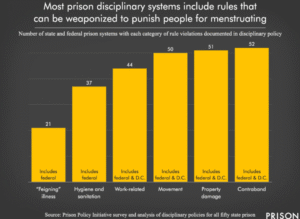
Menstruating in Correctional Facilities, Sometimes Ending in Mistreatment, Infractions (or Charges).
L
L
G
12/9/2025
m
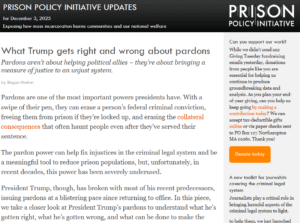
THE PRISON POLICY INITIATIVE – PARDONS
The real problem isn’t how many people he has pardoned, but instead that he appears to be reserving that Power just for His Friends and Allies.
Meanwhile, roughly 10,000 people have filed petitions for pardons or commutations at the federal level just this year, and only 10 have been granted. The rest should not be ignored just because they do not have the political sway of Trump’s friends and allies.
l
A
While President Trump has used his pardon power far more frequently than most recent presidents, it is still not enough. There are more than 200,000 people in federal custody on any given day. Trump’s 1,500 pardons represent less than 1% of the people locked up by the federal government.
To improve clemency and the pardon process, making it more frequent, accessible, and fair. A good place to start would be passing the FIX Clemency Act, which would:
- Replace the Office of the Pardon Attorney with an independent board of experts to recommend clemency to the President.
- Create greater transparency in the clemency process by publicly disclosing Board activities and recommendations.
- Protect applicants for clemency from greater prosecution.
><
The Prison Fellowship: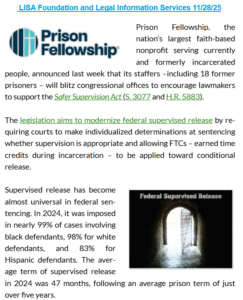
Senator Mike Lee (R-UT) introduced the Senate version, and Representative Laurel Lee (R-FL) – no relation to Mike – introduced the House bill. Both bills have Democratic Party co-sponsors.
S. 3077, Safer Supervision Act
H.R. 5883, Safer Supervision Act
Daily Reflector, Prison Fellowship Urges Congress To Pass Safer Supervision Act With Day of Action on Capitol Hill (November 18, 2025)
~ Thomas L. Root
><
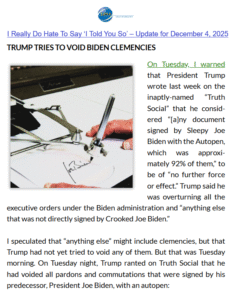
All Documents, Proclamations, Executive Orders, Memorandums, or Contracts signed by the unauthorized “AUTOPEN” in the Biden Administration are null and void. Any resulting “Pardons,” “Commutations,” or Legal Documents are also terminated and carry no legal effect. Thank you.
Which US president has granted the most pardons? 1945 – 2025.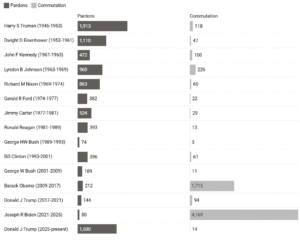
Just hours into his second term, Trump pardons about 1,500 people charged in the January 6, 2021, Capitol attack. By Hanna Duggal and Marium Ali, Published On 23 Jan 2025
Biden issued a record 4,245 acts of clemency and only issued 80 individual pardons, done verbally. Of course, as he has already demonstrated, Trump is unlikely to shrink from trying to reimprison someone simply because no one believes his power extends to such an action.
Newsweek, Trump Says All Pardons, Commutations Signed by Biden Autopen ‘Terminated’ (December 2, 2025)
Government Executive, Trump says he is voiding Biden executive actions signed with autopen (December 1, 2025)
Time, Why Trump Can’t ‘Void’ Biden’s Pardons Because of Autopen (March 17, 2025)
><
Was your crime drug-related? It’s not too late to Request Yours.
The Second Look Act (What’s changed: Presidents)
Spread The Word…

l
FEDERAL LEGAL NEWS (FLN) 12/1/2025
Congress Reclassifies Some Hemp Offenses;
On November 12, 2025, Congress revised the definition of “hemp,” reclassifying most hemp products as Schedule I substances to take effect in a year. The law raises the THC limit to 0.3%, bans most lab-made cannabinoids like delta-8, and imposes a 0.4 mg cap on intoxicating cannabinoids. The impact on past marijuana prosecutions is uncertain, but assistance is available as the situation evolves.
New US Supreme Court Cases; Review of Non-Retroactive 2025 Sentencing Guidelines;
Hemani addresses the Second Amendment limits on § 922(g)(3) concerning “drug users.” Barrett examines prosecutors’ ability to impose penalties under § 924(c) and § 924(j) for firearm offenses. Ellingburg questions if restitution under the MVRA is considered “punishment” under the Ex Post Facto clause. Villarreal analyzes Sixth Amendment restrictions on attorney-client consultations during trial recesses.
The 2025 US Sentencing Commission Guidelines introduce non-retroactive changes focused on supervision and probation, allowing courts greater discretion and removing the requirement for minimum sentences.
Recent amendments to drug guidelines have adjusted the Drug Quantity Table under §2D1.1(a)(5), reducing the emphasis on drug type and quantity for determining offense culpability, especially for low-level participants and fentanyl offenses. New subsection §2D1.1(e)(2) introduces lower offense-level caps for defendants with a mitigating role adjustment under §3B1.2, addressing inconsistencies in drug trafficking cases.
- Under revised §2D1.1(a)(5), if a defendant gets a mitigating role adjustment under §3B1.2 and the Drug Quantity Table’s base offense level is above 34, it’s capped at 32.
- If the defendant receives a four-level reduction under §3B1.2(a) for a minimal role and the offense level exceeds 30, it is capped at 30.
Maintenance Failures Force Closure of FCI Terminal Island;
The BOP announced that FCI Terminal Islands’ crumbling infrastructure has been deemed unsafe and will be evacuated: “A strategic and targeted approach will be used to relocate inmates currently housed at FCI Terminal Island to other locations across the agency.” “Several placement options are being evaluated, with a priority on keeping individuals as close as possible to their anticipated release locations.” The news of the planned evacuation came just days after the agency touted $2 billion in funding to address deferred maintenance priorities across the federal prison system from this year’s budget reconciliation law. Unfortunately, virtually every facility suffers from deferred maintenance, putting both prisoners and staff at unnecessary risk.
The BOP announced the evacuation of FCI Terminal Island due to unsafe, crumbling infrastructure. Deputy Director Smith covered several topics in his three Videos (11/19, 21, and 25/2025), that a strategic approach will be used to relocate inmates to other facilities, prioritizing proximity to their anticipated release locations.
Deputy Director Josh Smith acknowledged the pain employees have endured, including forced overtime.
They will be offering one-time payments: GS8 (and below) $4000, GS9 & 11(and below); $2500, and GS12-15: $1000.This announcement follows the agency’s recent mention of $2 billion in funding for deferred maintenance across the federal prison system, an issue that poses risks to both prisoners and staff.
Continued Problems with FSA, SCA Sentence Calculation;
FCI Phoenix
They have a history of blocking emails from the Federal Legal Center, which exposes mismanagement. Inmates report that BP9s are ignored, and mail to the region often doesn’t arrive. Many units lack basic amenities such as ice machines and hot water dispensers, despite the commissary taking in over $1 million from December 2024 to April 2025, with a profit of about $300,000. Inmates are told there’s no money for replacements. Additionally, all legal mail is copied, and many inmates never receive their original correspondence, raising concerns that legal mail is not being delivered.
Atwater
“My case manager at Atwater Prison Camp is quick to warn inmates about crossing him. He told me that, due to my year off with FSA STC, he won’t honor the Second Chance Act and that halfway houses aren’t accepting inmates with addresses anymore.
Terminal Island
FCI Terminal Islands’ crumbling infrastructure has been deemed unsafe. “A strategic and targeted approach will be used to relocate inmates currently housed at FCI Terminal Island to other locations across the agency.”
A TEAM sheet indicates I could go home in …, while the one from Atwater shows zero SCA with the earliest home confinement in the summer of …. The case manager rarely engages with inmates and has even retaliated against a report about commissary irregularities by discontinuing popular items. A reliable source from Central Office mentioned that the investigation is ongoing and changes are expected soon, as commissary profits are meant for prisoner benefits.”
FCI Forrest City
In applying time credits, there’s confusion and a failure to follow the administrative remedy process: “I often complain about time credits calculation. The BOP Director issued directives for FSA time credits to be calculated at 85% GCT, even while in the halfway house, but that’s not happening. There’s an ongoing dispute about who should redo the calculations—the regional office or case management teams. I’ve tried to find out when this will happen, but I’m just getting spun in circles and leaving meetings feeling dizzy. I can’t get the truth…”
FCI Elkton
The BOP director has indicated that the MAX of the SCA should be applied when appropriate, recommending the highest level of home confinement instead of a halfway house. However, I’ve seen instances where much less than the MAX was recommended. In some cases, individuals were initially told they’d receive home confinement but were later switched to a halfway house. I hope this issue gets resolved, as I am eligible for home confinement.
Derek Gilna, Director of Research, JD, (De Paul Law School, 1975), MARJ, (Vermont Law School, 2020), Federal Legal Center, 133 W. Market, #171, Indianapolis, IN 46204; flcjustice@yahoo.com or flctruth@yahoo.com. Inquiries in Spanish; federallc_esp@yahoo.com
P
12/1/2025
d
THREE SEX-OFFENDER DEATHS IN 3 MONTHS, FROM SEPTEMBER TO NOVEMBER, 2025
Ultimately, it comes down to knowing your client and the facility recommendation options available before SOTP-R placement. Keep in mind that no matter what the BOP says, this could be a real-life event; therefore, having this discussion with your client may prove crucial.
s
><
DOJ Expands Healthcare Fraud Unit: Their #1 Target Are Providers and Those in Patient Care and the Life Sciences.
s

When you and your attorney commit to taking a case to trial, it’s because the strategy supports it. Trust in your counsel’s experience is crucial. And with a strong defense, acquittals are not just possible—they do happen.
k
d
d
><
Deputy Director Smith, addressing a crumbling infrastructure and hiring: This may be an excellent start.
In Video, 11/25/2025.
l
FCI Terminal Island is set to undergo a temporary closure to fix the building’s decay. We’ll see if it’s a temporary or a final closure.
November 25, 2025.
p
><
THE BOP, AN AGENCY IN CRISIS – “THE BUCK STOPS HERE”

In Video 11/21/2025,
Deputy Director Josh Smith acknowledged the pain employees have endured, including forced overtime. They will be offering one-time payments: GS8 (and below) $4000, GS9 & 11(and below); $2500, and GS12-15: $1000.
h
In Video 11/19/2025,
Like blaming others (prior administrations and The Deep State), as Deputy Director Josh Smith did in his Video Message of 11/19/2025, this eventually has to stop. The Buck Stops at the Desk of BOP Leadership and the President – they knew that this would not be easy. The lack of food, water, and toilet paper (for inmates and staff alike), coupled with reduced pay and overtime, is not acceptable.
><
l

CLEMENCY Vs PARDON
Presidents and governors wield significant clemency powers that can profoundly impact lives. They have the authority to completely erase a criminal conviction through a pardon or to significantly reduce a person’s sentence via a commutation. These acts of mercy not only offer a second chance but also reflect the values of compassion and justice within our society. It is a powerful tool that could be used to address past injustices and turn the page on the nation’s failed era of mass incarceration.
A closer look at clemency, pardons, and commutations.
- A 2020 report by the Urban Institute explains how governors can and should use their clemency powers through broad eligibility criteria.
- The Collateral Consequences Resource Center has an essential resource on pardon authorities in all 50 states,
q
j
PPI Research Library added new reports, focused on Drug courts, Medicaid expansion, and the impact of Extreme Heat on Law Enforcement decisions.
- Extreme Heat and Calls to Law Enforcement Related to Domestic Violence
- Diesel Therapy, the hell you already know”: How prison transfers regularly upend incarcerated people’s lives

- Drug Courts in the Americas by Social Science Research Council,
- In 2020, Medicaid Expansion’s Spillover to the Criminal Justice System: No more, as Medicaid has been deleted as an option for most, come 1/1/2026
k
11-24-2025
HEALTHCARE IS STILL THE DOJ’S #1 TARGET
Justice Department Expands Health Care Fraud Unit to Target Health Care Fraud in Massachusetts. September 23, 2025
My Takeaway
As a physician-sentence mitigation consultant for those facing criminal federal sentencing, providers and health systems must be proactive in navigating the legal landscape, as the DOJ Strike Force is now expanding its footprint in Massachusetts and beyond. With risk-adjustment coding extending beyond Medicare Advantage into commercial, ACA, and value-based contracts, compliance risks are growing. Organizations must strengthen documentation integrity, implement MEAT-based clinical documentation, and create defensible, analytic-driven workflows that reduce audit exposure and protect revenue. In today’s landscape, coding accuracy, data quality, and proactive oversight are essential.

If you are facing charges, most federal cases today involve civil violations with financial penalties, though some can become criminal. In these situations, it’s essential to have an attorney who specializes in federal criminal defense and handles cases like yours in federal court. Here are key questions to consider when interviewing potential attorneys.
b
l
><
j
The Supreme Court Certiorari Petition Pile – Update for November 20, 2025
The Supreme Court has again relisted a case challenging whether judges can rely on uncharged, acquitted, or dismissed conduct at sentencing — a practice critics say violates the 5th and 6th Amendments. A relist simply means the justices weren’t ready to decide whether to take the case and will revisit it at a future conference. Most cases accepted for review are relisted at least once, though the Court denied a similar group of nearly ten petitions on this issue last term after multiple relists.
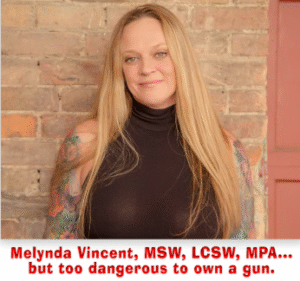
Separately, the Court will consider whether to hear the case of Melynda Vincent, who argues that the federal ban on firearm possession for people with felony convictions 18 USC § 922(g)(1) violates the 2nd Amendment as applied to her. Vincent’s only felony — bank fraud tied to writing bad checks during addiction — is now 15 years behind her. Since then, she has completed treatment, earned multiple degrees, and founded organizations focused on harm reduction, mental health, and criminal-justice reform.
P
><
The Pardon Power’s a Wreck – Update for November 18, 2025
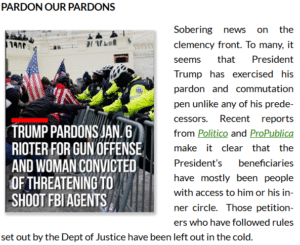
Trump’s Second-Term Clemency: Loyalty Over Process
President Trump’s recent clemency spree has overwhelmingly benefited political allies, donors, and high-profile supporters. In the past week alone, he issued 77 pardons — including Rudy Giuliani and others tied to efforts to overturn the 2020 election — and recently commuted former congressman George Santos’ sentence after only a few months behind bars.
While thousands of applicants follow the Department of Justice’s formal rules and wait years for review, Trump has largely bypassed that system. Nearly 10,000 people have filed petitions since he returned to office, yet fewer than 1% of this term’s clemency recipients came through the DOJ process at all.
Former pardon officials and clemency experts say the traditional system has effectively been sidelined, leaving ordinary applicants with almost no chance. Critics argue that Trump has turned clemency into a tool for rewarding loyalty rather than offering second chances — a sharp break from the constitutional role the pardon power was designed to serve.
><
P

THE BOP – AN AGENCY IN CRISIS
From Florida to California, staff report waves of colleagues departing: six at one Texas prison, eight at another, more than a dozen at a California facility, and over four dozen at a larger site. By early November, BOP had lost at least 1,400 more employees than it had hired this year.
- The ongoing losses have worsened critical shortages of food, hygiene supplies, and staff, leading to further lockdowns and reduced access to health care. Inmates stressed and frustrated; staff caught between inmates and BOP higher-ups.
AUGMENTATION (Page 8)
Teachers and medical staff are feeling the strain, often assigned as officers in a process called Augmentation. It’s disheartening to see some facilities unable to provide the basic necessities like paper towels, soap, or toilet paper for their staff (and inmates)
L
L
BOP leadership did not answer detailed questions – instead,
In a video statement, Deputy Director Josh Smith spoke directly to BOP staff, acknowledged the difficult times they have been through, and did his best to provide a better working atmosphere.
11/21/2025 Video
My Comment;
SPECIFICS. In video 11/21/2025, Deputy Director Josh Smith acknowledged the pain employees have endured, including forced overtime. They will be offering one-time payments: GS8 (and below) $4000, GS9 & 11(and below); $2500, and GS12-15: $1000. But blaming others, as Deputy Smith did at the end, is not helpful to anyone.
11/19/2025
In a video statement, Deputy Director Josh Smith blamed “shambles” left by the previous administration and said staffing was “catastrophic,” but promised aggressive reforms and “transparency and accountability.”
Like blaming others (prior administrations and The Deep State), as Deputy Director Josh Smith did in his Video Message of 11/19/2025, this eventually has to stop. The Buck Stops at the Desk of BOP Leadership and the President – they knew that this would not be easy. The lack of food, water, and toilet paper (for inmates and staff alike), coupled with reduced pay and overtime, is not acceptable.
Accepting responsibility is key (without blaming others); ICE, DoorDash, Lyft, Uber, and others will continue to purge employees from the BOP. Infrastructure, layoffs, and everything that should have been done were yesterday; enough of Big-Beautiful-Bill and what others didn’t do. Let’s see what you do; only time will tell.
Currently, the BOP has 4,000 vacant positions. The result is that AUGMENTATION has left the agency with so few officers that teachers, nurses, and electricians in prisons are regularly ordered to abandon their regular duties and fill in as corrections officers.
><
m
If crime is coming down, per The Sentencing Project, why are prisons and their populations rising? On the federal side, if the FSA SCA Task-Force is manually performing the calculations and moving eligible individuals in Halfway Houses (RRC) to home confinement, the next step is to move those eligible for early release from prison directly to home confinement…
Now: RRCs should have open beds, prison populations should drop, and, at least on paper, BOP overhead begins to drop. Here is part of our Catch-22: AUGMENTATION. Without teachers for programming, and medical staff to provide care – “The Catch-22.” No teachers (they’re on Officer Detail) – No FSA ETC. No Medical Staff: Delayed Medical Care can result in No Medical Care, or Worse.

c
ProPublica, The BOP and Its Challenges.
-
From sex abuse scandals and contraband problems to crumbling infrastructure and poor medical care, it’s seen as the worst federal workplace according to their employee surveys.
-
Oversight officials have blamed chronic understaffing that may have resulted in at least 30 prisoner deaths.
-
Then there was the executive order that cancelled the employees’ union contract, which has not helped employee spirits or retention.
In September, Moore White informed ProPublica that prisons were falling behind on utility bills and facing food shortages, particularly at Oakdale, Louisiana, where a union intervened to prevent riots. Other facilities reported shortages, like no eggs in California and reduced beef portions in Texas.
- Reduced staffing has limited access to medical care. In Victorville, complaints arose about cutbacks leading to missed procedures for inmates. Chyann Bratcher at Carswell missed a necessary surgery due to staffing issues.
- Facilities have implemented “blackout” days to reduce overtime, using staff from other roles as temporary corrections officers. Tom Kamm, who retired after 29 years (My job was to try to settle EEO complaints…), chose to leave upon learning he’d need to work two shifts per week as a corrections officer.
President Harry S. Truman was quoted: “THE BUCK STOPS HERE.”
H
11-17-2025
h
November 17, 2025:
1. Presidential Clemency
Donald Trump pardons Jan. 6 rioter to clear federal firearms charges

President Trump has exercised his pardon power in ways that appear distinct from his predecessors, favoring those with close ties to him, including allies and culture-war figures. Recently, he pardoned 77 individuals, including Rudy Giuliani and others linked to efforts to overturn the 2020 election, as well as Republican George Santos, who was released after serving just three months of an 87-year sentence for fraud.
Reports indicate that those who follow the Department of Justice’s (DOJ) rules for clemency have mostly been overlooked, with thousands of applications pending. Trump has largely bypassed the established process, leading to concerns that fairness is lacking. In his first term, less than half of his clemency recipients had applied through the Office of the Pardon Attorney, and this trend has continued in his second term, with only 10 of 1,600 recent pardons coming from formal applications. Many of these recipients do not seem to meet the DOJ’s standards.
Margaret Love, a former pardon attorney, expressed concern for those who have played by the rules, stating, “It’s unfair to the little guy.”
h
2. SCOTUS Oral Argument Lacks Compassion for Compassionate Release Cases
ARE YOU DISRESPECTING ME?
The Supreme Court is examining the extent of power judges should have when deciding compassionate release requests. The key question is whether judges can consider:
-
New sentencing laws that would give someone a much shorter sentence today, and
-
Serious concerns that a person might have been wrongly convicted.
Some justices seemed uncomfortable with giving judges that much flexibility. They suggested that issues like innocence or old trial errors should be handled through other legal processes that are more difficult to utilize. Only a few justices argued that compassionate release was meant to be a “safety valve” for unfair or outdated sentences.
The decision matters because it will shape whether people in federal prison can ask for a second look at sentences that are now far harsher than what the law would require today. A ruling that limits compassionate release could make these kinds of reductions much harder to get; a ruling,
- Supporting it would keep the door open for meaningful relief.
g
d

November 13, 2025, Congress Again Attempts Supervised Release Reform…
Safer Supervision Act — Why It Matters
The Safer Supervision Act (S. 3077 / H.R. 5883) is a bipartisan bill designed to fix the federal supervised-release system and make it fairer, more efficient, and less punitive.
What the bill does:
-
Supervised release only when necessary. Judges would be guided to impose supervision only when it actually serves a purpose—not automatically.
-
Early termination becomes the default. After someone has demonstrated stability and compliance, the law would presume they should be granted early termination unless there’s a strong reason not to.
-
Guaranteed legal help. People seeking early termination would have access to appointed counsel.
-
Minor violations won’t derail progress. Courts could ignore low-level conduct—like simple drug possession—rather than sending people back to prison for technical slip-ups.
-
Broad bipartisan support. Sponsored by Sen. Mike Lee (R-UT) and Rep. Laurel Lee (R-FL), alongside Democratic co-sponsors.
Why it matters:
-
Roughly 110,000 people are on federal supervised release today—about 70% of the entire BOP population.
-
Reforming supervision has a greater impact than most people realize: it reduces unnecessary reincarceration, makes communities safer, and frees people to rebuild their lives.
-
Reincarceration has always been a problem, as breaking a policy has long been a way to keep those from rebuilding their lives
Congress introduced similar bills in 2022 and 2023, but none were brought to a vote. The current version remains active until January 2, 2027, and—unlike past attempts—has support from both law enforcement groups and reform advocates, giving it stronger momentum.
><
F
National Jurist Editors
Law School Rankings, preLaw News
Top Law Schools for Criminal Law and Their Student Clinics
H
11/3/2025, Another Incident and Possible Upcoming Charge(s).
- Another reason to prepare defendants for their Presentence Interview, Sentencing, and the Dos and Don’ts of Life inside a federal prison.

3-Way Calls Are Not Allowed: P5264.08: PAGE 12: Third-party or three-way calls are not authorized.

IT APPEARS ‘COMBS’ WAS DRINKING IN PRISON! HIS RELEASE DATE WAS PUSHED BACK FROM 5/8/2028 TO 6/4/2028.
11/13/2025
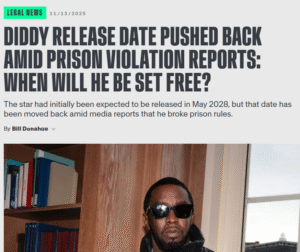
BUT…HE JUST ARRIVED AND NOW HE’S “ON THEIR RADAR!“
Case Update: Sean “Diddy” Combs
Legal & Compliance Insight
Sean “Diddy” Combs was convicted in July on two federal counts of transportation to engage in prostitution. He received a 50-month federal sentence, and while his original release date was May 8, 2028, the Federal Bureau of Prisons has since updated it to June 4, 2028, following reports of in-custody disciplinary issues.
Why This Matters for Clients
-
-
Reputation Risk: High-profile convictions demonstrate how quickly one could fall if they continue to act “entitled,” where nothing can touch them. The BOP is its Own Planet, with its Own Rules.”
-
Compliance Exposure: Even his current charge (and expected release date) Can Get Worse. The Bureau of Prisons can add years to his sentence (or transfer him) if he continues to disregard their rules.
- But, he apparently thinks he has some control and can do it: His Way. Nope,
-
He’s not related to (blue eyes) Frank Sinatra. Why is this special? Because Frank wrote and lived (that life) through his song: “I Did It My Way…“ Listen.
-
- He won’t get early release by being on the BOPs Radar – And Doing Time ‘His Way.’
b
My Take: Celebrities underscore the need for proactive client preparation, which includes the dos and don’ts of life inside.
At his upcoming appeal, will his Judge believe anything he has to say?
><
m
‘Battlefield-to-Prison,’ And Death Row.
Posted on Nov 10, 2025
l
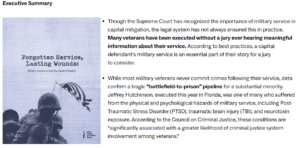
Forgotten Service, Lasting Wounds: Military Veterans and the Death Penalty
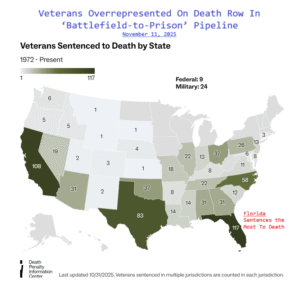
The Death Penalty Information Center (DPIC) reports that many veterans have been executed without juries being given meaningful information about their military service. Many of these veterans faced physical and psychological challenges, including Post-Traumatic Stress Disorder (PTSD), traumatic brain injuries (TBI), and exposure to neurotoxins.
Veterans are overrepresented on death row, with Florida using the Death Penalty more than any other state.
In 2025, the United States confronts a harrowing truth: this year stands as one of the deadliest for veterans on death row. With seven executions already carried out and three more on the horizon, veterans comprise a staggering 22% of all executions or pending warrants.
Despite representing only 6% of the U.S. population, veterans account for approximately 10% of those on death row—around 200 individuals across the nation. Since 1972, more than 800 veterans have been sentenced to death in 42 states, as well as in federal and military jurisdictions.
These courageous men and women have served in every major conflict since World War II, spanning all branches and ranks of the military. Many returned home bearing invisible wounds—PTSD, traumatic brain injuries, and other psychological scars that often go untreated. True justice transcends mere punishment; it demands a recognition of the profound and lasting effects of war, ensuring that the service of no veteran culminates in silence on death row.
><
k
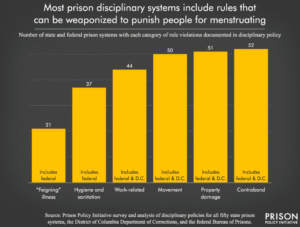
Menstruating in Correctional Facilities, Sometimes Ending in Mistreatment, Infractions (…Charges).
J
Combined with officer discretion, the general lack of oversight in prisons means even the most basic rules can be weaponized.
Property
The strict rules governing property provide an additional method for controlling possession, damage, and misuse.
Wasting state property. Poor quality menstrual products are typical in prisons and result in people needing to use more pads and tampons.
Misusing or altering state property. Incarcerated people often cope by finding ways to meet their own needs, including using makeshift materials as menstrual products.
People in prison lack sufficient access to menstrual products and often can’t proactively wear pads or tampons before their menses start.
V
Punishing people for menstruating is cruel and unnecessary, harming their self-esteem and mental well-being, with serious consequences in prison and after release.
{*Include in PSI Preparation}
RULES AND SANCTIONS TABLE
><
F
THE DC CORRECTIONS INFORMATION COUNCIL (CIC), 11.12.2025
An Organization Serving DC Residents Designated In The BOP.
This is another resource that supplements BOP.gov, often providing more up-to-date information that applies to everyone serving in a BOP Facility.
This update provides insight into:
f
k
Clemency Pay-to-Play? – LISA LEGAL; Update October 30, 2025
Jan. 1, 2025 – Nov. 10, 2025

Donald Trump’s approach to presidential clemency marked a sharp departure from historical norms, revealing a pattern in which loyalty and political utility often outweighed justice or rehabilitation. A striking number of his pardons and commutations went to close allies and associates—including Rudy Giuliani, Paul Manafort, and Steve Bannon—individuals whose personal or political connections to Trump were unmistakable.

Legal analysts argue that several of these pardons functioned less as acts of mercy and more as tools to shield the former president and his inner circle from accountability. By extending clemency to figures implicated in investigations such as the Mueller probe, Trump appeared to signal that loyalty would be rewarded—even at the expense of the rule of law.
The political overtones deepened after the 2020 election. Clemency increasingly served as a form of political currency, granted to those who advanced or defended Trump’s efforts to contest the election or minimize the January 6th insurrection.
Equally troubling was Trump’s near-total bypassing of the Department of Justice’s traditional review process through the Office of the Pardon Attorney. By dismantling institutional checks designed to ensure fairness and impartiality, Trump turned what is meant to be a constitutional safeguard for justice into a personal instrument of power and retribution.
d
Trump’s Pardon List: Donors, Allies, and Power Connections
Former President Donald Trump has issued 77 full, complete, and unconditional pardons, a list that prominently features political allies, loyalists, and major donors. Among the recipients are Rudy Giuliani, Mark Meadows, and Sidney Powell—all key figures in Trump’s efforts to overturn the 2020 election results.
Perhaps most striking is the full and unconditional pardon of Changpeng Zhao, the former Binance CEO who pleaded guilty to money laundering charges. Zhao’s company has documented ties to the Trump family’s cryptocurrency ventures, raising further questions about favoritism and the intersection of politics, loyalty, and financial interests.
Critics argue these pardons reflect a pattern of self-serving clemency, aimed at rewarding loyalty rather than advancing justice. Supporters, however, frame them as corrections to political overreach and prosecutorial bias.
J
A
D
D
11-10-2025
LISA LEGAL, Nov. 4, 2025
ANSWERS THE QUESTION: WHAT CONSTITUTES VIOLENT BEHAVIOR? TESTS THE IMAGINATION.
*
><
*
2025 Federal Sentencing Guideline Amendments Take Effect, November 1st.
G
><
*
FCI Milan’s program is unique to the Bureau of Prisons as it is the only high school located within a federal prison in the U.S. 11/6/2025
A
The FCI program, established in 1977 with a mere two students, has evolved into a dynamic educational initiative that now boasts a remarkable legacy of over 900 graduates.
Offering a diverse curriculum that includes life skills, traditional academics, fine arts, and industrial arts, this program is expertly guided by four certified teachers from Milan. Graduates receive a diploma equivalent to that of Milan High School, ensuring they are well-prepared to embark on their future endeavors.
At the core of the FCI program is a strong commitment to workforce development, with coursework based on the Michigan Merit Curriculum. In addition to earning their diplomas, students are equipped for high-level vocational training, such as Auto VT, or can seamlessly continue their educational journey through the Jackson College Associate Degree program, which is offered on-site.
A
In 2025, we proudly acknowledge the achievements of our students, as the program celebrated another milestone with 13 graduates last year alone. The FCI program not only transforms lives; it empowers students to pursue their ambitions with confidence and skill.
v
><
U
A 5K1 AGREEMENT CANNOT GUARANTEE HOW YOUR JUDGE WILL RULE AT SENTENCING
G

THE JUDGE SURPRISED EVERYONE
F
The sentencing hearing begins as expected. Both the defense and prosecution have agreed on a reasonable range. The defendant’s preparation has been thorough, and every step was taken in advance.
Preparation for the Presentence Interview was comprehensive:
- The probation officer received all requested materials well before the interview.
- A detailed autobiographical narrative provided context, accountability, and personal growth.
- Letters of support reflected strong family and community ties.
- Employment and reentry plans outlined a clear and stable path forward after release.
Even the prosecutor acknowledged the defendant’s substantial assistance, and, together with defense counsel, jointly recommended a sentencing range for the court to consider.
- Then, the judge imposed a sentence twice as long as everyone anticipated.
- There were no promises or guarantees, but the outcome still came as a shock to everyone involved.
Where Does This Leave the Client?
While the court’s decision is final, the work completed before sentencing remains important. Everything submitted during the Presentence Interview shapes the Presentence Report (PSR)—the document that follows the individual throughout their time in the Bureau of Prisons (BOP).
When preparation is comprehensive, it ensures the PSR reflects key details that can positively influence the client’s experience and opportunities while incarcerated:
- RDAP eligibility verified and included, when applicable.
- A specific facility placement request emphasizing appropriate rehabilitative programs, ideally supported by the court.
- Letters of support confirming good character, safe and supportive post-release housing, and verified employment opportunities.
- A clear understanding of the First Step Act (FSA), Second Chance Act (SCA), and Good Time Credit (GTC) provisions—combined with an authentic autobiographical narrative—equips the client to allocute confidently before the judge.
Even when the sentence itself is unexpectedly harsh, these proactive measures help the client move forward with purpose. They provide a foundation for rehabilitation, potential sentence reductions, and a smoother transition home.
A Final Thought
- Prison is temporary. Preparation, personal growth, and planning for reentry are what last.
- At Physician Prison Consultants / PPRSUS, we remind every client and attorney we work with that while there are no guarantees or promises, thorough preparation before the Presentence Interview remains the single most effective step toward improving what happens next.
THE HAIL MARY, A PRESIDENTIAL CLEMENCY
This all depends on Relationships with the White House.
- Who do you know,
- How much money can you ‘donate’? Etc.
- Clemency is while you’re incarcerated; Pardons are given five years post-release.
><
FEDERAL LEGAL NEWS (FLN) 11-3-25
TOPICS
- Pattern of Abusive Medical Care:
- Why Aren’t All Prisoners Over the Age of 60 or Those with Serious Chronic Problems Filing for Compassionate Release?
- Institutional Roadblocks to Proper FSA Calculations, Timely Release Measures
- Bugs Invade Alderson
- “Strawberry Danish Caper”
MEDICAL CARE
- The FBI has raided multiple institutions, including FCI Dublin, FMC Butner, and FMC Carswell, seizing computers and documents. Investigations have uncovered neglect in medical treatment, with staff omitting crucial information from medical charts, facing little risk of consequences. Chronic issues, including a lack of staff and funding, as well as delayed payments to outside medical specialists, contribute to this ongoing neglect that has persisted for over two decades.
- During the COVID crisis, thousands of elderly and chronically ill prisoners were released to supervised home confinement, with a recidivism rate below 5%. This suggests that similar releases could be successful under the supervision of the US Department of Probation.
- Compassionate release filings can be based on serious, untreated illnesses or a diagnosis of fatal illnesses. Eligible prisoners under 18 U.S.C. § 3582(c)(1)(A)(i) typically serve unusually long sentences, leading to a higher likelihood of becoming elderly, unhealthy, or disabled while incarcerated (U.S.S.G. § 1B1.13(b)(6), Nov. 1, 2023).
Institutional Roadblocks
- Case Managers are still not combining their FSA and SCA benefits, or, in the case of SCA-only prisoners, not granting them the whole year that the statute permits.
Bugs Invade Alderson
- “There has been a reported outbreak of bug bites that seem to cause itching and leave scabs afterward. The medical team has assessed the situation and determined it is not a significant concern at this time.”
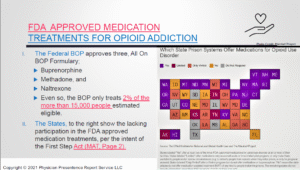
The MAT program is in my PSR.
- I’m at FCI Ray Brook and struggling with opioid addiction. I’ve tried for over a year to get into the MAT program, but I’m told I need to be 90 days to the door, only to be met with excuses about staffing issues. It’s incredibly frustrating.
“Strawberry Danish Caper”
- In May 2024, the food service bought around 3,000 strawberry Danishes for inmate breakfasts. Yet, by June 2024, inmates could buy them for $1.50 each???? They apparently were never served at breakfast..
Derek Gilna, Director of Research, JD, (De Paul Law School, 1975), MARJ, (Vermont Law School, 2020), Federal Legal Center, 133 W. Market, #171, Indianapolis, IN 46204; flcjustice@yahoo.com, in Spanish; federallc_esp@yahoo.com
><
S
The DOJ’s New Enforcement: Data-Driven Era in Health Care Fraud
v
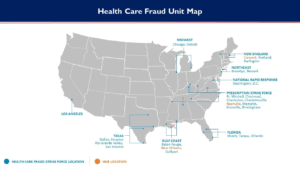
The Department of Justice’s Enforcement & Affirmative Litigation (EAL) initiative is reshaping how health care fraud is detected and prosecuted.
At its core, the Fraud Section’s Health Care Fraud Unit remains focused on two missions:
- Protecting taxpayer-funded healthcare programs, such as Medicare, Medicaid, and TRICARE.
- Protecting patients from fraudulent schemes that cause real harm, including the overprescribing of controlled substances.
A More Integrated, Data-Driven Approach
The DOJ’s new enforcement arm emphasizes an “integrated, data-driven, and swift” strategy that extends beyond traditional False Claims Act (FCA) cases. Enforcement now reaches into the life sciences industry, managed care organizations, private equity investments, and fintech-enabled health services — sectors where complex financial and data systems can obscure fraud risk.
Centralizing High-Impact Litigation
The EAL’s mission to “centralize high-impact affirmative litigation capabilities” means more efficient case selection and faster pursuit of credible leads. The goal: streamline investigations and maximize the impact of enforcement actions.
The Strike Force Model: Data Analytics at Work
At the heart of this approach is the Strike Force Model, which utilizes advanced data analytics and algorithmic tools to uncover fraudulent activity. This includes:
- Assessing scienter standards and causation frameworks in Anti-Kickback Statute cases.
- Evaluating inducement evidence and remuneration valuation across marketing practices, consulting arrangements, and “value-add” incentives.
- Examining medical necessity disputes and upcoding patterns through peer-comparison and physician-level outlier analysis.
Medicare Advantage Under Scrutiny
A central focus area is Medicare Advantage (MA). The DOJ is leveraging advanced analytics to review chart documentation, diagnosis coding, and risk adjustment data. These tools help identify inflated risk scores, unsupported hierarchical condition categories (HCCs), and retrospective coding initiatives that may distort program payments.
Litigation Starts Civil, Do Not Let It Turn Criminal
><
f
Fugitive tolling and federal supervised release
The SCOTUSblog By Richard Cooke, 10/29/2025
The fugitive-tolling doctrine: Rico v. United States,
- The legal principle stipulates that a criminal defendant shall not receive credit towards their sentence for the duration spent as a fugitive. This principle is applicable when a defendant absconds from supervised release, thereby interfering with the expiration of the supervision period while the defendant remains evading law enforcement.
- Rico understands that under 18 U.S.C. § 3583(i), the district court could revoke her supervised release for absconding and drug use, leading to imprisonment and a new supervision term.
l
><
l
l
S. 2899 The ‘‘Prison Camera Reform Act of 2021’’
- It is imperative that the Director of the Bureau of Prisons takes immediate action to rectify existing deficiencies and implement essential upgrades to the security camera and radio systems. These enhancements are crucial for safeguarding the health and safety of both employees and inmates within our correctional facilities. Senator Jon Ossoff.
K
><
D
THE SENTENCING PROJECT, 10/29/2025
THIS STARTS WITH INDIVIDUALS MOBILIZING TO VOTE
- Disenfranchisement of people with felony convictions and changes to U.S. laws.
- Electoral engagement among justice-impacted people – Barriers to electoral participation for eligible justice-impacted people.
- Pathways to voting for eligible justice-impacted people
Travis County peer support specialist
- Former Grassroots Leadership lead organizer for “Fighting Injustice at the Ballot Box”
><
P
FCC draft increases rate caps by as much as 83 percent for phone and video calling, 10-7-2025
FOR MORE OF THESE CHANGES,
- What new rates does the FCC propose?
- How does the FCC justify increasing rates after adopting lower rates last year?
- What else does the FCC propose to do?
- Do the FCC’s actions comply with the law and fair process?
- RULING ON PAGE THREE
D
D
11-3-2025
D
Front-End Loader – Update for October 28, 2025
f
RELEASE DATE
The release date of a prisoner is crucial for the Bureau of Prisons (BOP) because it affects facility placement, program eligibility, and the timing for transitioning to a halfway house or home confinement under 18 USC § 3624(c) (the Second Chance Act). The BOP has typically calculated the “statutory” sentence by assuming that prisoners will earn all possible good conduct time—54 days per year, as specified in 18 USC § 3624(b).
- However, prisoners can lose this time for rule violations, such as possession of a cellphone, which is a serious (high-severity prohibited act) offense. To address these concerns, the BOP is now using a new metric called the FSA Conditional Placement Date (FCPD) to manage inmates, allowing for the front-loading of Federal Time Credits (FTCs) like good conduct time (GCT).
- The new FCPD date assumes inmates will continue earning FTCS monthly and indicates when they may qualify for a halfway house, home confinement, or release based on earned time credits.
- This change aims to streamline inmate placement in lower custody levels, improving access to vital programs like residential drug abuse treatment. It will also prevent last-minute transfers that can complicate paperwork and housing arrangements, supporting smoother transitions and effective rehabilitation.
FSA LIMITED FOR NON-U.S. CITIZENS
- Congress mandated that earned time credits be used for prerelease custody or supervised release, subject to specific eligibility criteria.
- A memo on January 30, 2025, instructed prison officials to cancel prerelease placements for non-citizens with active detainers, except for permanent residents (Adepoju v. Scales). It allowed up to 365 days of credits for early supervised release but prohibited them for home confinement or halfway houses. This policy was reaffirmed on April 8, 2025, requiring the transfer of non-citizens with detainers back to secure institutions unless otherwise permitted by court order or settlement.
G
AN OVERVIEW OF THE FIRST STEP ACT
- Reduction in Recidivism
- Incentives for Success
- Confinement
- Correctional Reforms
- Sentencing Reforms
- Oversight
><
g
Director Prioritizes Timely Reclassification and Designation Process;

From FPC Alderson: “There has been a lot of speculation that by Nov 1, starting with white collar, they would be sending minimums to home confinement.”
p
A Very Clear Explanation of Your “Conditional Placement Date” From The BOP.
The Date You Could Be Eligible for Early Release.
10/2025.
D
J
“Conditional Placement Date” Assumes New Importance;
- “To ensure complete alignment with this statutory framework, the BOP is updating its approach to classification and designation decisions.
- Staff will now utilize the FSA Conditional Placement Date (FCPD), aka: the time credit worksheet, as the anchor for key inmate management decisions for those eligible to earn and apply FSA time credits under 18 U.S.C. § 3632(d)(4).
- The BOP has introduced a new metric called the FSA Conditional Placement Date (FCPD) to guide inmate management decisions.
- Front-loading FTCs in the same way they front-load Good Conduct Time.
- Unlike the previous Projected Placement Date, which only considered credits earned up to a specific date, the FCPD Assumes,
- That inmates will continue to earn their GTC and FSA Earned Time Credits each month.
- This change means that the FCPD will determine eligibility for halfway houses, home confinement, or supervised release, influencing security classifications and facility placements.
- As Walter Pavlo noted in Forbes, this shift marks a significant cultural change, recognizing earned time credits as a key factor in inmates’ movement through the system.”
- Still, ”In the BOP, the devil is in the details.”
F
FEDERAL LEGAL NEWS (FLN) 10-27-25
F
BOP Medical Care Through The Eyes of Ret. Correctional Officials Still Cause Unnecessary Suffering;
- The Director also wishes to prioritize medical staff hiring, but that is only part of the problem.
- Just scheduling but not providing care, or the wrong care, is closing in on malpractice.
- Individuals with deteriorating chronic conditions, including aggressive cancers, are going untreated.
- Even Federal Medical Centers (FMC), For Example, DEVEN FMC
- In the end, Compassionate Release/Second Look Act or A Civil Malpractice Suit (Difficult)…
- Inspection of the Federal Bureau of Prisons’ Federal Detention Center SeaTac
D
In medicine, healthcare negligence is medical malpractice, and medical malpractice is negligence.
S
D
D
S
MAT programs, which Congress designed to treat the thousands of street drug addicts in federal prisons.
BOP facilities are not equipped to chemically detox individuals due to shortages of medication supplies and staff.
A
q
- Incarcerated people are reporting that the abrupt changes are wreaking havoc on their health and mental well-being. By Pam Bailey, Truthout, March 26, 2025
L
Granting 12 months of Second Chance Act Halfway House/Home Confinement for Non-FSA Eligible Prisoners;
- Getting a substantial halfway house placement under the Second Chance Act (SCA) is NOT optional.
- If your sentence is > 60 mo. (5 yrs) = 6+months on home confinement.
- If your sentence is < 60 mo. (5 yrs) = last 10% on home confinement.
><
K
u
Director Marshall is looking for wardens who care, have social skills, and are willing to implement the mission of his FSA Task-Force.
- “The future of the Bureau hinges on our leadership choices. Wardens not only manage institutions but also shape culture and expectations. For too long, we’ve used the same hiring practices and expected different outcomes. This will change now. Selecting Wardens is crucial, and we need to elevate the standard. That’s why we’ve partnered with Precythe, Sturm Advisory Group (PSAG) to assist in the selection process.”
Derek Gilna, Director of Research, JD (De Paul Law School, 1975), MARJ (Vermont Law School, 2020), Federal Legal Center, 133 W. Market, #171, Indianapolis, IN 46204; flcjustice@yahoo.com, or (not both) flctruth@yahoo.com, and for Spanish, federallc_esp@yahoo.com.
a
*
10-27-2025

In medicine, healthcare negligence is medical malpractice, and medical malpractice is negligence.
o
Under the Federal Tort Claims Act (explainer here), inmates can bring a negligence action against federal officers or employees. Proving negligence is much easier than proving deliberate indifference, which is why keeping meticulous records of all of your interactions by date, date, time, and name, in a formal journal or any other means, can make the difference.
- The malpractice suit must be filed in the state where the negligence occurred. The lawsuit is assessed under state malpractice laws, even when filed in federal court. Most states require plaintiffs to include an expert’s affidavit with their complaint, outlining the standard of care and asserting that the Bureau of Prisons (BOP) physician or nurse failed to meet that standard, thereby constituting a serious breach of duty, aka: “affidavits of merit.”
Getting an expert’s affidavit is a challenge while you’re in prison. If you had a second opinion and the BOP chose not to follow it, then you may have this covered. If you hire one, that cost could run into the thousands.
l
Erie Railroad Co. v. Tompkins (1938) is a landmark Supreme Court case that ruled there is no general federal common law. Federal courts must apply state substantive law in civil cases that don’t involve federal questions, but can still use the Federal Rules of Civil Procedure. The decision is considered a cornerstone of American federalism.
At the Supreme Court hearing in Berk v. Choy, Case No 24-440, several justices questioned whether Delaware’s rule requiring an affidavit of merit to file a medical malpractice lawsuit fits with how federal courts are supposed to work.
- Justice Elena Kagan said the rule goes against the idea behind the Federal Rules of Civil Procedure, which are meant to make filing a lawsuit simple — you state your claim and move forward, without extra paperwork.
- Justice Ketanji Brown Jackson agreed, pointing out that under federal law, a case officially starts when the complaint is filed, and no affidavit is needed.
- Justice Sonia Sotomayor noted that Delaware’s rule also delays when defendants have to respond, which conflicts with federal rules that require an answer within 20 days.
- The defendant hospital argued that federal courts shouldn’t throw out a whole state law just because some parts don’t match federal rules.
- But Justice Neil Gorsuch pushed back, saying that trying to apply only parts of the Delaware law would create a “Frankenstein” version of it — something federal courts aren’t allowed to do.
The Supreme Court is now revisiting this issue in Berk v. Choy, which asks whether Delaware’s affidavit of merit rule for medical malpractice cases is procedural (and thus not required in federal court) or substantive (and therefore binding on federal courts).
A ruling invalidating the affidavit-of-merit requirement would be a major victory for inmate FTCA filers. Berk v. Choy, Case No 24-440 (argued October 6, 2025)
**While I’ve summarized the main points as accurately as possible, I encourage you to review the full article to fully appreciate its context and nuances.
k
><
D

You Should Have Told Me That…
October 24, 2025
People who pull such scams should keep their employees happy. While the company made over $4 million, an unhappy employee started a qui tam claim, which, if proven, would result in a financial reward.
The day after the couple pled guilty in 2016, the Government took over the qui tam action from the employee under the False Claims Act. Guilty pleas can lead to prison, fines, and reputational damage, but they can also be used in civil actions.
Nita Patel (Nita) filed a 28 USC § 2255 asserting that she was never told that her guilty plea could be used against her. The 3rd ruled that Nita, despite completing her prison sentence and supervised release, still met the § 2255 “in custody” requirement due to significant collateral civil consequences from her conviction.
Nita asserted that her attorneys should have advised her that the guilty pleas could also affect her civil liability.
Her attorneys were not at fault, but a heads-up would have been nice.
p
s
><
k
o
‘All Work And No Pay’ For BOP Employees
October 23, 2025

The State reported that “many staff members were already living paycheck to paycheck.”
“The shutdown will leave many federal prison guards unable to pay mortgages, car payments, or afford groceries and gas. Many are single moms or caregivers facing medical bills and rising living costs. ‘Creditors don’t want to hear it,’ Coleman said.”
During the 2019 shutdown, the BOP provided employees with a letter for creditors. This time, no such letter has been given.
k
f
The impact of the Government Shutdown on inmates and staffing alike.
Before the lockdown, it was evident that the BOP Correctional Staff were already short-staffed. To address this, staff members, such as teachers and medical personnel, were substituted to cover the staffing shortages. Unfortunately, this has resulted in delayed or denied medical care, as well as increased waiting lists for FSA programming, with some programs temporarily shut down.
p
p
p

*
Parole in Perspective takes a deep dive into the laws and regulations governing these systems, the decision-making criteria they rely on, and the data on releases.
- Few studies have examined racial and gender disparities in parole decisions. However, research from South Carolina and California shows that Black individuals are significantly less likely to be granted parole than their white counterparts.
- A study on parole transcripts for women incarcerated for homicide related to intimate partner violence found that mentioning their experiences of violence during hearings made it less likely for them to be granted parole.
- Check out their section of our Research Library dedicated to parole and probation issues.
p
Probation and parole are often pathways back into incarceration.
Staying in compliance with dozens of high-stakes, arbitrary rules is so unmanageable that experts call community supervision systems “a deprivation of liberty in their own right.”

The MacArthur Justice Center developed 16 guiding principles to make parole a successful tool for decarceration.
—Leah Wang, Senior Research Analyst
><
j
P
FEDERAL LEGAL NEWS (FLN) 10/20/2025
BOP’s PATTERN System of Scoring,
- Designed to deny First Step Act (FSA) sentence credit for arbitrarily-designated “medium” and “high” recidivism outcomes.
l
INEFFECTIVE COUNSEL.
In Baker v. US, No. 23-2059 (3d Cir. July 25, 2024)
- Filling a motion under Section 2255, claiming ineffective assistance from his attorney, led to a miscalculation of his sentence exposure during plea negotiations. The District Court denied relief, citing a lack of prejudice. However, due to the significant disparity in sentence exposure and Baker’s testimony, he would have accepted the plea deal; he demonstrated substantial prejudice. We overturn the District Court’s ruling and remand for further consideration.
- The issue highlighted in our past newsletters is that the BOP has incorrectly classified certain offenses, including 922g—deemed non-violent by the Supreme Court—as ineligible for FSA. The LOPER Bright decision has overturned the CHEVRON ruling, allowing more challenges to the Bureau’s interpretations of Congressional statutes. This means the Bureau can no longer arbitrarily limit RDAP eligibility, SCA placements, or delay FSA releases without facing potential legal challenges.
p
BOP PREA Complaints Backlogged
In December 2022, a Senate report revealed a backlog of about 8,000 PREA-related internal affairs cases within the BOP, noting that the agency does not publicly disclose this issue and that its failures endanger inmates, especially women.
Derek Gilna, Director of Research, JD, (De Paul Law School, 1975), MARJ, (Vermont Law School, 2020), Federal Legal Center, 133 W. Market, #171, Indianapolis, IN 46204; flcjustice@yahoo.com, OR (not both) flctruth@yahoo.com, or in Spanish: federallc_esp@yahoo.com,
><
h
Judge partially grants Fort Dix inmate’s bid for prerelease custody review
s
><
a
a
New Policy: A Win For Staff And Prison Reform
- The Devils In The Implementation – Responsibility Shifts to Staff
Staff will use the FSA Conditional Placement Date (FCPD), also known as the time credit worksheet, as the anchor for key inmate management decisions for eligible inmates to earn and apply FSA time credits.
- Inmates will be placed in appropriate custody levels sooner.
- Earlier reclassification enables timely transfers to lower security facilities.
- FSA-eligible inmates will be based on their Conditional Placement Date.
- Initiate placement to lower security levels.
d
Caveat
- BOP Case Managers’ Responsibility Increases, as
- They Lose Their Union, and
- Are Understaffed.
- We all hope they get the support that they need.
S
p
p
Prison Reform After Years of Advocacy by Tzedek
l
><
D
DFCC COLEMAN
S
d
m
10/20/2025
B
First Circuit Requires District Courts to Address:
- Rehabilitation—In Combination with Family Circumstances,
- When Ruling on Compassionate Release under Amended U.S.S.G. §1B1.13
What’s Important;
- A 20 Year Sentence, with Demonstrated Rehabilitation, and a need for Compassionate Release Will Work.
Another example;
Dana M. Douglas, Circuit Judge:
- The U.S. appeals the compassionate release of Joel Francois Jean, which the district court granted due to his extraordinary rehabilitation and a significantly shorter sentence if imposed today. We AFFIRM, finding no abuse of discretion.
Why and How?
- On the day of his trial, Jean pleaded guilty to conspiracy to possess cocaine and possession of a firearm.
- He was ultimately sentenced to 292 months.
He has been incarcerated in Texas since 2009.
In 2023, Jean filed a motion for compassionate release pursuant to § 3582(c)(1)(A)(i), arguing that three reasons:
1st, at issue on appeal, Jean argued that non-retroactive changes in the law
2nd, his sentence was unjust because it was longer than that of his co-defendants, convicted of more heinous offenses.
3rd, Jean argued that his post-sentencing conduct and rehabilitation favor compassionate release.
l
REHABILITATION.
- As soon as Jean began his 292-month term of imprisonment, he worked with fervor toward self-improvement.
At his PSI, he told the officer that “He’s sorry for the situation he caused and plans to change his thinking and choices about his associates to prevent it from happening again.”
The district court valued letters from BOP officials supporting Jean’s release. A BOP manager noted:
- I have over 20 years of experience with the Federal Bureau of Prisons, and I rarely see inmates focused on self-improvement after admission. Jean is a “valuable and indispensable asset,” educating himself and others as he prepares to re-enter society.
- Another supervisor with two decades in corrections called Jean a potential “vital spokesman and shining example to thwart recidivism.”
q
S
10-21-2025
PRESIDENT TRUMP MAKES BOP DESIGNATION DECISIONS
S
C
David Fathi, director of the ACLU’s National Prison Project—which represents 21 inmates—stated that none met the criteria for ADX placement under the BOP’s Program Statement 5100.08, Inmate Security Designation and Custody Classification Manual. He noted, “None of our plaintiffs were designated for ADX. Under Attorney General Bondi, all have been slated for ADX not due to security concerns, but rather to inflict maximum suffering.”
C
DJ
N

C
“People should be very concerned about the president and attorney general’s disregard for the law in this case,” Fathi said.
“Today, it may be people who are very unpopular. Tomorrow, it could be anybody.”
s
Wall Street Journal, Biden Spared 37 Killers From Execution. Trump Ordered Up a Lifetime of Torment (October 11, 2025)
Bureau of Prisons Program Statement 5100.08 CN-2, Inmate Security Designation and Custody Classification Manual (March 5, 2025)
~ Thomas L. Root
><
N
10/2025
…PART OF THE WH PLAN?
FUNDING FOR THE JUDICIAL BRANCH HAS LAPSED. SOME CASES WILL BE DELAYED, DETERMINED BY FEDERAL JUDGES AND THEIR STAFF – WORKING WITH NO PAY.
G
*
*
ANOTHER SENTENCE COMMUTED
HIS MOST FAVORITE RADIO STATION: W.I.I.F.M.
“WHAT’S IN IT FOR ME?”
Maya Angelou – “When someone shows you who they are, believe them the first time.”
S
PARDONS, CLEMENCY, and SENTENCES COMMUTED IF YOU’RE CHOSEN; THE PRICE,
You’re Found Guilty and have Something To Offer…
G
Santos stipulated that he had engaged in the following additional criminal conduct,
The Credit Card Fraud Scheme
- Falsely represented his FEC filings.
- He then repeatedly charged contributors’ credit cards without their authorization.
- Santos sought out victims he knew were elderly persons suffering from cognitive impairment or decline.
Fraudulent Political Contribution Solicitation Scheme
- He defrauded prospective political supporters by accepting the funds
- The transferring them into his personal bank accounts, and in one instance, was laundered through two of Santos’s personal accounts.
Unemployment Insurance Fraud Scheme
- COVID-19 PPP Loan Fraud
False Statements to the House of Representatives
d
D
><
October 2025: The justices consider Restitution
In Ellingburg v. United States, the justices will decide if the ex post facto clause applies to the Mandatory Victims Restitution Act. If it does, Holsey Ellingburg’s restitution will be limited to the amount required at the time of his bank robbery; if not, he may face stricter federal laws.
- Ellingburg argues that his restitution obligation is criminal, established during sentencing by the trial judge. He points to the statutory framework, emphasizing that the restitution amount is determined at sentencing and follows criminal procedures.
- Highlighted is the significance of sanctions for unpaid restitution, with immediate incarceration for defendants who disregard restitution orders—unlike civil disputes. The Mandatory Victims Restitution Act (MVRA) designates restitution as serving “punitive purposes,” and the Supreme Court views it as a criminal sanction.
- The outcome seems predetermined, with the government admitting that MVRA restitution is criminal under the ex post facto clause.
9/16/2025 NACDL released: How Federal Restitution Law Fails Everyone
L
G
a
10-14-2025
L
FEDERAL LEGAL NEWS (FLN) 10/13/2025
The use of tablets may be soon.
Correspondence from Coleman Low:
- “Medical pill line is telling us they are not doing prescription refills due to the government shutdown. People are going to start dying soon. Look at what happens when you stop heart medications and blood pressure pills abruptly.” Only time will tell.
FSA SCA Task-Forces’ effort at Recalculating ETC is still a “work in progress,” meaning thousands are kept past their proper “out” dates. The associated “backlog” of uncalculated credits is causing frustration among inmates, as staff are left to confront their disappointment at being housed longer than necessary.
The BOP “drug treatment,” or BOP MAT program.
- RDAP, in some facilities – shortly after it became law, began denying the (up to) one-year sentence credit for those who had a firearms conviction ANYWHERE in their criminal backgrounds, not just in their current offense.
- A LOPER Bright-based challenge may be in its future.
s
*
RDAP Disqualifying
- Sections 2250, 2251, 2251A, 2252, 2252A, 2260, 2283, and subparagraphs (A)(i) or (B)(i) of section 401(b)(1) of the Controlled Substances Act (21 U.S.C. 841(b)(1)), or paragraph (1)(A) or (2)(A) of section 1010(b) of the Controlled Substances Import and Export Act (21 U.S.C. 960(b)), related to manufacturing, distributing, or possessing with intent to handle a detectable amount of heroin.
But only if the sentencing court finds that the offender was an organizer, leader, manager, or supervisor,
- Subparagraph (A) or (B) of section 401(b)(1) of the Controlled Substances Act (21 U.S.C. 841(b)(1)) or paragraph (1) or (2) of section 1010(b) of the Controlled Substances Import and Export Act (21 U.S.C. 960(b)), regarding manufacturing, distributing, dispensing, or possessing a controlled substance, or importing or exporting it, if the court finds that: (I) the offense involved a detectable amount of N-phenyl-N-[1-(2-phenylethyl)-4-piperidinyl]propenamide or its analogues; AND (II) the offender was an organizer, leader, manager, or supervisor in the offense.
- The designation of “Leader, Organizer” is key.
Derek Gilna, Director of Research, JD, (De Paul Law School, 1975), MARJ, (Vermont Law School, 2020), Federal Legal Center, 133 W. Market, #171, Indianapolis, IN 46204; flcjustice@yahoo.com, or (not both) flctruth@yahoo.com, and in Spanish: federallc_esp@yahoo.com
N
d
Allegations of Misconduct in the BOP…
9-30-2025
The predominant types of misconduct allegations are centered around unprofessional behavior and violations of policy, with instances of profane language and harassment surfacing frequently within prison environments.
Other significant concerns included absenteeism and defiance of supervisors’ directives, particularly regarding mandatory overtime. Though these actions may not be classified as criminal, they have the potential to undermine workplace culture and severely deplete valuable resources. Alarmingly, criminal misconduct accounted for approximately 14% of all allegations from 2014 to 2024.
This disturbing trend encompassed grave incidents of physical and sexual abuse, exemplified by the closure of a federal prison in California in 2024 due to serious accusations of staff abuse against incarcerated women.
WatchBlog: Following the Federal Dollar
My Opinion. Time will tell if removing the BOP employees’ union will help or hinder Director Marshall’s II efforts to turn around this agency.
He is facing,
- BOP Employees who are understaffed (at times with mandatory overtime) and whose pay for some is below that found in the private sector.
- A Crumbling Infrastructure
- FSA Task-Force, where some staff still do not believe it’s mandatory.
l
*
This Is A Prison Problem – Not Only A Connecticut Problem
9-29-2025
Overdose deaths within prisons have surged alarmingly due to both illegal drugs and prescribed medications. The rise of synthetic drugs like K2 has worsened this crisis, posing significant risks to inmates and staff. K2, a synthetic opioid blend, is difficult to detect when smuggled inside. Once in the facility, it can cause severe reactions, including paranoia, seizures, and loss of control. Correctional systems face the twin challenges of preventing drug infiltration and providing essential treatment for those in need.
m
v
Federal Legal News (FLN)
10-6-25
Terminating the Council of Prison Locals
The end of union protections allows employees to be terminated for failing to follow BOP policies and procedures. While this has been an ongoing issue regarding FSA Implementation, a large part of the blame can be attributed to a lack of direction from Grand Prairie, TX, to Case Managers.
Compassionate Release Still Effective Even Without Retroactivity
The 2025 US Sentencing Guideline changes, which take effect on November 1, 2025, show promise for supporting petitions for sentence reduction without including Retroactivity.
The proposed amendment addresses key issues such as the roles of offenders, the varying purity of methamphetamine, fentanyl misrepresentation, machinegun enhancements, and safety valve eligibility. The amendment addresses public health crises like the opioid epidemic by promoting rehabilitation for low-level offenders and prioritizing reform over punishment. It also recognizes compassionate release for those who demonstrate significant changes in circumstances or character.
Second Chance Act Review: Advocates Make Argument for Compassionate Release Based upon Inadequate and Non-Existent BOP Medical Care
The failure of BOP employees to follow policies and procedures could justify a compassionate release if a prisoner’s safety or health is compromised. Examples include medical staff downplaying serious illnesses and inadequate treatment, which violates federal medical records law (in how they write their SOAP Note, vs treatment provided) and can lead to suffering or even death.
For those unable to use FSA for sentence reduction, the Second Chance Act (SCA) applies to all citizens on supervised release, regardless of offense or sentence length. Despite having resources, the Bureau failed to increase halfway house bedspace as required. The BOP Director’s June 2025 memo established policies to enhance sentence reduction during release placement, stating:
- FSA Earned Time Credits and SCA eligibility can accumulate, enabling qualified individuals to serve parts of their sentences in home confinement.
- Placement decisions will prioritize stable housing and community readiness, not past employment.
RRC bed capacity will not hinder home confinement for those eligible.
The CR filings highlight the threat to prisoner health resulting from the apparent Bureau of Prisons (BOP) incompetence.
The medical treatment approach in the Bureau of Prisons (BOP) appears to focus only on relieving symptoms. The petitioner claims he hasn’t received the necessary standard tests that would typically be administered outside of prison, leaving him unable to assess whether his health is deteriorating. His concerns stem from his own physical condition and discussions with other inmates, revealing that inadequate testing and treatment are widespread in the BOP.
If federal prisons only provide care for immediate symptoms and neglect the needs of cancer patients requiring regular testing, it could be considered malpractice. For example, individuals needing follow-up tests to check for cancer recurrence or those with brain tumors may not receive the necessary monitoring while incarcerated in the Bureau of Prisons (BOP). This seems to reflect a systemic policy problem.
Failed Suicide Prevention Test
A study published in BMJ Public Health revealed that the suicide rate in federal prisons rose from 10.57 per 100,000 individuals in 2009 to 19.01 per 100,000 in 2020. Notably, in 2020, the age-standardized suicide rate in federal prisons exceeded that of the general U.S. population for the first time.
Derek Gilna, Director of Research, JD (De Paul Law School, 1975), MARJ (Vermont Law School, 2020), Federal Legal Center, 133 W. Market, #171, Indianapolis, IN 46204; flcjustice@yahoo.com, OR flctruth@yahoo.com or Spanish; federallc_esp@yahoo.com.
d
10-7-2025
N
Ellingburg v. United States, which asks whether mandatory restitution constitutes criminal punishment such that the Constitution’s ex post facto clause would prohibit it, will be argued on October 14. 10/6/2025
Placement Within 500 Miles of your Legal Residence
Myth. The First Step Act requires that the BOP place someone within 500 driving miles of their home, which is incorrect. Instead, it says that the BOP shall place the prisoner in a facility as close as practicable to the prisoner’s primary residence, and to the extent practicable…
According to the fine print in 18 USC § 3621(b), Congress specified that placement is subject to factors such as bed availability, the prisoner’s security designation, programmatic needs, mental and medical health needs, any faith-based requests made by the prisoner, recommendations from the sentencing court, and other security concerns. This demonstrates that the policy is more complex than it may initially appear.
DOJ OIG Report 9/25/2025
j
d
SEAN DIDDY COMBS, HIS RISE AND FALL
From Indictment, To Trial, And Sentencing. Defense by Attorney Teny Geragos and their team. https://lnkd.in/ek_RdDJh
><
Diddy’s Day In Court:
- Four Years and 2 Months.
- The Prosecution wanted an 11-year prison term.
How long will he serve?
- He will immediately get credit for the 12 months he spent at the Metropolitan Detention Center (MDC) in Brooklyn.
- The Drug Program (RDAP), nope, due to Violence.
- GOOD Time Credit: 54 days per year or a little over 216 + 9 (for the 2 months) = 225 days.
The First Step Act (FSA):
- After 26 months, he may be eligible for 300 days off his sentence.
Second Chance Act (SCA);
- 10% on Home Confinement
Judge Subramanian
While Combs was not convicted on sex trafficking and racketeering charges, the judge referenced;
- The federal Mann Act, which criminalizes transporting people across state lines for prostitution. https://lnkd.in/eNuWBHC7
- “The drugs may have exacerbated your erratic and violent behavior over the years. However, the court has to consider all of your history here,” Judge Arun Subramanian told Sean “Diddy” Combs.
- Did the judge consider Public Safety Factors? It appears so.
- He also must pay a $500,000 fine.
His Counsel promises an Appeal.
- Brian Steel told CNN he thinks the sentence “sends the wrong message” and argued Combs was sentenced for conduct the jury did not find him guilty of.
><
His Sentencing is tomorrow, 10/3/2025.
- He’s facing Counts 1-3, but to his judge, here he has to make a Great First Impression.
- So far, he has excellent counsel, but tomorrow he will have his chance to address the judge.
His positive actions in jail are exemplary, but hopefully, he has been coached and prepared for his most significant performance – requesting leniency, without using those words.
d
d
HEALTHCARE PROVIDERS ARE THE DOJ’S NUMBER ONE TARGET, AND THAT INCLUDES TELEMEDICINE
g

Telemedicine must involve a genuine patient-provider interaction; the absence of a video encounter with “the patient” undermines its effectiveness and is just what the DOJ is looking to prosecute.
p
My Opinion Here.
- This specific medication should not be the focus of this charge.
The federal case challenging the safety of mifepristone, which is used to treat miscarriages and to induce early abortions, is being transferred from Texas to federal courts in Missouri, Kansas, and Idaho.
p
g
o
USP-Big Sandy Conspiracy to Brutalize Prisoners – Sentencing set for November 2025.
p
The conspiracy involved an associate warden and a guard captain, E.E. and M.D.
- On January 24, 2025, former BOP guard Lt. Terry L. Melvin pleaded guilty to inmate assaults, describing them as a “commonplace occurrence” at the facility.
- He revealed an unofficial policy that allowed these assaults to reduce the number of prisoners in protective custody (PC). When inmates requested PC, they faced a grim choice: fake an assault to trigger violence and a transfer or withdraw their request and remain vulnerable in the general population.
- BOP reaffirms its commitment to eliminating staff-on-prisoner violence. Melvin faces up to 10 years in prison for violating a prisoner’s Eighth Amendment rights and conspiring to infringe on civil rights, with sentencing set for November 2025. See: United States v. Melvin, USDC (E.D. Ky.), Case No. 7:25-cr-00001
f
k
TYLENOL AND THE WRONG INFORMATION RELEASED
This provides false and dangerous information to the public.
- Wrong Information (with no studies supporting their claims) to Pregnant Women (who should listen to their OBGYN), and not HHS, NIH, and FDA.
- This could also lead to baseless lawsuits against Tylenol, forcing them to defend themselves against unmerited claims that are being spread.
U.S. Senator Bill Cassidy, M.D. (who unfortunately appointed RFK to his position), expresses support for President Trump’s efforts to address this issue and to support the Health and Human Services (HHS). HHS should release the new data it has to substantiate this claim. The Majority of Evidence Indicates that This (TRUMP) Is Not Accurate!
p
Trust in HHS, the National Institutes of Health (NIH), and the Food and Drug Administration (FDA) continues to decline. As a result, various Specialty Medical National Associations have publicly discredited these organizations and RFK. They strongly recommend: 1) being aware of the potential harm that could arise from following their misguided medical recommendations, and 2) seeking information and answers from trusted physicians or specific National Medical Associations.
d
i
9-29-2025
Federal Legal News (FLN)
o
During the pending government shutdown, stay vigilant about institutional initiatives that may increase hardships for prisoners and visitors. Confirm visiting hours before traveling to see loved ones, and check if toilet paper and hygiene products are being rationed again. Further disruptions,
The Central Office has received numerous complaints regarding,
- financial mismanagement related to expanding halfway houses without adding beds,
- and empty commissary shelves for an inmate-funded service.
Community physician consultants,
- Many outside medical providers also refuse BOP referrals for specialized treatment due to unpaid prior services.
- Also, the Clinical Director (CD) is not obligated to follow the recommendations of outside specialists, Pages 20-21.

y
Medical Care Delayed and/or Denied, the Administrative Remedy Process was followed. Unfortunately, his last will and testament is below, and only outside advocacy that can change the BOP Attitude. These examples do happen and can be found throughout my website.
- “Last Will and Testament; I am presently exhausting my administrative remedies about medical care, I believe that there is something wrong with my heart, I also have several lesions on my body… I went to medical (and)…they sent me to Pekin medical center, (but the prison) doctor never examined the lesions; no ex-ray or Ultra Sound, Biopsy…. they canceled my treatment without telling me, on or around 06/09/25… the one (lesion)under my arm swelled up and exploded oozing green puss for days, I went back to sick call and they just gave me anti biotics. They said in my BP-8 that they canceled because it was cosmetic without any type of diagnosis. My heart is skipping beats and pounding out of my chest … In case of my untimely death due to heart failure, I put in my BP-9 that I want them to send you my BP-Remedies to show that this was a death that could have been prevented….” This was received (by FLN) before his email was deleted as part of the BOP’s nationwide block.
- The challenge becomes greater when they are too ill to go through this process.
The case of Gonzalez v. Herrera, No. 24-2371 (9th Cir. 2025), held that FSA Credits can be used to reduce a sentence, and (the court of appeals held) FSA time credits in excess of one year should be applied to a defendant’s term of supervised release.
–
p
Valladares v. Ray, 130 F.4th 74, 79 (4th Cir. 2025): “time credits can be applied toward earlier placement in pre-release custody or supervised release,” found on page 6 of 8.
- Congress enacted the FSA in 2018, which, among other mechanisms, established a system of time credits and provided eligible inmates the opportunity to earn these credits for participating in evidence-based recidivism reduction programming and productive activities. 18 U.S.C. § 3632(d)(4)(A). Under the FSA, the time credits can be applied toward earlier placement in pre-release custody or supervised release. Id. § 3632(d)(4)(C).
The reclassification of certain courses as non-FSA qualifying undermines Congressional intent that all forms of “productive activity” by prisoners, including prison employment, should confer FSA eligibility.
p
Akwuba v. Stover, Connecticut District Court, 3:23-cv-01557, May 27, 2025.
- “College correspondence classes predated the FSA and meet the definitions of EBRRs and PAs. While the Attorney General or the BOP can assign EBRRs, there’s no provision allowing them to reclassify activities that fit the statutory definition. Ms. Akwuba’s college correspondence classes in real estate law were approved by her unit team at FCI Aliceville, which instructed her to continue taking them before her departure. This approval satisfies any requirement for her classes to qualify as EBRRs or PAs.”
s
DOJ OIG Releases Interactive Dashboard On BOP
- The BOP Should Ensure Accurate Calculation of Driving Miles.
- Driving miles is the calculation method required by the FSA, not the straight-line “as the crow flies” method currently being used.
- The BOP Should Properly Document Placement Decisions.
- The BOP Should Ensure that Address Information Is Accurate and Standardized.
p
0
p
–
h
Written Policy, Regarding The DOJ OIG BOPs Interactive Dashboard
l
p
Official OIG Audit of the Federal BOP’s Efforts to Place Inmates Close to Home
s
Their Interactive Tool Allows You to,
- Filter your results by state or inmate security level using the dropdowns in the top left, or switch the bar chart using the buttons in the top right.
- The BOP’s “straight mile” method uses the spherical distance between the center of an inmate’s home zip code and the center of their designated facility’s zip code.
- The FSA’s “driving mile” method uses the driving distance between the center of an inmate’s home zip code and their designated facility.
–
l
k
BOP Ends Union Contract
l
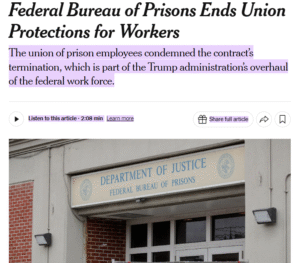
j
p
v
v
*
9-25-2025
COMPASSIONATE RELEASE: The Data “%,” How Successful Will Yours Be?
-
- MOTIONS FOR COMPASSIONATE RELEASE BY MONTH
- BY MONTH OF COURT DECISION
- GEOGRAPHICAL DISTRIBUTION
- BY EACH CIRCUIT AND DISTRICT
- BY YEAR OF ORIGINAL SENTENCE
- BY CIRCUIT OF GRANTED MOTIONS
- BY DEMOGRAPHIC CHARACTERISTICS
- BY SENTENCING FACTORS
- BY TYPE OF CRIME
- BY TYPE OF CRIME FOR INDIVIDUALS DENIED
- BY ORIGINAL SENTENCE LENGTH
- REASONS GIVEN BY SENTENCING COURTS FOR THOSE GRANTED
- REASONS GIVEN BY SENTENCING COURTS FOR THOSE DENIED
*
9-22-2025
M
FEDERAL LEGAL NEWS (FLN)
n
The agency’s years of half-hearted compliance with the First Step Act continue.
s
- “FSA Earned Time Credits and SCA eligibility will (now) be treated as cumulative and stackable, allowing qualified individuals to serve meaningful portions of their sentences in home confinement when appropriate.
Conditional Placement Dates
a
Projected credit accrual and statutory timelines will drive timely referrals, rather than bureaucratic delays. Placement decisions will be guided by stable housing and readiness for community reintegration, rather than previous employment history. Additionally, limitations on Residential Reentry Center (RRC) bed capacity will not hinder home confinement placement for individuals who are statutorily eligible and suitable for such placement.
Still, many institutions appear to treat it as advisory rather than mandatory.
- AG Pam Bondi’s DOJ continues to oppose prisoner 2241’s request for sentence credits, reiterating outdated and incorrect arguments from Biden’s Justice Department, which delays early releases.
- In the case of Gonzalez v. Herrera, No. 24-2371 (9th Cir. 2025), the Ninth Circuit ruled that FSA Credits can be used to reduce a sentence. This decision contradicts the standard briefs submitted by Assistant United States Attorneys (AUSAs) nationwide, which sought to undermine the clear directives of the First Step Act (FSA).
i

a
d
Congress May Tackle Criminal Reform, 9-22-2025
p
Republicans eye a crime bill for Trump, and for the midterms. SEMAFOR,  Sep 17, 2025
“Combating violent crime has consistently been a top priority for President Trump, and this commitment will undoubtedly persist. We are exploring a comprehensive array of solutions. Congressional Republicans are engaged in serious discussions about a sweeping crime bill. Their plans are still in the early stages but show promise; a national crime bill could significantly boost the party’s momentum as the midterm campaign intensifies. This strategic focus comes at a pivotal time, as recent polls indicate a decline in voter confidence regarding Trump’s economic management.”
- …the bad news is that what comes out is unlikely to be a “Second Step Act.” Instead, imagine an extension of the Violent Crime Control and Law Enforcement Act of 1994. This may put Trump’s FSA-SCA with stacked ETC, providing a pathway for Early Release to Home Confinement, in the senator’s trash can.
Don’t expect a BOP Rehab program that takes into account withdrawal.
“The Bureau is well aware that a significant number of inmates grapple with drug addiction, yet medication-assisted treatment (MAT) remains underutilized, despite the widespread availability of drugs within prison walls. Those fortunate enough to be enrolled in the program are increasingly alarmed by unnecessary changes. One inmate shared, ‘I’ve been on the MAT program here, taking Suboxone (generic equivalent) at a daily dose of 8mg for over seven years—five years on the outside and two in prison. It has literally saved my life.
- Now, instead of receiving our medication daily at 12:30 pm, they’re shifting to an alternate-day schedule. This means I’ll only receive my dose on Monday, Wednesday, and Friday, leaving weekends without any support. The increase in dosage may be labeled as “adjustments,” but this is not a medical decision—it’s a staffing issue.’ This change risks undermining the progress we have made in recovery.”
- From those I have spoken with, it is clear that staffing shortages (when medical staff have to substitute as corrections, including teachers, leaving FSA Programs shuttered or delayed), as well as the medical supplies being low or worse, are just one more problem to deal with after shortages in staff and medical supplies.
p
p
Inmate Deaths Happen, But Why With This Frequency?
Four in 9/2025.
k
These deaths can’t all be of natural causes; why so many?
f
9/24/2025 had been in custody at FCI Petersburg Low since September 23, 2025, was found unresponsive…
h
l
On 9/25/2025, a 29-year-old male arrived at FCI Englewood on Thursday, March 28, 2024. While under pre-trial status.
n
p
9/8/2025, a 60-year-old male who was ending a 60-month sentence at a FPC
d
d
p
9/21/2025, Was the Sex Offender’s housing taken into consideration, knowing his charges, before placement?
m
l
*
l
(FCI) Aliceville in the news. Compassionate Release could have been a consideration, but what contributed to the alleged neglect?
i
s
h
k
This sounds like the OIG-DOJ Report from FDC SeaTac?l
l
d
p
The OIG Report on SeaTac FDC
j
f
f
s
The BOP did not release redacted mortality reports from FCI Aliceville until Reason initiated FOIA litigation.
f
k
OTHER EXAMPLES
K
*d
s
Sept. 16, 2025. Bloomberg Law: Alarm at the Judiciary: Overuse of the High Court Docket (1).
- During a closed-door biannual meeting of the Judicial Conference, which is the federal court system’s policymaking body led by the chief justice, Rep. Hank Johnson (D-Ga.) stated, “The rule of law is at a Category 6 code red, a six-alarm fire.” This quote comes from a copy of his prepared remarks shared by his office.
Our Supreme Court’s (over)use of the Shadow Docket. So that you know.
a
s
*
f
9-15-2025

Why? Chris wrote back that he had been in the Special Housing Unit and had slipped his grievance under the door for pickup, the usual procedure for people in the SHU, and the only way he had to file. It wasn’t looking good for Chris as there was no way to prove that he/she attempted the Admin. Remedy Process while in the SHU.
- But Rule 56 has an escape hatch: Rule 56(e) permits a court to issue appropriate orders when “a party fails to support an assertion of fact properly.” The 3d Circuit reversed the District Court and reinstated Chris’s lawsuit. [Rule] 56(e): Doe does not compel courts to completely disregard unsworn statements when assessing the propriety of summary judgment. A pro se litigant’s ignorance of procedural rules may or may not provide a procedural break. It just gives you the time to get your case together and another chance to make your case.
Lauria v. Lieb, Case No. 24-1461, 2025 U.S. App. LEXIS 23622 (3d Cir. September 12, 2025)
United States ex rel. Doe v. Heart Solutions, PC, 923 F.3d 308 (3d Cir. 2019)
Appeals Hearing on Transgender Injunctions:
A US Court of Appeals for the DC Circuit panel recently expressed skepticism about overturning injunctions that block President Trump’s executive order to transfer 19 transgender women prisoners to male facilities. During a hearing, the appeals panel considered arguments to lift the injunction on the January 20th executive order, which barred individuals assigned male at birth from women’s prisons and mandated changes to gender-affirming medical care policies. A lawyer for the incarcerated trans women urged the panel to uphold the injunctions to prevent further sexual violence, stating, “This isn’t about abstract questions; this is about constitutional limits on prison officials’ ability to ignore serious violence risks.”
During last week’s arguments, Senior U.S. Circuit Judge Raymond Randolph stated that the Bureau of Prisons (BOP) did not seem to adhere to the requirements outlined in Trump’s executive order. Randolph highlighted that a provision of the Prison Rape Elimination Act mandates the BOP to ensure an inmate’s safety when considering a transfer to a new prison. However, this provision did not appear to be followed in several of the plaintiffs’ cases. Doe v. Bondi, Case No. 25-5213 (oral argument September 5, 2025)
FEDERAL LEGAL NEWS (FLN)
Post-Conviction Criminal Law – Compassionate Release
The FSA allows a judge to take a “Second Look” at the length of your sentence, including your supervised release. This review can consider factors such as the medical care you are receiving, positive changes in the law, and advancements in scientific research (for example, the purity of methamphetamine) to grant you relief, personally.
- It does not provide for leader-organizers, 924c, and some Sex Offenders.
- 2023 US Sentencing Guidelines broadening the ways to win relief,
- poor or non-existent medical care,
- lack of competent medical treatment,
- excessively long sentence,
- “Extremely Long Sentences.” According to the USSC, “ (6) UNUSUALLY LONG SENTENCE.—If a defendant received an unusually long sentence and has served at least 10 years of the term
- any changes in the law.
- With the increase in official reports detailing,
- the appalling living conditions in every federal prison,
- Most federal prison has
- serious mold problems, and
- a medical system where the official records do not match with the care you did or did not receive, extending to not actually treating you.
- The addition of the FSA Task-Force, this administration is placing a renewed focus on the comprehensive application of every available sentence-reduction tool.
- This still depends on case managers and counselors who, in the past, haven’t consistently verified your ETC, and may have inadvertently “lost” or delayed your administrative remedies.
- This impacts the reliability of the processes that could lead to your early release.
- Your attention should be focused on tracking your own FSA ETC, and next, if needed, on preparation to implement the BOP Administrative Remedy Process through 28 U.S. Code § 2241, pdf.
a
Compassionate Release

s
s
*
–
f
In Gonzalez v. Herrera, No. 24-2371 (9th Cir. 2025),
The Ninth Circuit held that FSA Credits can be used to reduce a defendant’s supervised release term, rejecting arguments from AUSAs that these credits are worthless. Gonzalez earned 610 days of credits, 237 of which were used to end his custodial sentence, leaving 373 that the government deemed insignificant.
After the district court denied his habeas corpus petition under 28 U.S.C. § 2241, Gonzalez appealed. The Ninth Circuit noted that 18 U.S.C. § 3632(d)(4)(C) has led to varied interpretations. The court emphasized that the statute clearly states that time credits earned through recidivism reduction programs should apply to supervised release, concluding that Gonzalez’s earned credits must be factored into his release term.h
h
9-2025 The DOJ OIG INSPECTION RESULTS OF FDC SEA TAC
FDC SeaTac is an administrative-security federal detention center housing both female and male inmates.
The DOJ OIG found significant issues at FDC SeaTac regarding inmate healthcare quality, staffing shortages, and contraband interdiction. These shortages of healthcare employees and Correctional Officers have led to severe operational challenges that impact the health and safety of both employees and inmates.
s
C
s
ThE DOJ-OIG Report…
At The Time of the DOJ-OIG Inspection, Significant Staffing Shortages.
- The Correctional Services Department was staffed at only 69 Percent.
- The Health Services were at 50 percent
- The Clinical Director position had been vacant for at least 18 months.
- 3/9 nursing positions and one of the two pharmacist positions were filled.
- SeaTac’s Health Services Department called the healthcare situation a “crisis,” necessitating a focus on emergency care for inmates, which contributed to various issues in inmate healthcare.
- The shortage of Correctional Officers led the institution to implement “Augmentation” policies, requiring non-correctional staff (teachers, nurses, etc.) to serve as substitutes. These stopgap measures contributed to low morale and employee exhaustion.
Result:
-
Inmate Healthcare Delays for Routine and Serious Issues
.
s
Q
*
9/8/2025
M
Prison Policy Initiative Library Updates
8/11/2025, Heat Incident Questions to BOP Director Marshall, From Congress.
a
Heat’s Deadly Impact
The lawmakers also raised concern over the current state of BOP personnel and infrastructure, discussing how that may impact the Bureau’s ability to respond to extreme heat in federal prisons:
- “Several reports, including one conducted by the U.S. Department of Justice Office of the Inspector General, emphasize the ongoing crisis BOP facilities face due to severe staffing shortages and deteriorating infrastructure.
Aging infrastructure poses significant risks to facilities lacking proper air-conditioning systems, which are critically important in preventing serious health issues associated with extreme heat.
- Staffing shortages limit staff capacity to mitigate extreme heat issues, making those with medical and mental health conditions that are exacerbated by high temperatures more vulnerable to heat-related illnesses or deaths.”
Climate Change Is Even More Severe on Those Incarcerated With Medical Illnesses
D

- Climate and the Impact on CDCR by California Department of Corrections and Rehabilitation, June, 2025
- Paying for One’s Own Incarceration: National Landscape of “Pay-to-Stay” Fees by Campaign Zero, June, 2025
- Prices for all Americans are set to unnecessarily rise by FWD.us, June, 2025
- Mental Health Care Barriers for Women Involved in the Criminal Legal System With Substance Use Disorders: A Qualitative Study by Emma M. Skogseth et al., March, 2025
G
G
FEDERAL LEGAL NEWS: PATTERN
The algorithm-based risk assessment tool was used to determine eligibility for home confinement during the COVID-19 pandemic and for First Step Act (FSA) earned time credit calculations.

Critiques indicate that PATTERN overpredicted recidivism risk for Black and minority individuals, leading to their disproportionate exclusion from release programs and delayed access to early release under the FSA.
- PATTERN MALE
- PATTERN FEMALE
- PATTERN SCORING
- PATTERN VIOLENT OFFENSE CODES
K
CURRENT EDUCATION PROGRAMS – OUTDATED
- “The materials for GED are from 2014, and we have no updated curriculum to tutor students. The FSA classes, like Finance, are outdated and cover basic topics like writing a check and using an ATM, while neglecting current methods such as Apple Pay, Google Pay, and Zelle.”
- “The USSC is considering retroactively applying Part A of the 2025 drug offenses amendment, as noted in a May 9, 2025, Federal Register notice, with public comments due by June 2, 2025. Under 28 U.S.C. § 994(u), courts can reduce sentences for defendants if the amendment lowers the guideline range (18 U.S.C. § 3582(c)(2)). The USSC assesses retroactivity based on the amendment’s purpose, impact on sentencing, and feasibility. We can assist in understanding these changes and expediting court petitions for sentence reductions.
L
DRUG CRIMES AND AI IN PROSECUTION
- The use of computerized and AI to process, identify, and prosecute potential drug offenders is astounding. The government instantly identifies known drug traffickers, their suppliers, their customers, and their relationships with confidential informants. A defense attorney’s discovery that does not request such information from the prosecution is probably grounds for a habeas petition for inadequate representation of counsel.
L
BOP DIRECTOR MARSHALL WILL REDUCE THE PRISON POPULATION
- The BOP Director is focused on reducing the prison population safely. While no timeline has been set, staff are advised to work with the FSA Task-Force and prepare for housing fewer inmates in the coming years. This is evident from the Director’s memo regarding the interview of new wardens.
9/2/2025
s
Busy Criminal Caseload for SCOTUS – Update for September 2, 2025
s
s
a
*
9/1/2025
A
National Organizations Call for Second Look Review – Updated 8-2025:
The American Law Institute (ALI) recommended a judicial review at 10 years for sentences imposed on youth and a sentence review at any time for those experiencing “advanced age, physical or mental infirmity, exigent family circumstances, or other compelling reasons.
The evolution of the second look movement, which began with the U.S. Supreme Court’s decisions in Graham v. Florida (2010) and Miller v. Alabama (2012) regarding juvenile life without parole (JLWOP) sentences. Recently, the movement has expanded to cover excessive sentences for youth and emerging adults facing life without parole (LWOP).
Fifteen states, the District of Columbia, and the federal government currently have second look judicial reviews, while 16 states have found specific, lengthy sentences unconstitutional under Graham or Miller. The report outlines second look and resentencing laws in the U.S., with examples of legislation and court rulings.
g
*
k
Federal Legal News
…On the lighter side, and I quote:
The main purpose of the Criminal Justice System (at this time) was not to do justice, but to
- settle scores,
- further political agendas, and
- create a lucrative federal bureaucracy.
In addition to,
- protect Americans from international drug-smuggling,
- sex-trafficking, and terrorism,
Except that these offenders make up a relatively small percentage of federal prison inmates.
m
Your ETC and Early Release to a Residential Reentry Center (RRC) or Home Confinement are blocked; a possible solution is available.
A prisoner who filed for habeas relief to obtain his earned FSA credits was summarily released to a halfway house before the BOP could suffer an adverse ruling.
- See: Cory Ray Garcia, Petitioner, v. B. Eischen, FPC Duluth, Respondent. No. 24-cv-4106, (USDC MN). “Petitioner Cory Ray Garcia filed this action seeking a writ of habeas corpus pursuant to 28 U.S.C. § 2241. Mr. Garcia claimed that under the First Step Act of 2018 (FSA) the Federal Bureau of Prisons (BOP) should have applied ‘earned time credits’ to transfer him sooner from prison to a residential reentry center (RRC) or home confinement.
- On March 25, 2025, United States Magistrate Judge Shannon G. Elkins recommended that Mr. Garcia’s petition be granted, noting that his transfer to an RRC was scheduled for April 8th. The BOP transferred Mr. Garcia to an RRC in Utah on April 3rd, and now Respondent moves to dismiss this case as moot.” Let us assist you in your FSA matters.
d
2255 Petitions.
A successful ineffective-assistance-of-counsel case typically requires a defendant to show that their lawyer’s performance fell significantly below a reasonable standard and that this deficiency had a “reasonable probability” of changing the trial’s outcome. This principle is established by the landmark case Strickland v. Washington.
- Examples of deficient performance: include:
- Failing to investigate potential alibi witnesses;
- Failing to object to inadmissible evidence;
- Failing to present mitigating evidence in sentencing;
- Misadvising the defendant about plea bargain options.
- Example: In United States v. Singh, No. 24-3655 (6th Cir. 2025),
-
- A physician was hired by staffing and telehealth companies to conduct “chart reviews” for patients in need of durable medical equipment (DME) like braces. She thought she was approving charts for patients already evaluated by other providers. However, the companies were later found to be defrauding Medicare by using physicians’ signatures to order DME and submit claims. The physician never examined the patients and wasn’t aware of the claims submitted or their amounts. Over three years, she earned approximately $78,000 for her work.
-
- A grand jury indicted her on six counts of healthcare fraud under 18 U.S.C. § 1347. During the trial in the Northern District of Ohio, she was accused of defrauding Medicare by signing Durable Medical Equipment orders for unexamined patients. Testimonies from patients, Medicare investigators, and a physician—who wasn’t an expert—were presented. The court excluded the physician’s exculpatory statements. The jury found her guilty on all counts.
-
- The Court of Appeals ruled that the district court erred by not instructing the jury on the defendant’s knowledge of her actions, excluding the physician’s statements, and allowing non-expert testimony. These errors were significant, leading to the vacating of the convictions and a remand for further proceedings.”
s
a
8/25/2025
New Wardens In The BOP Future
BOP Director Marshall, III.
Having to confront a front-line Wardens publicly is both embarrassing and should send a chill throughout the BOP senior staff that the days of the unacceptable may be over. 8/18/2025
· Why was he serving expired food that he wouldn’t eat?
During his and the Deputy Director’s fact-finding visits,
Augmentation. When general non-correctional staff (such as teachers and medical personnel) have to substitute as Correctional Staff.
Many prisons report shortages or expired food, medical care, and basic supplies, attributing continuous lockdowns and cuts to crucial programs, like drug treatment, to budget issues.
a
From other announced and unannounced visits,
1. Inability and/or unwillingness of staff to properly place FSA and SCA time.
2. Widespread use of group punishment.
3. Seemingly institutionalized homophobia and racism exhibited by staff, as in not just a couple of bad actors.
4. Environment of something resembling a partial lockdown.
· 3 men to a room of roughly 80 square feet in violation of congressional mandate regarding housing space; they try to get around it by counting the total floor area of the unit.”
a
The slowness in implementing his FSA Task-Force Mandate
– Identify individuals in Residential Reentry Centers (RRCs) eligible for home confinement.
– Manually calculate home confinement placement dates using both the FSA and Second Chance Act (SCA).
– Relay these dates to RRM offices to accelerate transitions and free up RRC bed space.
– Review incarcerated individuals for additional community placement opportunities.
As a result, on 8/28/2025, BOP Director Williams Released This Message;
s
*
g
t
8-24-2025
PHONE CALL POLICY UPDATE:
- CHARGES ARE LISTED, PLUS,
- IF YOU ARE PARTICIPATING IN FSA [PA, OR EBRR], YOU’RE ENTITLED TO 210 EXTRA MINUTES PER MONTH.
- VIDEO EMBEDDED.
a
s
s
Federal Legal News (FLN) 8/29/2025 – It’s Early.
Inbound email communication with inmates has faced strict limitations. One significant restriction is that non-profit organizations sharing current events or religious information are allowed to send only one email at a time. This limitation has forced some of these organizations to revert to traditional paper correspondence, which is an expense they cannot afford, while others have simply stopped communicating altogether.
Topics:
Education. With staffing shortages, FLN still receives letters from some institutions where inmates are doing the teaching, which may not be all that bad, as there are some very smart people incarcerated.
Inmate Protection. A 67-year-old inmate, being held with a charge of child pornography, was killed while he was at FCI Pekin. A former inmate faces a manslaughter charge (5/8/2025) in his death. Questions remain as to why he was bunked with any inmate, yet this particular one, and then left unattended for many hours in their cell.
BOP Director Marshall’s “Stacking” Memo, issued in June. While not being ignored by all Case Managers, it is definitely being ignored by a significant number. Read below: Federal Legal News 8/18/2025
- From Elkton: The case manager mentioned that stackability applies only to FSA credits with SCA. He believes the statutes treat halfway house and home confinement as separate, but only allow 6 months in a halfway house while suggesting it’s a year.
- He mentioned that once we’re approved for a year and the warden signs off, case managers can’t resubmit for home confinement. Many are resisting the new policy. The warden clarified in a memo that under the 2nd Chance Act, we can receive either up to 12 months of HWH or 10% of our time, which equals 6 months of home confinement.
From a prisoner at Tallahassee;
- Flooding in the triplex; the drains cannot handle more water.
- The kitchen staff are upset that people are writing up all the expired foods, serving sizes that are not the correct size, feeding buddies full servings, only to give the next person half a serving.
- Leaks in all buildings, water simply running.
- Now we are told there is not enough hand soap or tissue/Tampax pads.
- Classes are closed daily.
- Women here with open sores and undiagnosed rashes.
- Without medication for days, they are unable to meet anyone’s medical needs, as there are not enough medical personnel to carry the load or the expertise.
- We all agree, Alligator Alcatraz looks like heaven compared to Tallahassee. (FYI: the grass isn’t always greener…)
a
Prison Policy Initiative, 8/25/2025
d
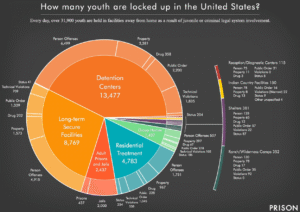
V
Over the past 25 years, youth confinement in the U.S. has decreased by over 70 percent, a significant improvement compared to the adult criminal system, which has seen little change.
However, the U.S. still confines youth at more than twice the global average, and the juvenile legal system reflects many troubling aspects of the adult system.
- Severe racial disparities.
- Large numbers of youth are held pretrial or for minor offenses.
- Prison-like conditions.
S
s
8-18-2025
Video Message from the Director – Doing the Right Thing
- Doing the right thing shouldn’t need a manual; it just requires social skills and character.
- The ‘feel-good video’ needed to be made, but it shouldn’t have required the time and oversight from BOP Director Marshall III.
- The staff are hard-working, face pay cuts, excessive overtime, lack respect from superiors, feel the stress from inmates, and receive inadequate training for their roles.
- President Truman’s phrase, “The buck stops here,” reflects the responsibility of leadership that Director Marshall follows.
Having to confront a front-line Warden publicly is both embarrassing and should send a chill throughout the BOP senior staff that the days of the unacceptable may be over. Time will tell.
- “The buck stops here” would be refreshing if we saw it in use at The Resolute Desk.
s
f
e
Heat Incident Questions To BOP Director Marshall, 8-11-2025
Director Marshall III has a lot on his plate. His recent video (8/18/2025) included a conversation he had with a member of his senior staff: why was he serving expired food that he wouldn’t eat?
- Dealing with Heat as a component of Climate Change, and Infrastructure…
- Ensuring his Wardens comply,
- Providing for the health of their staff and inmates may be questionable, or too much to expect?
- But, we can be hopeful.
- My Comments In The Upper Right Of The Letter.
a
H
Federal Legal News 8-18-25
CONFUSION STILL RULES THE DAY, 7 YEARS AFTER THE LAW WAS PASSED.
Case Managers: Regarding the processing of prisoner release dates.
DOJ attorneys representing the Bureau: as to current BOP policy allowing for the “stacking” of credits for both FSA and SCA, and
- continue to quote language from the SCA limiting halfway house/home confinement to 10% of your sentence,
- when there is absolutely NOTHING in FSA that limits the amount of home confinement that you can receive.
Result: it may be that for most who are eligible for home confinement, you’ll first have to go to a halfway house, so that US Probation can properly process them.
A reader’s personal experience trying to get an accurate release date:
“I was called in to the Case Manager’s office a few minutes ago to discuss my sentence miscalculation issue.
The Case Manager told him that DSCC had emailed him, advising that recalculation issues are more appropriately handled at the institution level (?).
a
Remember that Director Marshall’s FSA Task Force has already begun solving this issue.
- 8/1/2025: BOP Message from Director William K. Marshall III
- 7-15-2025: Director Marshall Visits FCI Sandstone and FPC Duluth (2)
- 7/14/2025: FSA Task Force – BOP_ Director Marshall
- Example of One BOP Facility WHO GOT THE MEMO: R– – FSA
- Please send me a ‘Nameless’ copy of yours – if your facility has got it right. Thank you!
- 6-17-2025 Directive to Fully Implement First Step Act
- Second Chance Act of 2007: SCA SECOND CHANCE ACT STATUTE-122-Pg657
Continuing:
Approximately three weeks ago, the individual sent a request to the DSCC Team, specifically to FSA Task Force, Rick Stover, in Grand Prairie, Texas, asking for the new task force to manually calculate my FSA credits through to my Projected Release Date. (PRD). This is precisely what the TASK-FORCE was created to do!!
- I included exhibits of my last few FSA Time Credit Assessment sheets as exhibits.
- Today, DSCC forwarded my request to the prison Warden’s Office, who forwarded the request to my Case Manager.
- The Case Manager, confused, typed an objection to DSCC because FSA FTC calculations are only done at the DSCC Regional Office, and
- that Case Managers have no authority or ability to recalculate FTCs at the institution level.
- I thought Rick Stover and the FSA Task Force were supposed to be handling this issue?
- You Are Correct. Please See Memos Above.
h
My Takeaway: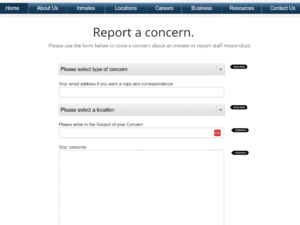
1. Another option:
2. Bop.gov
3. https://www.bop.gov/contact/
4. Pick: Report a concern
5. Inmate or Staff Misconduct Concerns
6. Next:
7. Select Type
8. Email (yes, this should be done by a loved one outside of prison – not you inside.)
9. Pick the prison
10. Enter the topic: BE 100% ACCURATE
In the box, describe that Director Marshall’s Memos aren’t being followed by his staff, and in the space below, be specific
Mail Return Receipt
To: Dir. Marshall III
Federal Bureau of Prisons
320 First St., NW
Washington, DC 20534
Phone: (202) 307-3198
a
d
f
Sizzling Hot, Drugs and Sex at the BOP – Update for August 19, 2025, lisa-legalinfo
BOP Unions Continue ‘Drug Poisoning’ Drumbeat:
Marc Fischer—a longtime mailroom supervisor at U.S. Penitentiary, Atwater and former Coast Guard member—lost his life after being exposed to contaminated mail,
a
Since then, nothing has changed. Dangerous substances continue to pour into federal prisons weekly, and staff are left to fight this epidemic with outdated technology and little support from the Bureau.”
a
FCC VICTORVILLE, CA, UNITED STATES, April 13, 2025.
Ten staff members at FCC Victorville suffered exposures over a four-day stretch.
In a separate report, WDTV reported that 5 FCI Hazelton employees were taken to the hospital last Wednesday morning, according to the BOP, after being exposed to drugs. The report said, “Any time fentanyl or carfentanil is found, the officers are being sent to the hospital as a precaution…”
- WTTV, Federal Prison Staff Still at Risk as Drugs Continue Flooding Through the Mail (August 13, 2025)
- WDTV, Multiple FCI Hazelton employees exposed to carfentanil for 4th time this week (August 11, 2025)
8-11-2025
a
a
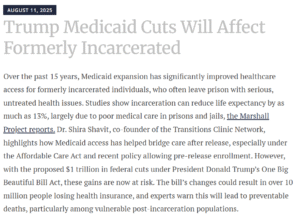
z
A key provision driving Medicaid cuts is the introduction of work requirements, which are scheduled to take effect in late 2026. Adults over 19 must demonstrate 80 hours of employment or community engagement each month and recertify every six months to maintain coverage.
Critics, including legal experts like Michigan law professor Mira Edmonds, argue this disproportionately affects formerly incarcerated individuals, who face a 27% unemployment rate due to stigma and systemic barriers. Many struggle to find stable work, making it challenging to meet the new requirements and risking their access to essential healthcare.
a
Federal Legal News
(USSC) The 2025-26 amendment cycle.
“Providing courts with additional guidance on selecting the appropriate sentencing option (e.g., imprisonment, probation, or fine);
- Further examination of the penalty structure for certain drug trafficking offenses, methamphetamine, and fentanyl.
- Examination of whether the fraud guidelines appropriately reflect the culpability of a defendant and harm to victims.
- Continued exploration of ways to simplify the Guidelines.
- Examination of whether the Guidelines provide appropriate adjustments for good behavior.
- Examination of offenses involving sophisticated means; and
- Review the human smuggling guideline to ensure it considers various factors. The Commission will also prioritize new laws, resolve circuit conflicts, and assess the effectiveness of the Bureau of Prisons in meeting sentencing purposes.
aaa
(See RDAP sentence reduction disqualification, limiting Second Chance placements, interpreting offenses that the Supreme Court has said are non-violent as violent, making it impossible for medium and high security prisoners to earn FSA sentence credits, etc.)
a
THE PRESIDENTIAL PEN.
The administration, starting with the J6s, has turned the dysfunctional clemency process on its head.
- Approximately 21,304 individuals are currently detained for non-violent immigration offenses, which constitute 34.7% of the federal system. Notably, around 20,000 would be willing to return to their home countries voluntarily, at a significant cost savings to us, and it would be more humane for them.
L
FAST TRACK DEPORTATION OPTIONS
- 3-2025_7 FAM 480 INTERNATIONAL PRISONER TRANSFER PROGRAM
- Fact Sheet_ Rapid REPAT
- Justice Manual _ 9-35.000 – International Prisoner Transfers
- Notice from September 23, 2003, United States Sentencing Commission
- The Institutional Hearing and Removal Program for Federal Inmates
a
The PEN could also help some of the 8,000 veterans in federal custody for non-violent drug-related offenses, many of whom are elderly or struggling with mental health and substance abuse issues, and are not receiving adequate medical care.
- S.2372 – VA MISSION Act of 2018, signed into law by President Trump in 2018, if properly applied, could spare the BOP the expensive task of properly treating these individuals and transfer them to the care and custody of probation and the VA.
- The Problem – HE HAS FIRED EVERYONE IN THE VA. THERE’S NO ONE TO ANSWER THE PHONE – IN A REASONABLE AMOUNT OF TIME.
S
Lawful Permanent Residents
The BOP can limit or cancel Residential Reentry Center placements for non-US citizens (Lawful Permanent Residents), regardless of Federal Sentencing Guidelines and Sentencing Commission eligibility.
a
Alderson Federal Prison Camp
“Today, 08/7/25, at 11:30 am, there was a town hall meeting, the topic was about the new 24/7 video that is available for the staff to watch during the town hall meeting. (Perhaps someone should reach out to Director Marshall III?)
The Results.
- No inmates’ dates will be changing
- At their teams, they will get an updated assessment sheet
- The only change on the sheet says they will be able to have a new home detention availability date.
- The new date does not mean that you will be going home on that date.
- It depends on the resources that are available in your city and state, where you are transitioning to.
- The bucket days will be capped at 760 days, and if any one sentence is pre-calculated for more time, they will have to lose those days because they cannot be accommodated for those days in the halfway house.”
a
Derek Gilna, Director of Research, JD (De Paul Law School, 1975), MARJ (Vermont Law School, 2020), Federal Legal Center, 133 W. Market, #171, Indianapolis, IN 46204; dgilna1948@yahoo.com or Spanish; federallc_esp@yahoo.com
a
s
Heat’s Deadly Impact
The lawmakers also raised concern over the current state of BOP personnel and infrastructure, discussing how that may impact the Bureau’s ability to respond to extreme heat in federal prisons:
“Several reports, including one conducted by the U.S. Department of Justice Office of the Inspector General, emphasize the ongoing crisis BOP facilities face due to severe staffing shortages and deteriorating infrastructure.
Aging infrastructure poses significant risks to facilities lacking proper air-conditioning systems, which are critically important in preventing serious health issues associated with extreme heat. Staffing shortages limit staff capacity to mitigate extreme heat issues, making those with medical and mental health conditions that are exacerbated by high temperatures more vulnerable to heat-related illnesses or deaths.”
a
i
l
Heat’s Deadly Impact on Those Immunocompromised And Incarcerated“Heat’s Deadly Impact on Those Immunocompromised And Incarcerated”
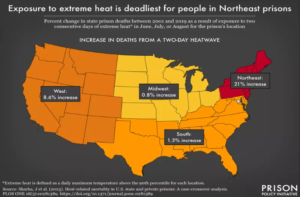
Climate Change Is Even More Severe on Those Incarcerated With Medical Illnesses
e
e
8-6-2025
C
News Release, August 6, 2025
A
A
ALLENWOOD LOW
Certification of the VT barbering program through the Pennsylvania State Board of Barber Examiners, launched in April 2023.
l
s
The Medical Center for Federal Prisoners (MCFP) in Springfield, Missouri, operates the only prosthetics lab of its kind within the federal prison system.
- They fabricate and repair prosthetic and orthotic devices entirely in-house using materials such as thermoplastics and carbon fiber laminate.
- Telemedicine: Can Expand Access and Streamline Care
- Its Broader Impact can be on a person’s Rehabilitation and Reentry, as the training involved is through a rigorous 8,000-hour apprenticeship program.
THE CAVEAT: AS THE BOP IS SHORT STAFFED, AND EVERYONE IS LOOKING AT THE FSA/SCA ETC TASK FORCE, IF THE PATIENT’S PROSTHETIC PRESCRIPTIONS DON’T COME IN…
- Time will tell, as this program has been here for 20 years.
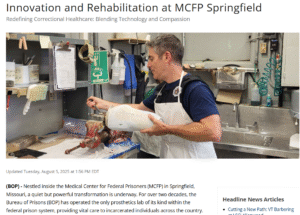
S
S
In A Major Shift, Judges Now Openly Distrust Government Lawyers
The traditional bonds of trust—referred to in legal terminology as the presumption of regularity- extend far beyond the harsh labels judges have used, such as “egregious,” “brazen,” and “lawless,” to characterize the different facets of Trump’s aggressive pursuit of power.
a
Doubts raised by judges about the department and its representatives can significantly affect court operations. Law professor Stephen I. Vladeck noted that the credibility of the government is essential for the legal system to function effectively. Without this credibility, it becomes harder for the government to handle even routine matters in court, leading judges to question decisions they would have previously accepted.
a
In recent weeks, many judges have voiced skepticism about the honesty and credibility of Justice Department lawyers. A notable instance occurred in June when Magistrate Judge Zia M. Faruqui criticized prosecutors for seeking “highly deferential” compliance to keep a search warrant sealed. He rejected this notion, declaring, “Blind deference to the government? That is no longer acceptable. Trust that has taken generations to build has been shattered in mere weeks.”
MY COMMENT. This sentiment is bound to spill over into criminal cases, where having great defense counsel is crucial.
*
*
Federal Legal News 8-4-25
One prisoner shared, “I received my halfway house date, which I’ve had since last November, after finalizing my travel plans and completing my thumbprint. Then I found out I lost my date due to a lack of bed availability.” Practically, it could take a while (up to a year?) to fully implement and get a “buy-in” from BOP staff.
- At a time when the BOP struggles to stock its prisoner-funded commissary, provide adequate medical care, and provide toilet paper, it will, sadly, not be able to correct your release date, forcing you to stay in prison longer unless you seek judicial intervention.
a
In a case brought to my attention by a reader, the BOP incorrectly based its disqualification on an enhancement, rather than one of the enumerated disqualifying offenses specified in the FSA.
- “Petitioner pled guilty to Possession with Intent to Distribute Fentanyl but specifically did not plead guilty to a count charging “that death or serious bodily injury resulted from the use of such substance… the mere existence of an enhancement did not convert his conviction to one for an offense under the portion of 841(b)(1)(C) referenced in 18 USC Section (d)(4)(D)(1viii…. “Citing Lallave v. Martinez, 635 F. Supp. 3d173 (E.D.N.Y. 2022) dealt directly with this issue. The BOP eventually agreed and granted Petitioner his credits. In noting this, the court stated, “Petitioner is a federal prisoner proceeding pro se and in forma pauperis with a petition for writ of habeas corpus pursuant to 28 U.S.C. § 2241. On August 9, 2024, Petitioner filed the instant habeas petition. (Doc. 1.) On November 6, 2024, Respondent filed a motion to dismiss the petition. (Doc. 10.) Respondent seeks dismissal because Petitioner was granted the relief he sought, to wit, the BOP has deemed him eligible to earn and apply First Step Act time credits to his sentence.” Note that the successful Petitioner filed more than FIVE YEARS before his outdate.
a
This week’s Sentencing Committee vote focuses more attention on the Methamphetamine changes that both scientific studies and numerous court decisions have shown are long overdue.
a
My Opinion
The street mixing of these analogues has dramatically intensified their medical impact, making it a critical issue that cannot be ignored.
- Xylazine HCL (only for Veterinary use), but is now mixed with Fentanyl, called TRANQ Dope, further mutating to POLYDRUGS.
- Policing the most significant drug market on the eastern seaboard: officer perspectives on enforcement and community safety.
- The urgent need for congressional action on illicit Xylazine
- The BOP has its Manual for Detoxification of Chemically Dependent Inmates, judge for yourself. Page #14, 9. OPIATE WITHDRAWL
a
a
8-1-2025
Epstein victims claim ‘Cover Up.’
Ghislaine Maxwell has been transferred to a less restrictive, minimum-security federal prison camp in Texas, FPC Bryan. According to a Bureau of Prisons policy (Chapter 5, Page 12), people with a sex offender determination known as a “public safety factor” are required to be housed in at least low-security prisons unless they receive a waiver from an arm of the bureau that designates inmates.
The rest appears to be routine. After meeting with Deputy Attorney General Todd Blanche in Florida, he reports to his leadership, Attorney General Pam Bondi. After this, BOP Director William Marshall III is brought into the loop, and the rest is history. However, please note that this is not the typical process for determining an inmate’s eligibility for a lower security prison.
_______
a
A Message From BOP Director William Marshall III, Overview;
- The updated Time Credit Application Program tool has integrated the First Step Act and Second Chance Act to provide home confinement placement dates.
- BOP staff now have 24/7 access to a training video on maximizing home confinement under the First Step Act and the Second Chance Act.
- This video training ensures that all case managers, whether experienced or new, accurately interpret dates, verify eligibility, and effectively utilize the capacity of halfway houses.
- The Caveat. This is one more job for case managers, as the system is still understaffed, and for some, their plate is full.
- Augmentation. When general non-correctional staff (such as teachers and medical personnel) have to substitute as Correctional Staff.
- Those who neglect their responsibilities will be held accountable. I won’t let the hard-working 99% be overshadowed by the few who fail to do their jobs.
><
*
n
a
Rick Stover, Senior Deputy Assistant, Will the First Step Task Force Make A Difference?
FIRST STEP TASK FORCE FINDING ITS FOOTING
Rick Stover, Senior Deputy Assistant Director of the Federal Bureau of Prisons’ Designation and Sentence Computation Center (DSCC), stated that the task force has begun evaluating prisoners now in halfway houses, who could be transferred to home confinement (because the BOP’s computer program currently  cannot calculate these dates once inmates are released [to] halfway houses” ) for them to receive the full benefit of “stacking.”
Another significant difference here is that Director Marshall was put in a position where he knew he had to make a decision, and he did!
a
7-28-25
Federal Legal News
*
FPC Alderson
“My Case Manager isn’t following the latest memo from the Director. My main issue is the unit team giving me the runaround about the Home Confinement Expansion directive. They claim they’re correctly filing paperwork to the RRM/RRC, but if there’s no availability in the halfway house, why not consider home confinement? …we’re being kept away from our families longer than necessary.”
FPC Canaan
“My case manager mentioned that due to the new FSA Taskforce, the regional response and BOP director Marshall’s directive state that individuals placed in home confinement will only receive 6 months under the SCA, instead of the potential 365 days…”
A
Derek Gilna, Director of Research, JD, Federal Legal Center, 133 W. Market, #171, Indianapolis, IN 46204; dgilna1948@yahoo or in Spanish; federallc_esp@yahoo.com.
____ The Process – An Overview ___
To get Good Time Credit, you must either have the following;
- 54 days of credit against EVERY YEAR – UP FRONT YEARLY..
- Earned your GED or,
- Made satisfactory progress toward reaching your GED and
- Avoid disciplinary infractions.
A
First Step Act (FSA)
- The program allows up to 365 days of earned time credits (ETC), which will apply to early release
A
RDAP
- Time off Sentence with RDAP
- sentenced > 36 months, you may receive up to 12 months off the sentence.
- Sentenced> 30 months, you may receive up to 9 months off the sentence.
- Sentenced> 24 months, you may receive up to 6 months off the sentence.
A
Second Chance Reauthorization Act (SCA)
No one can be released to HC for more than 10% of their sentence, with a maximum of 6 months, whichever is shorter.
If an individual has,
- An established release plan and
Does not need the services of a Halfway House, and
Has a 60-month sentence,
That individual cannot receive more than 180 days of home confinement.
Or,
-
- If your sentence is > 60 mo (5 yrs) = last 6 mo on home confinement.
- If your sentence is < 60 mo (5 yrs) = last 10% on home confinement.
7/21/2025
*
s
Federal Legal News 7/21/2025
*
FCI Sheridan,
The newest Prison to Embrace Censorship is blocking prisoner access to Federal Legal News.
- To get medical care, an inmate was left to fake a suicide attempt to get seen.
- Correctional officers are working mandatory overtime, leading to exhaustion, and healthcare workers and educators are being asked to perform tasks for which they were not hired, according to Michael Horowitz, the Justice Department’s Inspector General.
*
FSA Task Force
Director Marshall initiated a task force at the Designation and Sentence Computation Center (DSCC) to help the Bureau’s Residential Reentry Management (RRM) offices by manually identifying and correcting community placement dates. This aims to ease the workload on institution staff and expedite the transfer of eligible inmates to community confinement. The task force will:
– Identify individuals in Residential Reentry Centers (RRCs) eligible for home confinement.
– Manually calculate home confinement placement dates using both the FSA and Second Chance Act (SCA).
– Relay these dates to RRM offices to accelerate transitions and free up RRC bed space.
– Review incarcerated individuals for additional community placement opportunities.
*
While at FCI Bryan, inmates were informed that a June 17, 2025, policy directive from Director William K. Marshall regarding FSA and SCA would be ignored. Town halls indicated that the bulletin on home confinement and prerelease placement is invalid due to a lack of signature and BOP approval. The Unit Manager stated that home confinement dates will only consider actual dates, disregarding earned credits and community readiness, and dismissed inmates’ concerns about reporting issues. Fearing retaliation, the women are requesting an investigation into these matters. DIRECTOR MARSHALL, IT APPEARS THAT PARENTAL SUPERVISION IS NEEDED AT FCI BRYAN, AS THE UNIT MANAGER MAY NEED A ‘TIME OUT.’
A
The BOP still relies on a DOSS (really ?) -based system that requires manual calculations for sentence credits, even in 2025. Many unit team members prefer the outdated, decentralized system, allowing wardens to manage prisons with little oversight. Although there are dedicated Bureau employees, changing this culture of unaccountability will take time. In the meantime, we are here to assist you with the new Director’s Memos for 2241 petitions, which will be essential for months or years to come.
A
UNDOCUMENTED?
The BOP agrees that you are entitled to FSA credits for earlier release, even with an ICE detainer. However, it often assigns a “Public Safety Factor” administratively to prevent you from being transferred to a halfway house.
><
Derek Gilna, Director of Research, JD, Federal Legal Center, 133 W. Market, #171, Indianapolis, IN 46204; dgilna1948@yahoo or in Spanish; federallc_esp@yahoo.com.
a
a
7/20/2025
*
Newsletter to Federal Prisoners
BOP WEEK
Marshall Establishes FSA Task Force:
Bureau of Prisons Director William K. Marshall III last week announced the establishment of an FSA Task Force at the Grand Prairie DSCC.
F
Marshall cited inmate “frustration that their paperwork for home confinement… wasn’t being processed by staff despite Director Marshall’s directive to maximize the use of community placement. But at the same time, the staff told [Marshall] that the systems they rely on weren’t always showing the right dates… The majority of staff were doing their best with the information they had, but, unfortunately, they were taking the blame from inmates and families who thought they were dragging their feet. That wasn’t fair to them.”
G
The task force will identify prisoners in halfway houses who are eligible for home confinement; manually calculate home confinement dates that “stack[] both the FSA and Second Chance Act (SCA);” and review eligible incarcerated individuals inside institutions for additional community placement opportunities.”
J
Writing in Forbes, Walter Pavlo said, “Having a person serve a portion of their sentence in the community is not something new and has been used for decades by the BOP. However, the Agency has been slow to move inmates after the [First Step Act] was codified… in January 2022. The initiative is part of Director Marshall’s broader strategy of “Leadership in Action,” which has included institutional walk-throughs, direct engagement with frontline staff, and timely operational changes based on what he hears.”
BOP, Director Marshall Launches FSA Task Force (Jul 14)
Forbes, Bureau Of Prisons Launches First Step Act Task Force (Jul 14)
L
><
FPC Duluth to Remain Open:
Seven months after then-BOP Director Colette Peters listed FPC with six other facilities that would be closed because of “aging and dilapidated infrastructure,” Marshall announced last week after a site inspection that the minimum-security camp “will not be deactivated.”
Currently, there are about 258 inmates at the facility.
Minnesota Public Radio, Duluth prison camp to remain open, reversing earlier decision to ‘deactivate’ the facility (Jul 16)
L
><
SENTENCING COMMISSION HOLDS GUIDELINE RETROACTIVITY HEARING
The Federal Defender Sentencing Guideline Committee made the case bluntly:
If there was ever a time for the Commission to make ameliorative guideline amendments retroactive, it is now. The reality is simple, indisputable, and unacceptable: the [BOP] is unable to humanely and safely hold the people in its custody… The BOP is in the midst of multiple, self-described crises, which are decades in the making and from which the BOP has neither the plan nor the means to escape.”
A retroactivity decision will come next month.
US Sentencing Commission, Public Hearing on Retroactivity (Jul 16)
Federal Public Defenders, Comment on Possible Retroactive Application (Jul 16)
a
*
7/15/2025
Compassionate Release Rulings – Update
a
1st. The 4th Circuit ruling first: Richard Smith has served about half of his 504-month crack cocaine conspiracy and stacked 18 USC § 924(c) sentences. He filed for compassionate release, citing his advanced age, poor health, rehabilitation efforts, and the disparity between his current sentence and the one he would receive for the same conduct if sentenced today.
The district court found that there were “extraordinary and compelling reasons” to grant the compassionate release motion, but in weighing the 18 USC § 3553 factors, the court concluded that “[r]eleasing Smith would not reflect the seriousness of the offense conduct, promote respect for the law, provide just punishment for the offense, or deter criminal conduct.”
The 4th Circuit reversed the district court’s decision and instructed that Dick be allowed to go home. It ruled that the sentence disparity from the First Step Act‘s elimination of “stacked” mandatory minimums under §924(c) can be considered an “extraordinary and compelling reason” under § 3582(c)(1)(A)(i). This suggests that the Sentencing Commission’s compassionate release guideline 1B1.13(b)(6) is lawful. The Supreme Court will soon decide whether this guideline oversteps the Sentencing Commission’s authority in Rutherford v. United States.
2nd. The Circuit found that the district court’s summary of the §3553 factors overlooked that they favored Smith’s release. At 71, Smith suffers from multiple serious health issues, making him totally disabled and posing no recidivism risk. He has had only two minor infractions in 20 years and has actively engaged in vocational and drug treatment programs. The court criticized the district’s view that a reduced sentence wouldn’t deter crime, noting that Smith will have served nearly 25 years of his 42-year sentence by the time of his release, which already serves as a significant deterrent.”
><
ff
FORMER BOP INMATE – NOW BOP DEPUTY DIRECTOR
*
*
*
0
*
l
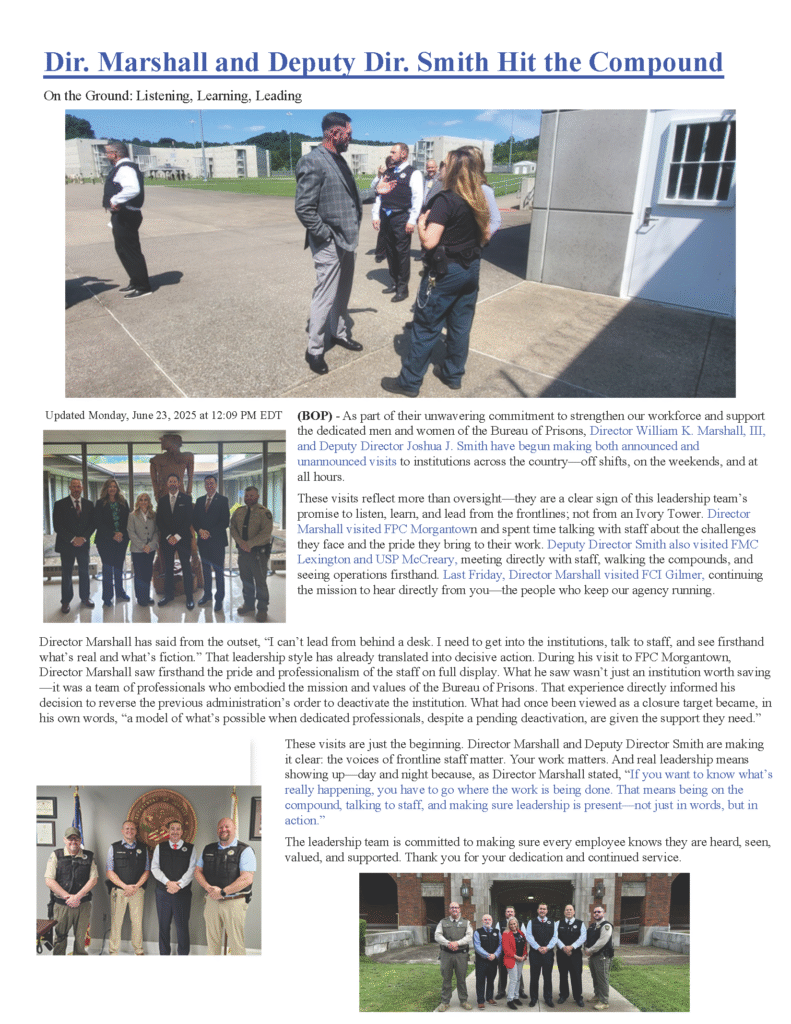
w
*
*
;
7/14/2025
New initiative to Tackle Delays, Equip Staff with the Tools to Deliver Timely FSA Results.
*
OVERVIEW.
- Identify individuals currently in Residential Reentry Centers (RRCs) who are eligible for home confinement;
- Manually calculate home confinement placement dates that “stack” both the FSA and Second Chance Act (SCA);
- Relay those dates to RRM offices to accelerate transitions and free up RRC bed space;
- Review eligible incarcerated individuals inside institutions for additional community placement opportunities.
A
*
a
7-14-2025,
Federal Legal News – At The Same Time, At…
a
FPC Bryan, Texas:
Case Managers are still using the outdated system, pressuring prisoners to sign for halfway house dates before their eligibility is assessed correctly, even for those eligible for home confinement. The Warden stated the new mandate doesn’t apply, and Unit Teams claim they’re awaiting direction from RRM-Grand Prairie. One Unit Team Manager even said that dates wouldn’t change, so inquiries are pointless. Hope you retain your current date instead of losing it.
a
FCI Milan:
“I was also told (by my case manager that ‘there was no such guidance coming from the bureau, and if there was, it’s not our business’). The higher-ups here stated, ‘Yeah, well, the BOP only put that memo out to shut Congress up, but there is no such change.’”
a
FCI Coleman, LOW
Deputy Joshua J. Smith,
He did a rare, largely unescorted tour of Coleman, where he listened to prisoners’ complaints without staff interference. These were just some of the complaints:
1. Inability and/or unwillingness of staff to properly place FSA and SCA time.
2. Widespread use of group punishment.
3. Seemingly institutionalized homophobia and racism exhibited by staff, as in not just a couple of bad actors.
4. Environment of something resembling a partial lockdown.
5. Almost total lack of rehabilitative training. Our only vocational classes that are regularly in use are horticulture and culinary, and I have been on both waiting lists for over five years, for example.
-
- 3 men to a room of roughly 80 square feet in violation of congressional mandate regarding housing space; they try to get around it by counting the total floor area of the unit.”
a
a
‘CHANGING A CULTURE’ WITHIN THE BOP.
IMPLEMENTING THESE CHANGES – SOUNDS EASY. WHAT IF NO ONE’S LISTENING?
*
THE FULL BENEFIT OF THE FSA AND SCA IS TRIGGERED WITH SENTENCES OF OVER 74 MONTHS
(UNDER AND OVER 60 MONTHS, COULD BE INFLUENCED BY YOUR ADVOCACY)
*
7-7-25 Federal Legal News
The Bureau restricts the sharing of First Amendment-protected information (such as email) with prisoners from charitable, religious, and legal sources. It’s disappointing that a transparent administration would block news that helps isolated prisoners connect with the outside world.
From: admin@corrlinks.com
Date: 7/7/2025 1:55:09 PM
Subject: Messaging Policy Change
Message,
The Bureau of Prisons has instructed CorrLinks to ensure that each message is sent exclusively to one BOP inmate. This does not prohibit you from communicating with multiple inmates, but messages must be sent to only one BOP inmate. This also means BOP inmates cannot be in an inmate group. The change will be effective July 9th morning.
><
- Many prisons report shortages of food, medical care, and basic supplies, attributing continuous lockdowns and cuts to crucial programs, like drug treatment, to budget issues. These problems intensified after the election and the cancellation of “retention pay” bonuses.
- Mismanagement and potential fraud in the Bureau are clear, with some staff worsening inmate discomfort amid salary cuts and changes to sentence reductions. If inmate necessities are underfunded, why are there new soft-serve ice cream machines in employee canteens?
- The Director must quickly address this issue. The Central Office should collaborate with the Attorney General to educate staff on not defending violations of the FSA and SCA, ensuring prosecutors understand that prisoners can be held accountable for constructive activities and good behavior.
- Inmates shouldn’t take everything their case manager says at face value. It’s important not to let your case manager delay your release date, as they’re responsible for calculating sentence credits. If they experience difficulties, their families can contact Washington, and inmates can start the Administrative Remedy Process.
- The Director’s newest memos, which summarize the law that should have been followed over the past four years, are not optional. Don’t wait to file your remedies.
A
MY TAKEAWAY: UNTIL GRAND PRAIRIE, TX., CASE MANAGERS AND WARDENS FOLLOW DIR. WILLIAMS III 6/17/2025 MEMO.
ENSURE YOUR
PRESENTENCE REPORT, RELEASE PLAN, AND DAILY ROUTINE ALL FOLLOW THE SAME GOAL
A
FOR MEDICAL COMPASSIONATE RELEASE
Remember, since the 2023 Guidelines went retroactive,
-
- The grounds for compassionate release to extract you from this medical nightmare have greatly expanded. Among the grounds for compassionate relief are:
Rehabilitation,
-
- Serious physical or medical condition 5410.01, (USSG §1B1.13(b)(1)(B)),
- Terminal illness (USSG §1B1.13(b)(1)(A)),
- Family circumstance – care for minor/disabled child (USSG §1B1.13(b)(3)(A)),
- COVID-19/pandemic (USSG §1B1.13(b)(1)(D)) ,
- Multiple 18 U.S.C. § 924(c) penalties (stacking),
Career Offender issues,
-
- Other mandatory minimum penalties/long sentence,
- Family circumstances – care for parent (USSG §1B1.13(b)(3)(C)),
- Extraordinary and compelling (not specified, 21 U.S.C. § 851 enhanced drug penalties, unusually long sentence (10 or more years), and change in law (USSG §1B1.13(b)(6)),
- Mandatory nature of the guideline at sentencing,
- Bureau failure to provide treatment (USSG §1B1.13(b)(1)(C)),
- Guideline amendment (not yet in effect),
- Deteriorating physical or mental health due to the aging process (USSG §1B1.13(b)(1)(B)),
Age 65 and deteriorating health and served 10 years/75% (USSG §1B1.13(b)(2)),
-
- Nearly meets the requirements of USSG §1B1.,
- Safety Valve disqualification,
- Family circumstances – care for other immediate family member (USSG §1B1.13(b)(3)(D),
- Abuse by correction officer/BOP contractor (USSG §1B1.13(b)(4)), and other unspecified.
d
Here are just a few cases (predating the Guidelines change), that support that form of relief, which we would be happy to work with you on.
See:
-
- United States v. Howell, 2020 WL 7260740, at *1 (D. Colo. Dec. 10, 2020), where a family member has stage IV cancer, and the mother of the children cannot help;
- United States v. Bryant, 2020 WL 6686414, at *1 (E.D. Wash. Nov. 12, 2020) where the defendant had, Ankylosing Spondylitis, an inflammatory disease, a deformed spine, had to take Humira, which is an immunosuppressant, had an immune system weaker, with his mother at home suffering from dementia;
- United States v. Morrison, 2020 WL 6806765, at *1 (D. Nev. Nov. 19, 2020), where children, 15 and 16, have severe medical conditions, and the current caregiver was a 60-year-old mother with a bad back.
- United States v. Collins, 2020 WL 3971391, at *1 (D. Kan. July 14, 2020), where in addition to being a diabetic and Hep C patient, the defendant’s husband is sick and incapacitated.
- United States v. Osborne, 2020 WL 3958500, at *1 (W.D. Va. July 13, 2020), where the defendant has Lupus, and the defendant’s mother is 70 years old, suffers from cardiac disease, COPD, diabetes, is on oxygen, and needs daily assistance from a caretaker.
s
Derek Gilna, Director of Research, JD, (De Paul Law School, 1975), MARJ, (Vermont Law School, 2020), Federal Legal Center, 133 W. Market, #171, Indianapolis, IN 46204; dgilna1948@yahoo.com @yahoo.com (English newsletter and ALL inquiries, English or Spanish); federallc_esp@yahoo.com
A
a
6/30/2025
Walter Pavlo, a writer for Forbes.com, 
Recently conducted an exclusive interview with the newly appointed Bureau of Prisons (BOP) Director, William Marshall III. Marshall told me, “…We intend to fully implement the First Step Act (FSA), something that will be part of this president’s legacy on criminal justice reform.”
Under the First Step Act (FSA), eligible inmates can earn up to 15 days off their sentence each month, with a maximum reduction of one year, and accumulate an unlimited number of days toward home confinement.
However, implementation has faced challenges, including computer issues that affect sentence calculations and a need for more precise guidance for case managers. Feedback from inmates and families indicates uncertainty, with signs on case managers’ doors reflecting this lack of information.
To address these issues, our Washington office is prepared to offer support. Case managers are encouraged to reach out with questions, and we will soon host a national training event to provide comprehensive guidance. It’s essential for everyone to actively participate to strengthen our Agency and achieve our goals.“
*
7/3/2025
From an RRC or Halfway House (HH)
a
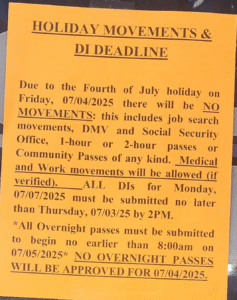
A
s
7/2/2025
From: LISA LEGAL (WHERE THE RUBBER MEETS THE ROAD) and Federal Legal News 6-16,30-25
A
William K. Marshall III promised that his new policy “ensures that FSA Earned Time Credits and SCA eligibility will be treated as cumulative and stackable, allowing qualified individuals to serve meaningful portions of their sentences in home confinement when appropriate.”
A
Not exactly…
Instead, it directs that “[]n addition to FTCs for those individuals who have earned less than 365 days of FTCs, staff must also consider adding up to an additional 12 months of prerelease time under the SCA, based on the five-factor review.”
A
6/17/2025
*
A
At one camp, the Unit Manager informed individuals who had waited for hours that there was no memo regarding changes, despite having previously acknowledged its existence. The manager requested not to be disturbed.
A
“I’m set for release in four months due to time credits, but I still owe over 200 days from the COVID transit period. My case manager mentioned home confinement for eligible inmates but dismissed it, saying, ‘I won’t act until I get directives from Central Office.’ This attitude keeps us in limbo.”
A
Alderson can be one of those failing to properly apply FSA and SCA sentence credits.
L
Individuals with less than 365 days of FSA time credits toward supervised release may have their pre-release time extended by up to 12 months under the SCA. This extension should be based on a careful five-factor review of each case.
L
Unfortunately, despite what the Director said, people who have more than 365 FTCs to be used toward prerelease custody will likely not receive any SCA time whatsoever.
L
Prisoners need to serve at least 74 months to earn over 365 FTCs for halfway house or home confinement eligibility. Ironically, those with the longest sentences benefit the most from this but may be denied access. This inconsistency reveals a flaw in the system that undermines fairness and the rehabilitation process.
L
The issue is that, despite the claim that time is “cumulative and stackable,” a five-factor review for someone already serving 12 months in a halfway house under the FSA is unlikely to find additional time necessary. This raises concerns about their opportunity to adjust for successful reentry.
Second Chance Act of 2007: Community Safety Through Recidivism Prevention.
42 USC 17501
A
Ongoing lockdowns and extensive waitlists on the rehabilitation of residents, particularly in areas such as education, programming, visitation, and access to medical and mental health services.
2. Fairview Residential Reentry Center (RRC),
…a privately-owned halfway house for women in Northeast D.C., operated by Reynolds and Associates.
It houses female inmates who are within 18 months of release and have contracts with the D.C. Department of Corrections (DOC) and the Bureau of Prisons (BOP).