


WHAT’S NEW IN THE FEDERAL COURTS & THE BOP.
EARLY RELEASE TO HOME CONFINEMENT – ARE YOU ELIGIBLE?
THE DEVIL IS IN ‘YOUR PREPARATION’
7-4-2026
PRISON FACILITY CLOSURES IN THE BOP
*
><
FEDERAL LEGAL NEWS
AT ISSUE,
Jun 29, 2026
- The First Step Act allows eligible incarcerated individuals to earn time credits for prerelease custody in RRCs and home confinement. However, as of January 2026, most individuals could not fully utilize their earned credits. Specifically, the BOP did not apply all credits for 71% of those eligible between March 31 and December 31, 2024.
- THE SCA
- If your sentence is > 60 mo. (5 yrs) = last 6 mo. on home confinement.
- If your sentence is < 60 mo. (5 yrs) = last 10% on home confinement.
- NOW,
- The BOP has diminished the re-entry benefits of the Second Chance Act (SCA), which used to grant prisoners six to nine months in halfway houses. Currently, the BOP states that eligible individuals can expect only an average of 60 days, with the availability of FSA credits contingent on halfway house resources, not considering home confinement. While the SCA allows for “up to twelve months,” Congress likely did not intend for appropriations to lead to just two months of halfway house placement.
- YES, CONFUSION ABOUNDS.
- BOP officials indicated that incarcerated individuals might receive the full 365 days, but only if RRC beds and home confinement spaces are available. In contrast, the FSA mandates that the BOP must place individuals without flexibility, as the statute uses “shall.” Since US Probation can assess homes for suitability and has monitoring technology, prisoners serving beyond their statutory time should be released to home confinement. Statistics show that individuals released during COVID had a significantly lower recidivism rate.
F
FEDERAL LEGAL NEWS
AT ISSUE,
Jun 15, 2026
- THE INTENDED USE OF FUNDING
- THE TRANSFER OF FUNDS OUTSIDE OF THE BOP
- BOP DATA COLLECTION AND IMPLEMATION, BISMAL AT BEST
- BOP’s FSA APPROVED GUIDE OVERSTATES THE FACILITIES THAT OFFER THESE PROGRAMS.
- HEALTHCARE DIAGNOSIS CODES (BPA 504) FALL SHORT WTI THE CURRENT ICD-10 CODES USED IN THE COMMUNITY.
- “The FBOP maintains a healthy inmate population but offers substandard care, severely limiting treatments and accurate diagnoses. By altering or withholding correct IDC-10-CM diagnoses, they hinder inmates from applying for Compassionate Release or Sentence Reduction, as many valid diagnoses aren’t included in the limited BPA 504 list of 200 codes out of 150,000 available.”
P
*
><
SO YOU’RE LOOKING FOR A PARDON, M/O STRATEGIES ($$PAYING FOR YOUR FREEDOM$$)…
PARDONS ARE GREAT, BUT WHAT DO YOU DO IF YOU DON’T HAVE THE $$?
J
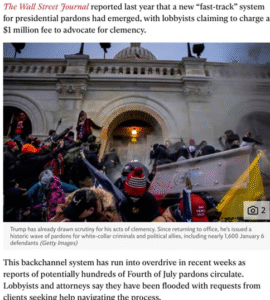
The largest amount, $960,000, was disclosed last year by Jack Burkman and Jacob Wohl for Joseph Schwartz, a nursing home operator who pleaded guilty to a $39 million payroll tax fraud. Schwartz served three months of his three-year sentence before receiving a pardon from Trump.
j
Cato Institute (Libertarianism.org): President Trump’s Pardons: An Embarrassment of Riches
- The vetting procedures of the Office of the Pardon Attorney are often sidestepped.
- Trevor Milton—donated $1.8 million to Trump’s campaign before a presidential pardon wiped out all $660 million of his restitution obligations.
- Paul Walczak—after his mother donated $1 million.
- Changpeng Zhao (Binance) brokered a $2 billion investment in Eric and Donald Trump. Jr.’s cryptocurrency business, World Liberty Financial.
A Cato analyst highlighted the risks of political and constitutional crises posed by presidential efforts to pardon state-level election criminals, warning that normalizing such actions could affect future elections.
k
P
><
A Prison Fellowship Academy Manager and former El Reno inmate offered a personal account of the power of evidence-based programming and the hope it provides for long-term change.
- Updated Tuesday, June 23, 2026
*
*
><
Supreme Court ‘Compassionate Release’ Ruling Could Send Ex-Inmates Back Behind Bars
- At 61, Bailey is facing a possible return to prison after a Supreme Court ruling and Justice Department action. “I hope everything turns out and I get my life back,” he said. “I’m a better person now — a productive citizen.”
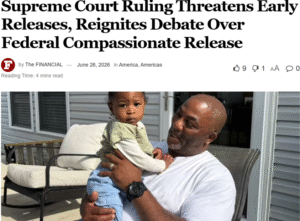
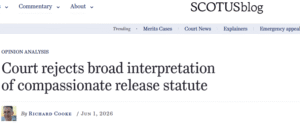
The Supreme Court recently ruled 6-3 that federal judges cannot consider extreme sentence disparities or outdated laws when deciding on compassionate release, which allows for shortened prison terms under “extraordinary and compelling reasons.” This decision undermines efforts to reform federal sentencing fairness. Although the compassionate release statute, enacted in the 1980s, originally permitted only prison wardens to file motions, the First Step Act of 2018 authorized incarcerated individuals to file such motions.
- While the COVID-19 pandemic saw increased use of this statute, fewer than 17% of motions were granted from 2020 to 2022. Courts have been divided on whether changes to nonretroactive sentencing law could qualify as “extraordinary and compelling reasons” for a reduction.
- The Sentencing Commission issued a policy statement in November 2023 that aimed to clarify these grounds, but federal prosecutors contested its legality. The cases of Daniel Rutherford and Johnnie Markel Carter, who faced disproportionate sentences under outdated laws, reached the Supreme Court, which ultimately affirmed the strict limitations on compassionate release.
- A legal debate arose regarding whether nonretroactive sentencing reforms, which would yield shorter sentences today, could qualify as “extraordinary and compelling reasons.” The Sentencing Commission introduced a policy statement addressing this issue, but federal prosecutors contested its legality.
Then there is:

AND,
><
BOP MEDICAL COPAYS – A BILL TO PROHIBIT THEM, WITH THIS EXCEPTION,
- When an individual in BOP custody is found responsible through the disciplinary hearing process for having caused an injury to another person in BOP custody that required a visit to a health care provider.
Z
6-11-2026
INMATE SECURITY DESIGNATION AND CUSTODY CLASSIFICATION (PAGE 1, 6). 5100.08, CN-3
- Ghislaine Maxwell: THE HOW, THE WHY.
*
G
><
FEDERAL LEGAL NEWS (FLN)
Jun 8, 2026
GOOD NEWS. The Bureau of Prisons (BOP) Camps have introduced a new initiative to transition qualified prisoners nearing their release dates to minimum-security facilities. Director Marshall emphasized the importance of providing inmates with preparation and support to reduce recidivism and enhance public safety.
- Effective immediately, eligible individuals will be moved to camps once they have a placement date for a Residential Reentry Center (RRC) or Home Confinement (HC). This process follows Program Statement 5100.08 CN-3 and will initially focus on inmates in low-security facilities suitable for camp placement.
- Those ineligible include individuals not qualifying for First Step Act (FSA) credits and non-U.S. citizens. This policy does not change the length of incarceration, only pre-release placement, for those who do not qualify.
The BOP’s implementation of the FSA and SCA is mixed. On June 17, 2025, BOP Director William K. Marshall III issued a memo stating that qualified individuals could serve portions of their sentences in home confinement. However, the BOP still struggles to comply with FSA directives, often conflating different statutory frameworks.
- Conditional Placement Dates should guide timely referrals, focusing on housing stability and community reintegration readiness instead of employment history. RRC bed capacity must not impede home confinement for eligible individuals.
- According to Section 3624(g) of the First Step Act, if a prisoner earns enough FSA Time Credits, maintains a low recidivism risk, and has an approved transfer petition, the Bureau of Prisons must transfer them to prerelease custody or supervised release, as mandated by the Supreme Court.
- 18 U.S.C. § 3632(d)(4)(C) Federal Defenders of New York Second Circuit Blog. states that time credits earned by prisoners in recidivism reduction programs must be applied to prerelease custody or supervised release. The Bureau of Prisons Director is required to transfer eligible prisoners into prerelease custody or supervised release.
Yet the BOP’s own implementing regulation at 28 C.F.R. Part 523, Subpart E, replaced Congress’s “shall” with “may” — providing that the Bureau “may apply” FSA Time Credits toward prerelease custody when criteria are satisfied.
S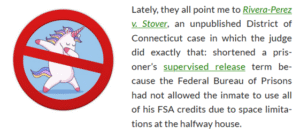
p
“Crossover Credits.” Once a prisoner’s FSA credits trigger a § 3624(g) transfer obligation, the BOP cannot limit the prerelease period to the SCA’s six-month or twelve-month caps. The FSA transfer pathway operates independently of the SCA, and courts have affirmed this authority, which Director Marshall’s June 17 directive aimed to implement at the institutional level.
- In Martin v. Phillips, No. No. 2:25-cv-00687 (E.D. Cal. Mar. 7, 2025), the court directed the BOP to transfer an inmate back to prerelease custody who had been removed from a halfway house due to an unresolved immigration detainer.
- In Crowe v. BOP (D.D.C., decided June 9, 2025), the court challenged the BOP’s systematic failure to transfer eligible inmates to prerelease custody on time.
L
Derek Gilna, Director of Research, JD, (De Paul Law School, 1975), MARJ, (Vermont Law School, 2020), Federal Legal Center, 133 W. Market, #171, Indianapolis, IN 46204; dgilna1948@yahoo.com.
L
A
><
DOJ Pushes for Significant Prison Time For Goldstein.
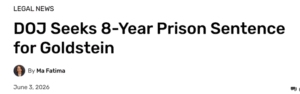
Goldstein is recognized as a leading appellate lawyer in the U.S., having argued many cases before the Supreme Court. He co-founded SCOTUSblog, a key resource for lawyers, journalists, judges, and law students.
b
His defense attorneys are,
- Requesting Supervised Release.
- Maintaining
 that he did not intentionally commit crimes.
 - Planning appeal strategies
- This is becoming a cautionary tale about financial compliance, professional responsibility, and personal conduct. In this period of upside-down law…
L
A Pardon may be in his future if all else fails.
J
How to get a Trump pardon: Forget the DOJ, call “Bobby” and other influencers.
A REUTERS SPECIAL REPORT. June 11, 2026
- Trump’s reference to “Bobby” highlights how he has transformed the pardon process in his second administration, bypassing over a century of Justice Department (DOJ) protocols. Currently, 96% of his second-term clemency grants have gone to recipients who did not meet longstanding DOJ guidelines, contrasting with less than 1% under Biden and 14% during Trump’s first term.
- Reuters identified 290 advocates who helped secure clemency for 197 recipients, with some representing multiple candidates, resulting in 624 acts of influence. Notable influencers include Brett Tolman and Roger Stone, with 110 being known as a Trump ally. Some intermediaries can charge up to $2 million for their services, although exact fees remain unclear.
- Stone and Angela Stanton King, another prominent advocate, acknowledged their roles but disputed any compensation received. Tolman did not respond to inquiries.
k
h
P
><
COMPASSIONATE RELEASE
k
OVERVIEW
- THE FIRST STEP ACT (FSA) OPENED THE DOORS FOR ITS USE
NOW INMATES CAN GIVE THEIR WARDEN 30 DAYS TO REPLY TO THE BP-9
THEN, WITH NO RESPONSE FROM THE WARDEN, ONE CAN GO DIRECTLY TO THE COURT - COMPASSIONATE RELEASE = MODIFIED INPRISONMENT: GRANTED ~14%
- But: THE GRANTING VARSIES BY DISTRICT WITH MARYLAND GRANTING~ 31%
NEEDED: EXTRAORDINARY AND COMPELLING REASONS
- USSC WANTED TO GIVE THESE DISCRETIONARY DECISIONS TO THE BOP, WHO ACTED VERY SLOWLY
- POST COVID PANDEMIC, THEY HAVE DROPPED SIGNIFICANTLY, TO 40 PER MONTH.
OUTCOMES
1. HEALTHCARE CASES ARE THE MOST DIFFICULT
- THE BOP STANDS BY, THAT THEY “CAN TREAT EVERYTHING.”
THE DOCTORS ARE WRONG - WE HAVE ALL THE FACILITIES NEEDED
- THEY’RE TOO DANGEROUS TO LET GO
**ADVOCACY (DETAILED DOCUMENTATION FROM THE INMATE AND OTHERS) IS MOST IMPORTANT**
EVEN IN CANCER CASES, DOCUMENTING THE BOP’S FAILURES, QUOTING THE DOJ, HHS, OIG
- LAWYERS CAN ALSO HELP
- CERTAIN JUDGES MAY NOT BE PURSUADED
- DOCUMENT COURSES TAKEN, JOBS DONE, MENTORING OTHERS
2. INEFFECTIVE COUNCIL
- ALLOWS JUDGES TO CORRECT (or adjust) THEIR SENTENCES
l
–
1/3; The Supreme Court Is Restricting Early Prison Release
- In recent decisions, the justices restricted the bipartisan First Step Act that President Donald Trump signed in his first term.
What counts as an extraordinary and compelling reason for early prison release?
- A terminal illness, advanced age, or a family emergency? In the federal system, the answers are often “perhaps” or “probably not.” However, concerns about harsh sentences or wrongful convictions have also been considered. Recently, the Supreme Court ruled that compassionate release cannot be used to question a conviction or to reduce sentences deemed excessive by current standards.
l

CURRENT CASES
- Pulsifer v. United States22-340
- Fernandez v. United States 24-556 Charged with killing two gang members and received two life sentences. 3582, denied by the Supreme Court. 2255 to challenge the conviction – per Congress.
- Rutherford v. United States24-820
- Maxwell v. Thomas25-5930
In 2018, Congress passed the bipartisan First Step Act to reform harsh federal sentencing and address racial disparities. It aimed to reduce overcrowding and costs by offering second chances to those serving long sentences. President Trump highlighted its potential for political unity and crime reduction.
j
Since then, the Supreme Court has done what it can to limit the First Step Act.
- In Pulsifer v. United States, the court narrowed the act’s expansion of the federal “safety valve,” a provision of the act that allows sentencing courts to forgo imposing mandatory minimum sentences if defendants meet certain criteria. Gorsuch noted that the court’s reasoning stemmed from a policy-driven argument for a narrower interpretation, thereby restricting district courts’ ability to grant relief and diminishing the act’s overall impact.
Elimination of mandatory ‘stacking’ under 18 U.S.C. § 924(c).
- In Rutherford v. United States, the court addressed whether prisoners under the old “stacking” regime could seek compassionate release due to reduced sentencing guidelines. Rutherford’s sentence would be 14 years shorter today, and Carter’s 21 years shorter. The court ruled that this disparity could not justify compassionate release, interpreting it as an improper retroactive application of the First Step Act, which was intended to apply prospectively only.
l
l
Justice Amy Coney Barrett argued that Congress’s choice to exclude new sentencing laws for older cases was logical. However, this overlooks the U.S. Sentencing Commission’s authority to define “extraordinary and compelling” circumstances. In 2023, the commission suggested that unusually long sentences might qualify for compassionate release under certain conditions, highlighting the ongoing debate within the Commission about flexibility in the justice system.
h
2/3; Supreme Court rules against prison sentence reductions
K
O
3/3; DURBIN RESPONSE
><
TWO BOP UPDATES
- FEDERAL RELEASE CARDS
- Strategic Expansion of Minimum-Security Camp Utilization, Enhancing Reentry Through Transitional Placement
h
l
l
o
o
5-28-2026
*
FEDERAL LEGAL NEWS (FLN)
5/25/2026
FLN has received troubling reports that some institutions are “zeroing out” or sharply reducing Second Chance Act placements despite BOP Director Marshall’s June 17, 2025, memo directing full implementation of the First Step Act and Second Chance Act.
- The Director stated that FSA credits and SCA eligibility should be “cumulative and stackable,” with timely referrals and expanded use of home confinement for qualified individuals, regardless of RRC bed limitations.
NOT AN ISOLATED EVENT. An inmate at FPC Pekin reported that the warden told prisoners the BOP is not legally required to grant Second Chance Act (SCA) placements, even for those who qualify, despite prior guidance emphasizing that SCA and FSA credits should be stacked.
- The DOJ has made similar arguments in some §2241 cases, noting the law provides “up to” 12 months of halfway house placement—not an automatic entitlement. While courts have held there is no constitutional right to SCA placement, the BOP is still required to follow the statute and Congress’s intent to maximize community-based reentry opportunities.
In Rodriguez v. Smith (2008), the court held that the BOP cannot categorically deny or limit Residential Reentry Center (RRC) or Second Chance Act (SCA) placements without considering the factors required under 18 U.S.C. § 3621(b). The court found BOP regulations unlawfully ignored Congress’s intent that placements be made on an individualized basis.
- Multiple federal circuits reached the same conclusion: while prisoners are not automatically entitled to SCA placement, the BOP must meaningfully consider each case under the statutory factors. Simply telling inmates, “We don’t do SCA here,” violates the law and Congress’s intent to maximize reentry opportunities.
The administration is also failing to fully utilize the International and BOP Treaty Transfer provisions that allow non-citizen prisoners who have served substantial portions of their sentences to complete them in their home countries. Expanding these transfers could save hundreds of millions of dollars and help reduce overcrowding.
- There are also growing legal challenges to enhanced methamphetamine purity sentences. Recent DEA and ATF data show that nearly all methamphetamine now qualifies as “pure,” undermining the rationale for higher penalties and raising serious due process concerns. Multiple federal courts have recognized this issue.
- At the same time, prisoners should not overlook potential relief under 28 U.S.C. § 2255. Successful ineffective-assistance-of-counsel claims often involve failures to investigate evidence, call key witnesses, challenge improper evidence, or properly advise defendants on plea options or sentencing exposure. Under Strickland v. Washington, defendants must show both deficient performance and a reasonable probability that competent representation would have changed the outcome.
Despite current focuses on the Supreme Court, Sentencing Commission, FSA, and SCA, 2255 motions remain a vital option. To win an Ineffective Assistance of Counsel (IAC) claim under Strickland v. Washington, a defendant must prove two elements:
-
Deficient Performance: The lawyer’s work fell significantly below a reasonable professional standard.
-
Prejudice: There is a reasonable probability that the outcome would have been different with competent counsel.
Examples of Deficient Performance
-
Failing to investigate alibi witnesses or present mitigating evidence.
-
Failing to object to inadmissible evidence.
-
Misadvising the defendant on plea bargains.
Key Precedents
-
Strickland v. Washington (1984): Established the foundational two-part test (performance and prejudice).
-
Kimmelman v. Morrison (1986): Failed to properly conduct discovery or object to illegally seized evidence.
-
United States v. Cronic (1984): Ruled that in extreme structural breakdowns of representation, prejudice can be presumed.
-
Wiggins v. Smith (2003): Found IAC where counsel failed to investigate and present mitigating life-history evidence at sentencing.
-
Koskela v. United States (8th Cir. 2001): Remanded to evaluate why counsel failed to present a viable alibi defense.
L
><

*
USP Canaan Is Not the Promised Land, Inspector General Finds
May 26, 2026
DOJ INSPECTOR GENERAL SLAMS LOCKDOWNS, HEALTHCARE, RESTRAINTS AT USP CANAAN
*
><
i
Felony Voting Bans In 2026

The state’s felony voting ban disproportionately affects Black Oregonians. While only 1.8% of Oregon’s population is Black, 8.7% of eligible voters banned from voting are Black, which is higher than the national average.
- Since 1997, 26 states and the District of Columbia have restored voting rights to over 2 million Americans with felony convictions. Oregon can enhance its progressive values by allowing all citizens, regardless of incarceration status, to participate in the democratic process. Lawmakers must act to ensure voting rights for all eligible individuals, champion racial justice, and affirm that voting is a fundamental right, not a privilege.
><
Legal and Systemic Arguments for Commutation of Federal Cannabis Prisoners.
*
><
The Trump administration pulls back on white-collar enforcement.

The Justice Department has moved to permanently drop the indictment against Adani, signaling a pullback on white-collar enforcement under President Trump. Additionally, the administration announced a $275 million settlement with a company founded by Adani for apparent violations of U.S. sanctions against Iran.
- In late 2024, prosecutors and regulators accused Adani and his associates of running a multi-billion-dollar scheme to mislead U.S. investors and global financial institutions. The Department of Justice (DOJ) alleged that they paid over $250 million in bribes to Indian officials for solar energy contracts expected to yield billions in profits, while concealing the scheme during fundraising efforts in the U.S.
- Recently, the DOJ announced it would drop the case, stating that it has chosen not to allocate further resources to these criminal charges against the defendants.
><
k
Who to Buy, Who to Influence For Trump Clemency
May 28, 2026

“Clemency” includes pardons (which erase convictions) and commutations (which reduce sentences but leave convictions intact).
- The DOJ’s Pardon Attorney website now obscures totals, but reporting cites over 20,000 pending clemency requests—up from about 5,000 at the end of the Biden term and 18,000 after his first year.
- The current clemency process departs from tradition. Previously, applicants submitted to the Office of the Pardon Attorney (OPA), which consulted agencies and officials before forwarding selected cases to the White House for review and a presidential decision.
- Traditionally, pardons were considered only after at least five years out of prison and after sentences were complete. Now, some pardons are granted during active sentences—or even before trial or sentencing.
Toobin’s The Pardon YouTube says clemency decisions are shaped by White House counsel David Warrington, deputy Sean Hayes, and chief of staff Susie Wiles—whose influence often outweighs others.
- Trump’s Pardon Attorney, Ed Martin, lacks significant criminal law experience and has taken a partisan approach (“No MAGA left behind”), while reportedly being minimally engaged. Trump also created a “pardon czar” role for Alice Marie Johnson, but her influence appears limited.
- The process now relies heavily on access and influence rather than formal channels. For most applicants, neither Martin nor Johnson can deliver outcomes, and success may depend on reaching key insiders, as Trump often listens to the last adviser he hears.
- Examples of controversial clemency include a last-minute pardon of a convicted sheriff and a pardon of Binance founder Changpeng Zhao, whose company has financial ties to Trump ventures.
The New York Times, How to Get a Pardon in Trump’s Washington (May 22, 2026)
DOJ, Pardon Application
Toobin, Jeffrey, The Pardon: The Politics of Presidential Mercy (February 11, 2025)
New York magazine, Trump’s Pardon Office Is ‘Totally Decimated’ The team has been virtually replaced by highly paid lobbyists and friends of the president. (February 27, 2026)
Wall Street Journal, Iran Moved Billions Through Binance to Fund Regime – Continuing Into This Month (May 21, 2026)
~ Thomas L. Root
><
Trump’s plan to Pardon 250 on America’s 250th Is Rumored
May 18, 2026

The Wall Street Journal recently reported that discussions are still in the early stages, and it remains unclear whether the action will involve only a pardon (forgiveness of a conviction) or a commutation (reduction of a sentence without erasing the conviction).
- Trump, a convicted felon appealing in New York, granted clemency over 2,000 times during his term. This is half of what President Biden has done, including commuting sentences under the CARES Act, pardoning past marijuana possession offenses, and reducing 38 out of 40 federal death row sentences to life imprisonment.
- Trump’s clemencies have sparked more controversy than Biden’s. While Biden was criticized for pardoning family, Trump pardoned 1,500 January 6th rioters on Inauguration Day and granted clemencies to campaign donors, drawing bipartisan backlash. The Wall Street Journal reported that some candidates are now seeking to have their convictions erased.
- Trump’s clemency policies and the appointment of Alice Marie Johnson as clemency czar led to a surge in petitions, with about 5,100 filed in 2024 and over 16,150 the following year.
- St. Thomas School of Law Professor Mark Osler, a federal clemency expert, has expressed frustration over unanswered client petitions. He described the pardon attorney’s office as a “zombie office” that simply assigns numbers to cases without meaningful progress. Osler noted that clients receive no updates, forcing him to tell them their petitions are “pending,” which effectively means they are being ignored. He finds it particularly troubling that wealthy individuals often receive clemency, while marginalized, less fortunate individuals are neglected.
Wall Street Journal, White House Explores 250 Pardons to Mark America’s 250th Birthday (May 13, 2026)
Dept of Justice, Office of the Pardon Attorney (May 17, 2026)
New Yorker, Donald Trump’s Pardon Economy (April 27, 2026)
~ Thomas L. Root
><
Circuit Courts Tend to Get in Line
May 14, 2026
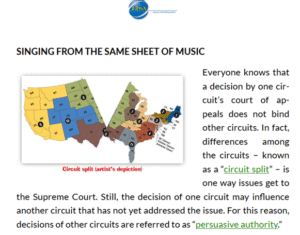
In an upcoming Southern California Law Review article, Georgetown Law professor Amy Griffin examined the deference circuit judges give to “peer circuit precedent,” or decisions from judges in other circuits, despite not being obligated to follow them.
- Professor Griffin noted that the first circuit to address a legal question significantly influences future court decisions nationwide. This raises concerns about the Supreme Court’s “percolation” practice, as some lower courts seem to quickly align rather than develop unique reasoning. Griffin found that the 10th Circuit’s rulings were followed by other appeals courts 75% of the time, while the 2nd Circuit had the lowest “win rate,” with its position chosen 49% of the time in later decisions.
National Law Journal, Appellate Judges Put a Lot of Weight on Sister Circuit Precedent, Study Finds (April 20, 2026)
~ Thomas L. Root
l
><
Presume Bigots on Jury Are Unfair, 9th Says
May 19, 2026

Andres’s lawyers claimed that trial comments revealed racial bias and homophobia, leading to structural error that justified a new trial. Structural error requires a retrial without needing to show its impact on the verdict. Although the district court removed the racist juror before a verdict, it later denied a new trial post-conviction, stating that Andres could not prove the comment affected the jury’s decision.
The 9th Circuit reversed.
- The Government argued that the district court’s standard was correct, asserting a verdict should be reversed only if the defendant proved the dismissed juror’s racial bias affected it. The defense claimed any pre-verdict juror bias was a structural error. The 9th Circuit found otherwise, stating that pre-verdict bias isn’t a structural error, but ruled that Andres should receive a new trial based on the 1954 Supreme Court case United States v. Remmer, which established a “heavy presumption of prejudice” for jury tampering.
- The Circuit ruled that Remmer applies when “jury taint originates from within the jury,” including exposure to another juror’s partiality. The court rejected the government’s argument to exempt cases of racial bias from Remmer, stating that both racial bias and corruption lead to juror taint for improper reasons. If a different standard were needed, it should impose a stricter prejudice standard for racial bias, not a lesser one.
United States v. Sanchez, Case No. 23-2533, 2026 U.S.App. LEXIS 13615 (9th Cir. May 12, 2026)
United States v. Remmer, 347 U.S. 227 (1954)
United States v. Shapiro, 669 F.2d 593 (9th Cir. 1982)
~ Thomas L. Root
><
x
PROVIDERS, DON’T BE LURED IN BY A FALSE SENSE OF SECURITY
*
C
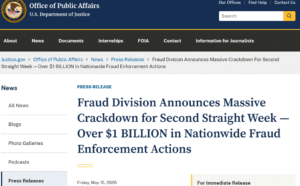
The Department of Justice (DOJ) utilizes advanced data analytics and artificial intelligence to identify healthcare fraud schemes and hold those responsible accountable. The Data Analytics Team within the Health Care Fraud Section identifies healthcare providers who are extreme outliers, meaning they receive an unusually high amount of Medicare payments for similar procedures or services in their area.
- This occurs when they have been paid significantly more than the next-highest group of providers, who are more appropriately specialized for the services rendered. Investigations and evidence presented at trial have led to successful convictions.
s
Although white-collar crime is mentioned throughout this memorandum, transnational activities, cartels, narcotics, healthcare, and immigration are at the forefront.
z
5-10-2026
FEDERAL LEGAL NEWS (FLN)
5/4/20236
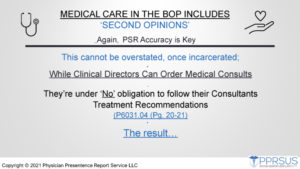
- THE BOP CLINICAL DIRECTOR (CD) IS NOT OBLIGATED TO FOLLOW THEIR SPECIALIST’S MEDICAL RECOMMENDATIONS
- The CD retains overall administrative and clinical responsibility for managing CCC inmates. The CD or responsible physician will provide requisite consultation to APPs, pharmacists, and therapists collaborating in CCC management in accordance with properly executed practice
agreements P6031.04 (Pg. 45). - The Physician CD is under no obligation to follow consultant recommendations.
- If the consultant’s recommendations are not followed, the Physician CD will document his/her justification in the EHR. (Page 48)
- The CD retains overall administrative and clinical responsibility for managing CCC inmates. The CD or responsible physician will provide requisite consultation to APPs, pharmacists, and therapists collaborating in CCC management in accordance with properly executed practice
- INCLUDING YOUR COMPLETE MEDICAL RECORD IN YOUR PSR IS A CRUCIAL FIRST STEP.
BOP Program Statement 6031.05 requires medically necessary care, timely care, specialty consultations, chronic care follow-up, and care-
level reassessment. BOP Program Statement 5100.08 supports placement at institutions capable of meeting medical needs; BOP Program Statement 5330.11 supports RDAP and co-occurring mental health treatment.
Program Statement No. 5241.01, Management of Aging Offenders, is defined as those 50 years or older exhibiting physiological, functional, or cognitive changes. Medical Care & Accommodations: Ensures access to assistive technology (wheelchairs, hearing aids), specialized housing (lower levels, proximity to restrooms/health services), and chronic care clinics. (Timely-Aspirational, from my perspective.)
At FCI Herlong, an inmate there for over three months went without seeing a doctor about their medications. The MAT program is another challenge, but the lack of access to MAT medications is due to a lack of supply, or supposedly consent form issues. Refill requests for high blood pressure and cholesterol meds haven’t been received for three weeks. (Not surprising, staffing shortages?)
Derek Gilna, Director of Research, JD, (De Paul Law School, 1975), MARJ, (Vermont Law School, 2020), Federal Legal Center, 133 W. Market, #171, Indianapolis, IN 46204; dgilna1948@yahoo.co
c
><
N
J
 J
J
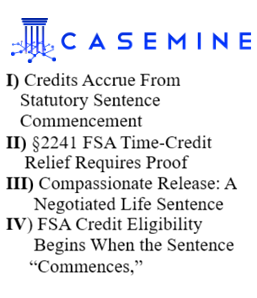
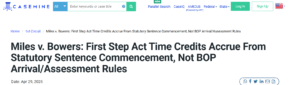
I) Miles v. Bowers: First Step Act Time Credits Accrue From Statutory Sentence Commencement, Not BOP Arrival/Assessment Rules
4-29-2026
Legal Reasoning
1) Statutory “sentence commences” controls; 28 C.F.R. § 523.42(a) cannot rewrite § 3585(a)
2) Risk-and-needs assessment is not a prerequisite to earning credits
3) Non-federal location does not categorically bar accrual where participation can be verified
4) Miles’ two-sentencing timeline did not justify splitting the 15-month period
J
 V
V
II) Harris v. Warden: § 2241 First Step Act Time-Credit Relief Requires Proof of Actual Qualifying Participation
4-29-2026
3.2. Legal Reasoning
(a) The court narrowed the dispute to proof of earning, not the timing of eligibility
(b) Burden allocation drove the result
(c) “Participation” is not a formality—credits are earned through action
Conclusion
- A prisoner cannot obtain § 2241 relief for miscalculated FTCs without proving participation in qualifying programming to earn credits. The Tenth Circuit emphasized that entitlement relies on evidence of earned credits. Future petitioners should focus on the law but emphasize the importance of the record in their cases.
J
 L
L
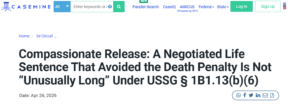
III) Compassionate Release: A Negotiated Life Sentence That Avoided the Death Penalty Is Not “Unusually Long” Under USSG § 1B1.13(b)(6)
4-26-2026
Legal Reasoning
-
-
Adequacy of the District Court’s explanation
-
USSG § 1B1.13(b)(6) and the “unusually long sentence” theory
-
Independent weight of § 3553(a)
-
Conclusion
- United States v. Julio Otero upholds a restrained approach to compassionate-release denials, indicating that brief reasoning is sufficient per Rita and Chavez-Meza. A negotiated life sentence is unlikely to be seen as “unusually long” under USSG § 1B1.13(b)(6). The decision emphasizes the importance of § 3553(a), especially when public safety concerns are significant, given the seriousness of the underlying conduct.
J
 L
L
IV) First Step Act Time-Credit Eligibility Begins When the Sentence “Commences,” and Post–Loper Bright Courts Must Independently Test the BOP’s “Successful Participation” Rule
4-24-2026
Legal Reasoning
1) Article III mootness/redressability
2) Statutory anchor: sentence commencement under 18 U.S.C. § 3585(a)
3) The interpretive conflict: “successful participation” and the risk-and-needs assessment
4) Record insufficiency and procedural posture
Conclusion
- The case Rahshjeem Benson v. Warden FCI Edgefield clarifies FSA time-credit litigation in the Fourth Circuit. It rules that district courts cannot invoke Chevron to support the BOP’s “successful participation” criteria and must determine the statute’s “best meaning.” The decision emphasizes that FSA credit eligibility starts when a sentence “commences” under 18 U.S.C. § 3585(a), not when an inmate arrives at a BOP facility. This allows prisoners to claim credit for completing qualifying programs outside their institutions and limits mootness defenses, as eligibility can vary over time.
K
><
c
Becker’s Hospital Review: Healthcare Is Still The DOJ #1 Target.
- DEI- FCA- LGBTQ. LESS ACCESS TO: REPRODUCTIVE HEALTH, MEDICAID, AND THE ACA.

The Fraud Division Launches West Coast Strike Force to Target Health Care Fraud Schemes Across Arizona, Nevada, and Northern California
April 30, 2026
*
RISK MANAGEMENT PREPARATION
- Keeping you, your practice, and business clear of a DOJ Audit is key to your finances and freedom. We know budgets are tight, and the DOJ is looking for convictions, but financial shortcuts in practice management aren’t the answer.
I understand that being involved in a DOJ healthcare inquiry is very stressful, as I went through this in 2006. Having experienced legal representation in cases like yours is crucial. If you’ve been found or pleaded guilty, call me.
Sentence Mitigation Options start with Preparation for your PSI and PSR, which is up to you.
j
THE NATIONAL HEALTHCARE FRAUD TAKEDOWN OF 2025.
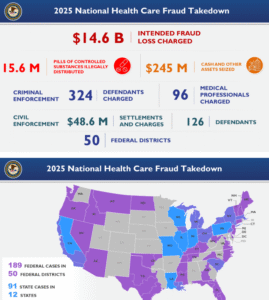
- The department’s enforcement model has led to charges against over 6,200 defendants for billing more than $45 billion to federal healthcare programs and private insurers.
- Officials have announced an expansion in response to rising fraud levels in three regions, particularly in technology-driven schemes. “Silicon Valley has become a hotspot for healthcare fraud targeting taxpayer-funded programs like Medicare.” This comes after a record year in 2025, with over $15 billion reported in alleged losses from the National Health Care Fraud Takedown.
j
h
FINANCIAL STRESS – THE 2027 BUDGET.
- The Trump administration’s fiscal year 2027 budget, released April 3, proposes a $15.8 billion cut to HHS, while requesting $1.5 trillion for defense, a 44% increase.
1. HHS faces a $15.8 billion cut. The proposed budget requests $111.1 billion for the Department of Health and Human Services (HHS) in fiscal year 2027, a 12.5% reduction from 2026. The administration described this cut as a means to eliminate “bloated and inefficient programs.” Under the One Big Beautiful Bill Act, which proposes nearly $1 trillion in Medicaid cuts, President Trump stated it is “not possible” for the federal government to sustain Medicare, Medicaid, and childcare funding. April 3rd, 2026
2. NIH loses $5 billion; 3 institutes eliminated. The budget requests $41 million for NIH research, representing a cut of approximately $5 billion compared to 2026 funding.
3. A new agency replaces several familiar ones: The American Health Agency (AHA) intends to improve efficiency by cutting $5 billion in funding for programs that are inconsistent with the Trump administration’s policy priorities. This reallocation ensures that the agency’s efforts align with administration goals.
4. Global health funding cut by $4.3 billion, PEPFAR restructured.
40% of the President’s Emergency Plan for AIDS Relief funds under the Biden administration supported service delivery, such as medications and testing, while the rest went to administrative costs and supply chain overhead. The budget cuts funding for some reproductive health services, circumcision programs, and LGBTQ-related health services.
5. The Hospital Preparedness Program would be eliminated. The The $240 million Hospital Preparedness Program, part of the Administration for Strategic Preparedness and Response, is facing elimination. This program has been essential for funding hospital surge capacity and disaster response.
f
Its potential removal is worrying as hospitals continue to learn from the COVID-19 pandemic and face future vulnerabilities.
C
6. VA healthcare investment spikes. EHR and AI implementation
7. AHRQ is effectively eliminated. The Agency for Healthcare Research and Quality would see a proposed $129 million cut.
8. LIHEAP scrapped — again. The administration is proposing to end the Low Income Home Energy Assistance Program.
9. WHO and the Pan-American Health Organization would be defunded entirely.
“These corrupt organizations have shown no independence from inappropriate political influences, such as when the WHO aided in the COVID-19 cover-up…”
History will be the judge.
p
I
><

Medical debt vs. Medicaid expansion: One state has a clear winner: Michigan, providing healthcare (Medicaid) to its citizens.
“People with more financial security earn higher incomes and pay more taxes in the future, making Medicaid expansion beneficial for state and local budgets,” states Becker. The brief from Michigan Medicine’s Institute for Healthcare Policy & Innovation emphasizes that Medicaid expansion can reduce financial stress and enhance economic stability for low-income individuals and communities.
- It warns that policies limiting Medicaid enrollment may negatively affect financial stability. Medicaid expansion remains a contentious political issue, generally supported by Democrats and opposed by Republicans.
H
><
J
*
c
c
a
5-2-2026
*
PRISON SHANKS AND CELL PHONE (CONTRABAND) MAY GET YOU MORE TIME IN PRISON
*
><
Open Letter to BOP Director William Marshall, III: It’s been 2,689 days since the First Step Act was enacted.
- Yet the law’s intent is still not being implemented; rather, it is being left to Agency Interpretation. At the same time, the Supreme Court overruled Chevron in Loper Bright, eliminating deference to agency interpretations.
By Carey Bilyeu
h
e
d
><
The War on Drugs, Meth “Sentencing Disparity”
- Fentanyl and other synthetic opioids are responsible for over two-thirds of overdose deaths and are often mixed with drugs like meth without users’ knowledge. This focus on fentanyl has led the Commission to unexpectedly abandon its meth reforms and issue misleading press releases.
- Research shows that sentencing varies based on lab testing practices rather than actual culpability, creating “unwarranted sentencing disparity.” This means that arguments about “excessive sentences” or “sentencing disparity” can still be used in petitions for compassionate release.
- In the post-LOPER BRIGHT era, the President, Congress, and the courts seem unconcerned with “sentencing experts” who contributed to the incarceration crisis and the profit-driven incarceration industry.
The following cases are good law:
- United States v. Robinson (S.D. Miss. 2022) Judge Carlton Reeves (later Chair of the Sentencing Commission); “Meth guidelines based on purity are, ‘not grounded in empirical evidence,’ (and) produce excessive and unjust sentences;
- United States v. Johnson, 379 F. Supp. 3d 1213 (M.D. Ala. 2019): Purity is no longer a reliable proxy for role in the conspiracy, and the guidelines produce unwarranted disparities;
- United States v. Bean, 371 F. Supp. 3d 46 (D.N.H. 2019): Meth purity guidelines lack an empirical basis, overstate culpability, and the court varied downward from the guidelines.
h
a
><
s
LAW 360.
The First Circuit ruled that federal inmates can begin earning FSA Credits while in a state lockup as they await arrival at a BOP Facility. 4/28/2026
b
><
p
Mail Scanning isn’t the Solution to Drug Use in Prisons — Is Your Prison Listed?
4-28-2026, Prison Policy Initiative
j
…mail scanning focuses on the wrong part of the problem, failing to prevent overdoses and leaving officials aiming at a constantly shifting target.
- Illinois is set to join other states in implementing mail scanning in its prisons. However, six months later, a report revealed no significant change in drug seizures or overdoses.
- The opioid epidemic has claimed over 806,000 lives since 1999, and prison deaths from drug or alcohol intoxication increased by about 500% between 2010 and 2018. However, little has been done to address these issues, including the harmful trend of mail scanning, which damages family connections without improving conditions in prisons.
“Physical mail is so important because it carries a certain tangibility that is stripped away when scanned and turned digital. The feelings and the essence of physical mail one can touch fades when digital, it’s like you can’t see and feel the love and contents anymore when it’s scanned.” —Alabama
About one-third of states process mail at the receiving prison, while most use for-profit central processing centers like Securus, which also profits from video calls and messaging. Mail sent to these centers is scanned for contraband and analyzed by AI for threats or explicit content before being digitized and provided on tablets or as photocopies.
- Incarcerated individuals can obtain photocopies of cards and letters sent to their tablets, typically for a fee. These copies are often of poor quality, making them difficult to read or missing pages. The original versions may be destroyed and never reach the recipient.
“I can’t print out scanned mail, and once I’m eventually released, I’ll lose access to all my scanned correspondence.”—Tennessee
b
A
><
Release Date Confusion For Those In Prison.
Needs Consistency, just like We Expect Daily.
By Walter Pavlo. 4-24-2026
k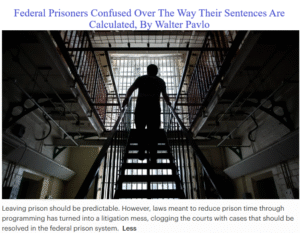
**My Key Takeaways:**
- **Prison Release Uncertainty**: Inmates often struggle with knowing when they will be released, with confusion surrounding the Bureau of Prisons’ (BOP) policies for prerelease custody (halfway houses or home confinement).
- **Good Conduct Time**: Inmates can earn 54 days of Good Conduct Time per year of their sentence, which can reduce the sentence if rules are followed. The First Step Act allows for additional time credits (up to a year off) for participation in productive activities.
- **Legal Confusion**: Confusion arises from the intersection of the First Step Act and the Second Chance Act, as both laws affect release timing but function differently. Misunderstanding these laws can lead to unrealistic expectations about release dates.
- **First Step Act**: This act encourages rehabilitation by allowing inmates to earn credits through programming, which can help in transitioning to supervised release but does not directly determine release timings.
- **Second Chance Act**: Provides BOP the authority to place inmates in prerelease custody, but does not guarantee it. Decisions are individualized based on various factors, such as risk levels and institutional history.
- **BOP Criticism**: The BOP has faced criticism for underutilizing prerelease custody, resulting in inmates remaining incarcerated longer than necessary due to facility neglect and staffing shortages.
CONSISTANCY.
><
v
g
Loper Bright May Be Coming for BOP Time Credit Rules
4-28-2026, Overview.
Benson was sentenced to federal prison but first spent 15 months in county jail, where he says he completed programs that should have earned him First Step Act time credits under 18 § 3632. The BOP refused to award credits because he hadn’t yet received the required individualized risk-and-needs assessment, which wasn’t done until he reached his designated federal prison.
- Benson filed a pro se § 2241 habeas petition seeking about 150 FSA credits. The district court dismissed it without requiring a government response.
- In April 2026, the Fourth Circuit vacated and remanded, holding that the district court erred by dismissing the petition so early. The court ruled Benson had standing and that his claims required factual development and a government response. The Fourth Circuit only held that the case must proceed.
-
The Fourth Circuit held that George had standing to seek First Step Act credits even though he was assessed as medium risk, because his risk level could later drop or the warden could approve prerelease custody, meaning the credits might still be usable. That possibility was enough to avoid mootness.
On the merits, the BOP argued credits require “successful participation” in programs recommended after a needs assessment, so  George’s county jail activities couldn’t count. But while the case was pending, the Supreme Court overruled Chevron in Loper Bright, eliminating deference to agency interpretations. The Fourth Circuit therefore remanded the case to the district court to decide—without deference to the BOP—whether a prior assessment is actually required to earn credits.
Benson v. Warden, Case No. 24-6713, 2026 U.S.App. LEXIS 11454 (4th Cir. April 22, 2026)
Loper Bright Enterprises v. Raimondo, 603 U.S. 369 (2024)
Chevron USA Inc. v. NRDC, 467 US 837 (1984)
~ Thomas L. Root
v
><

GROSS DISPARITIES ARE GROSS BUT NOT ALWAYS REMEDIABLE
4-27-2026, Overview.
 Back about 25 years ago, David Luster robbed a bank. And then another one. And another one. And so on.
…convicted of two counts of armed bank robbery, two 18 USC § 924(c) counts, and an Armed Career Criminal Act (18 USC § 924(e)(2)) count.
Dave was sentenced to 535 months under § 924(c), carrying a mandatory minimum sentence of 25 years. After the First Step Act, the § 924(c) mandatory minimum fell to 7 years (320 months).
Extraordinary and compelling, under USSG § 1B1.13(b)(6)’s “unusually long sentence,” nope.
The district court denied his motion due to the violent nature of the offense. Then the 11th Circuit affirmed, holding that the district court did not abuse its discretion, noting that the policy statement is discretionary; as (b)(6) gives the district court the option of finding that unchallenged facts are not “extraordinary and compelling.”
l
D
4-26-2026
LIFE DOES NOT IMITATE ART
4-23-2026
The Safer Prisons Act of 2026, S. 4305, cosponsored by Sen. Tom Cotton (R-AR), would double the maximum term of imprisonment for the offense.
- Sen. Marsha Blackburn (R‑TN) last week introduced a bill increasing penalties for inmates who assault BOP correctional officers, citing a rise in attacks and resulting PTSD among officers.
- Coincidentally, a BOP employee at FCI Talladega was arrested the same week for allegedly driving through police and fire barricades at an active fire scene and resisting arrest.
- The employee is, of course, presumed innocent—though the episode suggests that threats to safety may come from more than just inmates.
S.4305, Safer Prisons Act of 2026
Ripon Advance, Blackburn proposes bill to double down on inmates who assault federal prison officers (April 17, 2026)
WABM-TV, Talladega Prison Staffer Arrested on Obstruction, Resisting Charges (April 16, 2026)
~ Thomas L. Root
t
GUILTY PLEA WITHDRAWAL MOTION REQUIRES A HEARING WHERE FACTS ARE IN DISPUTE
4-24-2026
Withdrawing a Guilty Plea Isn’t “Easy, Peasy.”
- Rule 11(d) allows a defendant to withdraw a guilty plea before sentencing if there’s a “fair and just reason.” In
 practice, that’s anything but simple—especially when the defendant’s account conflicts with former counsel’s.
 - That’s what happened to Christen Clark. After pleading guilty to six drug charges, Clark learned his lawyer was abruptly leaving the profession amid pending disciplinary action. Clark moved to withdraw his plea, claiming counsel never showed him the evidence, fully explained the plea, or disclosed his disciplinary jeopardy. The district court denied the motion without a hearing and sentenced Clark to 270 months.
- Last week, the Sixth Circuit reversed. When a defendant raises factual disputes that go directly to whether a plea was knowing and voluntary—particularly where his claims conflict with counsel’s—a district court may need to hold an evidentiary hearing to satisfy due process. Here, the court held, the record did not clearly resolve those disputes, and Clark was entitled to a hearing.
United States v. Clark, Case No. 24-4068, 2026 U.S. App. LEXIS 10889 (6th Cir. April 16, 2026)
~ Thomas L. Root
h
><
THE SENTENCING PROJECT.
Reentry after Long-Term Imprisonment.
4-22-2026
d
><
Making Federal Prison Even More Dangerous for Transgender Inmates.
April 20, 2026
BOP Program Statement 5260.01: Management of Inmates with Gender Dysphoria.
c
j
Kali Holloway
In January 2017, the Obama administration issued guidelines for federal prisons to ensure transgender inmates had access to the needed programs and services. Both Democratic and Republican administrations upheld policies for gender-affirming care, including hormones and surgeries, but as noted by the Marshall Project, such care has been inconsistently provided, and housing for transgender prisoners remains rare.
h
f
u
h
><
Cannabis is to be classified as a Schedule III substance, which will include benefits pertaining to business taxes.
On April 23, 2026, the Department of Justice placed cannabis “subject to a state medical marijuana license” in Schedule III of the Controlled Substances Act (CSA). This Order is limited; any cannabis not FDA-approved or lacking a state medical license remains a Schedule I substance, while synthetic tetrahydrocannabinols stay in Schedule I.
- State-licensed medical cannabis businesses will benefit the most, as the Order provides relief from Section 280E, which has resulted in effective tax rates exceeding 75% for some. With Schedule III status, qualifying businesses can now claim standard business deductions, significantly improving the economics of medical cannabis operations.
D
D
><
Categorization of Offenses, Summary of Changes, March 19, 2026
Confusion Over PS 5162.06 Program Changes.
C
FEDERAL LEGAL NEWS (FLN) 4/20/2026
-
The BOP has a history of undermining Congressional sentence-relief proposals, notably the one-year credit for completing the RDAP. Courts, except in the 9th Circuit, often align with the BOP on eligibility, particularly affecting inmates with violent backgrounds.
-
Memo 5162.06 attempts to counter this trend but has flaws. It states that eligibility for FSA time credits is based on federal law while disqualifying all offenses under 18 U.S.C. § 922(g), even though Congress hasn’t explicitly excluded it. The memo also gives the Director discretionary power to deny benefits for convictions posing potential risks of violence, allowing the BOP to override Congressional rights without clear authority. Page 7c, 8#4, 9, 10, 11c, d.
-
Additionally, the BOP often transfers inmates with medical needs under various pretexts, forcing them to restart the administrative remedy process, which delays resolution and jeopardizes their health. Whistleblowers are frequently moved far from home to avoid complaints about misconduct.
-
Chief Justice John Roberts noted that agencies lack special competence in resolving statutory ambiguities, emphasizing that courts should interpret laws, as outlined in the 1946 Administrative Procedure Act. Page 7c, 8#4, 9, 10, 11c, d.
l
h
><
Sentencing Commission Amendments: 2025–2026 Overview
4-20-2026
d

- Despite the significance of this amendment cycle, the Commission concluded both the 2024–25 and 2025–26 sessions with brief, opaque public meetings that offered little explanation for key decisions. Several proposals were adopted, others were not, and the lack of transparency marked a disappointing moment for federal sentencing policymaking.
Key Adopted Amendments
The Commission approved several notable changes aimed at modernizing and simplifying the Guidelines:
- Recognition of Rehabilitation: New pathways allow defendants to receive credit for presentence rehabilitative efforts.
- Expanded Non-Custodial Sentencing: Greater emphasis on probation, home confinement, and split sentences.
- Economic Crime Updates:
- Loss table revised to reflect inflation.
- Elimination of the “sophisticated means” enhancement.
- New enhancement addressing non-economic harm to victims.
- Guideline Simplification: Removal of more than two dozen rarely used offense characteristics, some dating back to 1987.
Policy Goals
The amendments aim to:
- Simplify and streamline the application of the federal sentencing guidelines.
- Promote fairer, more consistent sentencing outcomes.
- Clarify available sentencing options, including probation, fines, and imprisonment.
Legislative Implementations
The package also incorporates:
- The HALT Fentanyl Act of 2025 permanently schedules fentanyl-related substances as Schedule I.
- The SAFER SKIES Act addresses offenses involving unmanned aircraft.
Timeline
- Submission to Congress: By May 1, 2026
- Effective Date: November 1, 2026 (absent congressional action)
Notable Omissions
- No changes to methamphetamine guidelines.
- No revisions to career offender status.
USSC, Reader-Friendly Proposed Sentencing Amendments (April 16, 2026)
Sentencing Matters, The Failure of President Biden’s Sentencing Commission (April 20, 2026)
Law 360, Sentencing Commission Votes To Enact Modest Reform Agenda (April 16, 2026)
National Law Journal, ‘No Longer One Size Fits All’: Tweaks to U.S. Sentencing Guidelines May Ease White-Collar Penalties, Cut Litigation (April 17, 2026)
HR 27, HALT Fentanyl Act of 2025
Sentencing Law and Policy, After lots of major proposals, US Sentencing Commission adopts some modest guideline reforms (April 16, 2026)
~ Thomas L. Root
><
Navigating Compassionate Release.
- Compassionate Release Is Possible; Just Not Guaranteed.
- Compassionate Release, Defined.
- Compassionate Release / Reduction in Sentence (RIS).
- Things a defendant should do.
- Legal: DOJ-OIG
d
><
ml
BOP In the News
d
s
4-17-2026
H
FEDERAL LEGAL NEWS (FLN)
4/13/2026
L
‘Allegations’ of Medical Neglect in Federal Custody
F
FCC Butner – Ophthalmologic Injury and Delayed Care
Following an alleged assault by a correctional officer while in federal custody, an incarcerated individual approaching age 50 suffered permanent loss of vision in one eye and severe vision impairment in the other. Medical records indicate a progressively detaching retina with ongoing deterioration.
While housed at FCI‑2 Butner, an extension of FMC Butner, a scheduled ophthalmology appointment did not occur. Subsequent communications indicate that Bureau of Prisons medical decision-makers declined corrective eye surgery despite continued vision loss.
H
FCI Waseca – Advanced Cardiac Disease and Denial of Compassionate Release
An incarcerated individual with documented cardiac disease was denied compassionate release after the prison administration characterized his condition as limited to a minor cardiac defect. Available medical records reflect significantly more serious diagnoses, including an aortic atrial aneurysm, a cardiac septal defect, regurgitation of all four heart valves, and a history of multiple strokes.
After a collapse associated with chest pain and extended cardiac monitoring, medical staff reportedly indicated uncertainty regarding treatment options. Despite the complexity of the condition, care has not been managed by a cardiology specialist.
J
WHERE THE COURTS HAVE INTERVENED AND GRANTED COMPASSIONATE RELEASE
January 6, 2026
DOJ OIG Releases Report of Investigation and Review of the Federal Bureau of Prisons’ Conditions of Confinement and Medical Treatment of Frederick Mervin Bardell
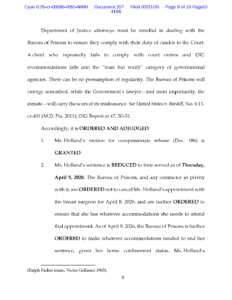
Filed 05/13/20. As the government itself acknowledged, the remedy for his medical condition appears to be relatively straightforward—get Bovis the medication he needs at the dosage he needs (and was prescribed by his treating physician) to properly treat his medical condition. But the BOP’s apparent indifference to Bovis’s life-threatening medical issues necessitates this ORDER that he be RELEASED IMMEDIATELY.
H

J
><
b
A Candid Conversation with the BOP Director and Deputy Director.
4-16-2026
j
S1E7 | Year One: Progress, Pressure, and Purpose: The Transcript.
The Federal Bureau of Prisons (BOP) is at a critical juncture. In this challenging environment, Director William Marshall, now a little over a year into his role, faces the daunting task of stabilizing the system while beginning necessary reforms.
- Years of operational strain, leadership changes, staffing shortages, and public criticism have eroded confidence in the agency. Budget cuts from Congress have forced difficult decisions about priorities and resources.
The Bureau of Prisons is facing significant operational challenges, particularly staffing shortages. Many facilities are running with fewer correctional officers and support staff than necessary, resulting in increased stress, safety concerns, and burnout.
- Augmentation. In some instances, non-custody staff are being reassigned to cover basic security functions, highlighting the strained system.
Putting out as many fires while looking at the bigger picture.
- There was a $600 million deficit and a severely understaffed, underfunded workforce that has ranked this location the worst place to work in the federal government for the past two years. The facilities are also in disrepair. We are starting to understand that it is unlikely we will receive the budget the president proposed.
- These things aren’t going to go away anytime soon, but we are starting to lay the foundation, going forward to fix these things.
- Transparency through their videos is a good thing, and as they acknowledged, there is much more to do.
g
><
Sentencing Commission to Adopt Proposed Amendments on Thursday, 4/16/2026.
k
The Sentencing Reform Act of 1984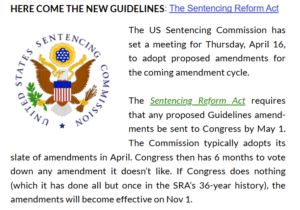
A proposed change for prisoners involves modifying methamphetamine guidelines.
- Option 1 suggests treating all forms of meth—mixtures, actual meth, and high-purity ice—the same.
- Option 2 keeps these distinctions but allows sentence reductions for those with minor roles or who were coerced.
For theft and economic crimes, the Commission proposes raising the loss tables by an average of 40% to simplify application and account for inflation, as the last adjustment was 11 years ago.
l
SEPARATELY. The USSC proposes to simplify the USSG § 2B1.1 loss table from 16 levels to 7, with 4-point jumps for each level. They also suggest adding an enhancement for non-economic harm to victims, including physical, psychological, emotional, and reputational damage or privacy invasion.
- The term “sophisticated means” is often applied by courts to any economic offense more complex than basic theft. The Commission aims to redefine it as “committing or concealing an offense with greater complexity than usual” and to provide clearer guidance to courts on how to determine applicable conduct.
k
Proposals include expanding eligibility for probation, home confinement, and “split sentences.” Notably, changes to the Guidelines defining “career offenders” could significantly impact sentencing ranges. The Sentencing Reform Act of 1984 requires that “career offenders” receive near-maximum sentences, but the current definition ensnares many defendants whose criminal histories do not warrant such labels.
L
RETROACTIVITY.
- The Commission aims to review its retroactivity procedure, but like the weather, it remains a topic of discussion without action.
US Sentencing Commission, Public Notice of Meeting
~ Thomas L. Root
F
><
h

…Trump is asking for $152 million from Congress to return Alcatraz Island in San Francisco Bay from a tourist attraction back into an enlarged and rebuilt maximum-security prison?
- The New York Times reported that the plan encounters significant political and practical challenges, particularly in San Francisco, where tourism thrives, and Alcatraz is a key attraction. The BOP already operates a modern maximum-security facility in Florence, Colorado, and the island has not housed inmates since 1962.
The New York Times, Trump Seeks $152 Million to Begin to Turn Alcatraz Back Into a Prison (April 3, 2026)
k
><
l
Bad Boys, Island Living, and Money
April 9, 2026
On Transparency Talk, Barnes explained that the Investigations Division is divided into nine regions and two specialty offices, with about 95% of cases starting as criminal inquiries. She noted that for each case, they conduct both criminal and administrative misconduct investigations. Common criminal allegations include contraband introduction, bribery, excessive force, and staff sexual abuse.
h
Citizens Portal, Deputy Assistant Inspector General Sandra Barnes outlines OIG probes into BOP staff corruption and contraband (April 1, 2026)
><
h
Courts Are Expected to Apply Supervised Release Policies, Not Create Them, 6th Circuit Says No
April 6, 2026
6th CIRCUIT SAYS NO TO ARBITRARY TIME ‘POLICIES’ ON SUPERVISED RELEASE TERMINATION
j

- Under 18 USC § 3583, individuals on supervised release can apply for termination after one year, which is vital for their reintegration. While the Sentencing Commission encourages early termination, many courts and probation officers impose their own rules, often interpreting “one year” as 18 months or longer. One probation officer even mentioned that her judge believes no one should be released early and insists on serving the full term. This inconsistent application undermines the goals of rehabilitation and fairness.
- The 6th Circuit reversed the District Court’s denial of Guy’s motion, stating that blanket rules on supervised-release terms are inappropriate without individualized assessments of the § 3553(a) factors. The Circuit found that the District Court failed to explain how the proportion of Guy’s completed supervised-release term related to any relevant factors. The court emphasized that time served cannot be the sole basis for early termination decisions, which must be grounded in an individualized inquiry. While the proportion completed may be relevant, a court must clearly connect it to the specific factors for each defendant, as Congress mandates a minimum of 1 year and prohibits increasing it without a proper basis.
United States v. Collins, Case No. 25-5395, 2026 U.S. App. LEXIS 9438 (6th Cir. April 1, 2026)
~ Thomas L. Root
l
><
f
BOP National Resource Team, in the News
FCC Victorville and FCC Coleman
- Meetings with BOP Staff and Inmates alike, looking for solutions and listening for recommendations and ideas.
d
><
l
Through the First Step Act and the Second Chance Act, the BOP continues to expand access to meaningful education, particularly in financial literacy.
- Reentry preparation also includes the Release Orientation Program, offered 18 to 24 months before release.
o
k
><
l
Guaranteed income programs are effective in reducing recidivism and promoting self-sufficiency, often paying for themselves in the process. Upon release from prison, individuals confront rising living costs and additional financial burdens due to the criminal justice system, complicating their reintegration into society. Cash assistance, also known as “guaranteed income,” provides a crucial safety net that supports job placement, housing, and the fulfillment of court obligations.
This article highlights the Just Income program in Alachua County, Florida, as an exemplary model of how unconditional cash assistance can serve as a beneficial policy for supporting reentry. With nearly 2 million people incarcerated in the U.S. at any given time and around 8 million individuals reentering society each year, the financial challenges after release—such as unemployment and substantial fines—continue to pose significant barriers to successful reintegration.
><
c
CONSISTENT WITH THE NEW DOJ DIVISION THAT IS LOOKING FOR TAX EVADERS. See Below.
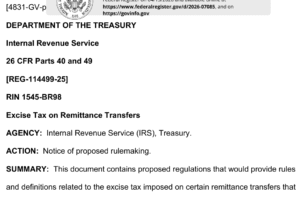
SUMMARY: This document contains proposed regulations that would establish rules and definitions for the excise tax imposed on certain remittance transfers made after December 31, 2025. The proposed regulations would affect certain remittance transfer providers and certain individuals sending remittance transfers. DATES: Electronic or written comments and requests for a public hearing must be received by [INSERT DATE 60 DAYS AFTER DATE OF PUBLICATION IN THE FEDERAL REGISTER]
><
c
HEALTHCARE AND TAXES ARE NOW ON THE DOJ RADAR.
CIVIL AND CRIMINAL PENALITIES: DOCUMENTATION VERIFIED
C
><
P
HEALTHCARE IS THE DOJ #1 TARGET, AND CRIMINAL IS NOW ON THE TABLE.
4-9-23026
K
4/8/2026
Nearly forty years ago, Justice William Brennan noted that prisoners are often neglected and exist in a hidden world. This remains true today, as American prisons are largely shielded from public scrutiny, allowing suffering and injustice to flourish. These institutions affect millions of lives, and ignoring them is a choice that sustains inequity. To tackle mass incarceration, we must bring these hidden realities into the open.
G
L
><
Compassionate Release May Be Denied Solely on § 3553(a) Without a Sentencing Transcript…
K
f
><
v
Punishment Beyond Prisons 2026: 5.5 Million People in the U.S. Under Correctional Control
l
In first place: Georgia
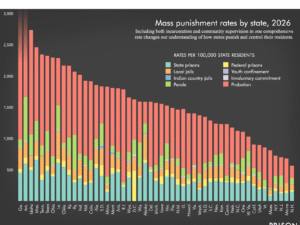
Rates of mass punishment include state prisons, federal prisons, local jails, youth confinement, Indian country jails, involuntary commitment, parole, and probation. Rates are per 100,000 state (or D.C.) residents.
For example, Louisiana has an incarceration rate of 1,121 per 100,000 residents, which is already above the national average. However, its total punishment rate is twice as high. Interestingly, some states with relatively low incarceration rates seem much more punitive when other forms of correctional control are considered.
- The vast majority of individuals in the mass punishment system are under community supervision, with about 3 million on probation and roughly 536,000 on parole.
- Understanding the full scope of punishment requires examining state-level data that includes incarceration alongside probation and parole. Some states may seem to have low incarceration rates, but when all forms of correctional control are factored in, they can appear much more punitive. This highlights the complexity of our justice system and the urgent need for reform.
><
p

HHS Secretary Robert F. Kennedy Jr. and CMS Administrator Mehmet Oz, M.D., MBA, have discussed replacing “pay and chase” with a real-time “detect and deploy” strategy, using advanced AI tools to identify fraud and prevent improper payments before they go out. What are the legal guardrails on that approach?
j
The healthcare sector is hopefully listening.
k
TOPICS THAT I’VE COVERED

g

m
><
MEDICAL CARE DELAYED/DENIED
LESSONS LEARNED – BY A JUDGE TIRED OF BEING LIED TO ORDERED, COMPASSIONATE RELEASE.
- 1st) Documentation using the Administrative Remedy Process, and thankfully, she was not too ill to fight for herself.
- 2nd) The judge was incensed when he requested a full medical file, and the BOP lied, showing up with a partial file.
- 3rd) He had read the Prison Policy Initiative Article: In federal prisons, the grievance system is designed to reject nearly all complaints about medical care _ Prison Policy Initiative
><
p
l
Shocking News! BOP Grievance Procedure
Doesn’t Work.
L
What the PPI Found.
P
During the study, 32% of medical complaints filed by inmates were rejected as “improperly filed,” while 51% were  closed on appeal for similar administrative reasons. Only 14% made it through the procedural hurdles, resulting in just 940 cases (1.4% of total complaints) that were granted relief.
Winning a “scratch-off” is ten times more likely.
Denials were highest for mental health and dental complaints, with 78% and 83% rejected for administrative reasons, respectively. Complaints regarding forced medical treatment had no cases that cleared procedural hurdles.
PPI noted that although grievance procedures should help incarcerated individuals seek fair treatment, they often serve as obstacles, deterring complaints and making it difficult to achieve real change.
Prison Policy Initiative, In federal prisons, the grievance system is designed to reject nearly all complaints about medical care (March 24, 2026)
~ Thomas L. Root
><
FSA Credits Not Redeemable for
Supervised Release, 2nd Circuit Says, nope!
April 2, 2026
l
Unicorns do not exist, regardless of our wishes.
In § 3632(d)(4)(C), it states that “Time credits earned by prisoners shall be applied toward time in prerelease custody or supervised release.” Raul believes this means FSA credits must reduce time on supervised release. However, the Bureau of Prisons (BOP) argues that these credits are meant to shorten the prison sentence itself to expedite supervised release.
- The Circuit noted the ambiguity in the statute and ruled that the phrase “applied toward time in… halfway house” favors the BOP’s interpretation. The following sentence clarifies that it’s about transferring prisoners from prison to RRC, not reducing the time spent in either prerelease custody or supervised release.
Thus, while disappointing, unicorns aren’t real – FSA credits cannot shorten supervised release duration.
l
Rivera-Perez v. Stover, Case No. 25-149, 2026 U.S.App. LEXIS 8819 (2d Cir. March 26, 2026)
~ Thomas L. Root
><
p
By Tyler Spence, April 7, 2026
f
3-29-2026


Wroblewski notes that compassionate release now serves a broader role, with the Sentencing Commission allowing sentence reductions for individuals suffering from serious medical  conditions, cognitive impairments, or age-related health declines. This applies to the elderly, those facing acute circumstances, abuse victims, and individuals serving disproportionately long sentences due to legal changes. Interestingly, there is no requirement for penitence or contrition.
- However, compassionate release is rarely utilized. The BOP holds over 10,000 prisoners aged 61 or older, many of whom have chronic conditions. Studies show that older adults in prison face significantly higher rates of serious medical issues compared to their counterparts in the community. Hundreds, if not thousands, of federal prisoners likely meet the criteria for compassionate release, as described by the Commission. With about one person dying in BOP custody daily from various causes, there are likely numerous prisoners suffering from terminal illnesses, such as advanced cancer, ALS, end-stage organ disease, and advanced dementia.
 Data shows that individuals in Bureau of Prisons (BOP) custody are more likely to receive compassionate release the longer they are incarcerated, mainly for rehabilitation purposes. However, judges consider various factors in their decisions.
Upcoming Supreme Court rulings could affect thousands of BOP prisoners eligible for compassionate release due to changing family circumstances during incarceration. Wroblewski estimates that a few thousand motions could meet the Commission’s standards annually, but in fiscal year 2024, there were only about 2,700 filings, with just 391 granted.
There are disparities in the application of compassionate release, which raises concerns about fairness. For example, the Middle and Southern Districts of Florida processed 11% of motions but represented only 4% of nationwide sentences, while some districts had no motions despite a significant number of defendants.
Grant rates vary across districts, with Maryland granting 31% of motions and Ohio only 2.5%. Long-serving prisoners generally file fewer motions. The BOP has initiated only 19 compassionate release requests out of over 2,700 filings. Wroblewski argues that the BOP may not be applying the compassionate release statute as consistently as the Commission intended, especially given the number of elderly prisoners and deaths in custody.
Substack, What’s Really Going on with Compassionate Release? (March 19, 2026)
~ Thomas L. Root
O
><
p
THE PRISON POLICY INITIATIVE
MARCH 24, 2026
THE BOP’S PROCESS IS DESIGNED TO DENY HEALTHCARE.
‘YOU’ NEED A PHYSICIAN ON YOUR SIDE.
P
Cut-Rate Care: The systemic problems shaping ‘healthcare’ behind bars
- In correctional healthcare systems, care is secondary to controlling costs and avoiding lawsuits — a problem plaguing both private and public healthcare delivery. What will it take to get people the care they need?
H
THE PRISON POLICY INITIATIVE
MARCH 24, 2026
J
98% OF THE TIME THE BOP FAILS TO PROVIDE HEALTHCARE.
- THE ADMINISTRATIVE REMEDY PROCESS FAILS AGAIN TO RECTIFY THAT PROCESS
Administrative Remedy Program, PS 1330.18
PURPOSE AND SCOPE §542.10
**a. Purpose.** The Administrative Remedy Program is designed to provide inmates with a formal process for reviewing issues related to their confinement.
- Grievance systems are designed to help incarcerated individuals address issues like inadequate medical care or harassment.
- However, in practice, they often face numerous rules and rarely find success in seeking relief. Many people in the U.S. struggle to access basic medical care, but incarcerated individuals face even greater challenges, including limited choice in doctors and continuity of treatment. Since 2000, about half of state prison systems have been court-ordered to enhance their mental and medical healthcare due to inadequate conditions.
l
THE ADMINISTRATIVE REMEDY PROCESS, FALSE ASSUMPTIONS.
If you are too ill to go through the process, you’re left at the mercy of the BOP, fellow inmates, and ultimately either loved ones with Power of Attorney at home or outside legal counsel. Should you be fit enough to go through the process, the BOP is very strict as to following the procedure.
- THE COMPLAINT YOU ARE MAKING, AND WHAT YOU WANT, OR THE RESOLUTION YOU ARE LOOKING FOR MUST BE IDENTICAL FOR ALL FORMS (THE BP-9, 10, 11, AND 2241). THEREFORE, MAKE 4 COPIES OF EACH: THE BP-10 (SHOULD INCLUDE A COPY OF THE BP-9), THE BP-11 (SHOULD INCLUDE COPIES OF THE BP-9 and 10). THE 2241 (SHOULD INCLUDE COPIES OF THE BP-9, 10, and 11).
- WITH NO COPY MACHINE, HANDWRITTEN IS ACCEPTABLE – EACH EXACTLY THE SAME.
- WITH NO CASE MANAGER (OR NO ONE TO SUPPLY THE FORMS, WRITE AT THE TOP OF EACH BLANK PAGE THAT THERE WAS NO STAFF TO PROVIDE THE FORMS. THIS IS OK.
- Dental and Mental Health grievance categories had the highest rates of these rejections: 78% of dental and 83% of mental health grievances were tossed out for administrative reasons, including cases that had reached the appeals stage.
THIS IS AN OVERVIEW SUMMARY. DETAILS ARE AVAILABLE VIA THE LINKS BELOW.
The BP-9 Goes to The Warden
- They have 20 calendar days to deny, agree, or take no action. Taking no action is a denial. Now you have to submit the BP-10
The BP- 10 Goes to The Regional Director
- They have 30 calendar days to deny, agree, or take no action. Taking no action is a denial. Now you have to submit the BP-11
The BP- 11 Goes to the BOP General Counsel in Washington, DC
- They have 40 calendar days to deny, agree, or take no action. Taking no action is a denial. Now you can submit a 2241 to the judge.
The 2241 FORM TO THE COURTS
- EACH MUST BE THE SAME AND HAVE ATTACHED YOUR BP-9, 10, and 11.
It is an arduous process, and some fail to complete it. Most inmates have not been taught this, so they may not even know it is an option. Other inmates may have the knowledge, and that could be their lifeline.
><
l
FEDERAL LEGAL NEWS (FLN)
MARCH 16, 23, 2026
Methamphetamine. Judges have refused to sentence based upon the “purity” argument, instead opting for lower sentences. The principal case is US v Robinson. US v. Robinson, No. 3:21-CR-14-CWR-FKB-2 (S.D. Miss. Dec. 23, 2022). The Guidelines questioned the distinction between “methamphetamine” and ‘actual methamphetamine,” where defendants caught with actual methamphetamine could get longer sentences than defendants caught with a methamphetamine mixture (or not as pure), rather than just based on weight.
The OIG identified alarming conditions of its food service and storage operations, including our observations of inmates being served moldy bread and vegetables rotting in a refrigerator in a food preparation area. Ethics and money were also in the OIG crosshairs. From Butner: While “the (officers’) mess hall was receiving a brand-new Vulcan Convection Oven worth approximately $25K, Dental care had no equipment to make dentures on-site. The current dentist there is a qualified prosthodontist and could accommodate several inmates with comfortable dentures, so they can chew food.”
Remedy issues are prevalent in many institutions. A recent petition regarding Lompoc highlights their failure to accept and process inmate complaints as required by BOP Program Statement 1330.18. The petitioner was informed by the Unit Team and the Warden to address any First Step Act Earned Time Credit issues directly with the court, as they were advised to deny these complaints. This failure to process remedies undermines efforts to maximize sentence credits. We can help you navigate this process and secure the time credits you deserve.
The pathway to sentence relief appears to be expanding as the new administration has reactivated the Warden’s exception provision of the First Step Act. Wardens are now encouraged to exercise their discretion to grant compassionate release, recognizing that they know prisoners best.
- The United States Sentencing Commission (USSC) permits sentence reductions for those with serious medical conditions, cognitive impairments, or deteriorating health due to aging. This includes older adults, those facing acute challenges, abuse victims, and individuals serving disproportionately long sentences under updated laws, with a catch-all for similarly grave circumstances.
- Currently, over 10,000 individuals aged 61 and older are incarcerated in federal prisons. Many of these older prisoners suffer from chronic conditions, with studies indicating they experience serious medical issues at higher rates than their peers in the community. This underscores the urgency to consider compassionate release for numerous federal inmates facing significant health challenges due to age.
Under the Freedom of Information Act, the names, dates, and causes of death for individuals who died in custody since 2005 have been released. Causes include cancer, pulmonary issues, cardiac problems, blunt trauma, hanging, and drug overdose. Many Bureau of Prisons (BOP) inmates likely suffer from terminal illnesses like metastatic cancer, ALS, end-stage organ disease, and advanced dementia, as noted in the Commission’s compassionate release policy.
The shortage of qualified medical professionals is a significant issue in providing effective care. Many doctors avoid certain locations, leading agencies to hire less experienced individuals. Some Bureau of Prisons (BOP) doctors also face malpractice lawsuits, making it difficult to secure insurance and endangering the health of chronically ill inmates.
- While hiring outside contractors is a potential solution, insufficient funding remains a barrier since Congress has not increased the agency’s budget. It’s crucial to raise this issue with elected representatives, as prisoners often suffer from neglect. We can also assist with compassionate release petitions to the warden and the courts, addressing broader concerns beyond medical care.
L
><
27 States: Expanding Medicaid To Prisoners – Months Before Their Release
THIS IS A BIG DEAL. Medicaid now covers a limited range of services starting up to 90 days before an inmate’s release and continuing afterward.
- When Jon Desantis was released from jail last September after six months, he faced significant challenges, including losing his girlfriend, his construction job, and his truck.
- However, California’s Medicaid program provided vital support. A healthcare worker in jail helped him obtain a 30-day supply of medications for his depression and anxiety, and a case manager from a nonprofit assisted him in scheduling appointments with a psychiatrist and therapist. Within months, Desantis found contracting work and began the paperwork to start his carpentry business, crediting Medicaid for his regained stability.

CLASP’s vision for re-entry requires prioritizing community repair and an active divestment from community supervision, including parole and probation systems.
l
3/16/2026
N
HIGHLIGHTS
-
The federal prison population declined slightly, falling about 1% from 155,972 at the end of 2023 to 154,093 at year’s end 2024.
-
At year’s end 2024, 8,202 individuals in Federal Bureau of Prisons custody had prior military service—representing more than 5% of the total federal prison population.
-
Thirty percent of incarcerated individuals reported having a minor child age 20 or younger, a decrease from 35% in 2023.
-
The number of non-U.S. citizens in federal prison continued to decline, dropping to 21,948 in 2024, down from 22,817 in 2023 and 24,078 in 2022.
><
x
CORRECTIONS 1: ADDRESSING THE MENTAL HEALTHCARE CRISIS
J
The mental health crisis in our correctional system reflects broader societal failures—but it also presents an opportunity for reform. With evidence-based strategies that protect both public safety and human dignity, correctional agencies can improve mental health care behind bars.
The question isn’t whether we can afford these changes—it’s whether we can afford not to.
M
><
s
Right On Crime
Emphasizes data-driven federal sentencing policies that enhance public safety and protect victims and looks forward to working with the United States Sentencing Commission on 2026 amendments. Part of the Texas Public Policy Foundation, it promotes conservative solutions to reduce crime and strengthen communities.
y
><
a
FEDERAL LEGAL NEWS (FLN)
March 9, 2026
After years of being unable to issue new guidelines due to a lack of quorum, the administrative body is now leading efforts to reform the justice system. Since 2023, it has positively influenced reform, especially alongside the President’s First Step Act (FSA), which has created pathways for sentence relief.
There’s broad support for changes regarding methamphetamine sentencing. The “Right On Crime” initiative calls for eliminating the outdated use of drug purity as a measure of culpability, suggesting that current standards do not reflect an offender’s role. The Commission’s new proposals will consider conduct alongside quantity.
Despite this progress, the Bureau of Prisons (BOP) faces significant challenges, including a healthcare crisis, corruption, and operational incompetence, hindering rehabilitation efforts for prisoners. Many facilities are failing to provide necessary programming and job training, or to adhere adequately to agency policies.
At FCI Coleman Low, common areas have been stripped of essential resources, such as tables and books, making independent programming difficult for inmates. Reports indicate that these items were discarded rather than stored.
Additionally, a recent arrest of a guard at FCI Aliceville for sexually assaulting female prisoners highlights ongoing issues within the BOP. A bipartisan committee’s report revealed widespread sexual abuse by BOP employees at many federal facilities housing women. “A correctional officer at an Alabama federal prison has been indicted in the sexual assault of seven female inmates. Felix Sylvester Wilder, 37, violated the civil rights of the women when he sexually assaulted them while they were behind bars at the Federal Correctional Institution in Aliceville, federal officials said Wednesday.
j
The USSC policy statement on compassionate release, §1B1.13, effective November 1, 2023, provides judges with more guidance. Compassionate releases are being granted across all circuits, with the reasons for these grants detailed in a recent USSC publication.
J
**Grounds for Compassionate Release:**
K
1. **Rehabilitation**
2. **Serious Physical or Medical Condition** (USSG §1B1.13(b)(1)(B))
3. **Terminal Illness** (USSG §1B1.13(b)(1)(A))
4. **Family Circumstances:**
- Care for minor/disabled child (USSG §1B1.13(b)(3)(A))
- Care for parent (USSG §1B1.13(b)(3)(C))
- Care for other family member (USSG §1B1.13(b)(3)(D))
5. **COVID-19/Pandemic** (USSG §1B1.13(b)(1)(D))
6. **Multiple 18 U.S.C. § 924(c) Penalties (Stacking)**
7. **Career Offender Issues**
8. **Other Mandatory Minimum Penalties/Long Sentences**
9. **Extraordinary and Compelling Reasons:**
- Enhanced drug penalties (21 U.S.C. §851)
- Changes in law or unusually long sentences (USSG §1B1.13(b)(6))
10. **Failure to Provide Treatment** (USSG §1B1.13(b)(1)(C))
11. **Deteriorating Health (Age 65)** (USSG §1B1.13(b)(2))
12. **Safety Valve Disqualification**
13. **Abuse by Corrections Officer/BOP Contractor** (USSG §1B1.13(b)(4))
M
**The federal government’s “War on Sex” has failed, similar to the “War on Drugs.”**
K
While wealthy elites benefited from Jeffrey Epstein, thousands received long prison sentences for viewing and downloading disturbing images of underage children.
- Nearly 20,000 sexual offenders, often grappling with addictions or mental health issues, are imprisoned with minimal treatment and face significant risks from fellow inmates and staff.
- FDC Honolulu is one of many places where prison staff ignore an extortion scheme, allowing vulnerable sex offenders to give up their food trays to avoid beatings.
Derek Gilna, Director of Research, JD, (De Paul Law School, 1975), MARJ, (Vermont Law School, 2020), Federal Legal Center, 133 W. Market, #171, Indianapolis, IN 46204; dgilna1948@yahoo.com.
b
><
*
IMMIGRATION PAROLE
Probation Officers now have an expanded job description, added to the earlier inmate releases in accordance with the FSA.
j
><
o
2025 CONDITIONS OF CONFINEMENT
Staffing shortages are not just a problem in Connecticut prisons; they are a national issue affecting prisons nationwide.
- Connecticut’s correctional system is facing severe failures, including staffing shortages and inconsistent access to health care, sanitation, food, legal resources, and communication. Governance issues continue despite warnings. These problems are preventable and can be corrected with sustained legislative oversight and independent monitoring. The Office of the Correction Ombuds presents this report as a warning: without decisive action, Connecticut’s correctional system risks becoming an enduring cycle of instability and harm.
><
K
K
Bacterial sexually transmitted infections (STIs) are prevalent among incarcerated individuals,
These highlight the significant gaps in prison healthcare. There is an urgent need for increased STI testing upon admission and throughout incarceration, as well as better treatment strategies to reduce transmission.
- Research on bacterial STI prevalence in prisons—especially in low- and middle-income countries—is vital, as is improved diagnostic reporting to support effective resource allocation. Strong implementation and evaluation of testing and treatment in these settings are necessary to meet the WHO’s 2030 elimination targets for sexually transmitted and blood-borne infections.
- Continuity of care is essential to prevent STI transmission among incarcerated individuals and their communities. Overall, high rates of chlamydia, gonorrhoea, and syphilis, especially among adolescents and women in prison, call for investment in sexual health services and opt-out testing to achieve public health goals.
><
*
PRISON PHONE RATES
g
The 2024 rule promised to save millions for incarcerated individuals and their families, who often pay around $500 monthly for communication. However, the November draft included an unexpected 6.7% inflation increase with no public notice. FCC Chair Brendan Carr quickly overturned the bipartisan rule, claiming the previous price caps led to “negative, unintended consequences” and were too low to cover safety measures.
This claim is contested by a Worth Rises analysis indicating that about 75% of U.S. prisons already operated below the proposed 2024 caps. The new fees will exceed those of 94% of prisons, with only Florida, Kentucky, and Oklahoma charging more. Securus had argued for an 11.6% adjustment based on 2022 data, which the FCC granted without requiring justification.
Commissioner Gomez criticizes the changes: “[Incarcerated Persons Communication Service] Providers have the data but fail to submit it, claiming the FCC lacks necessary information when it doesn’t favor them. The Commission grants their requests without requiring new data, thus rewarding bad behavior.”
L
3-9-2026
O
WHAT DO STATES EXPECT?
p

From someone on probation who can’t feed themselves or their families, and they haven’t had time to find that elusive job opportunity, then returning to their old ways to provide food.
g
People on probation who don’t have access to food, as a complex patchwork of state laws limits their eligibility for federal food assistance, known as SNAP benefits. PPI analysis reveals that 39 states impose disqualifications for probation violations, either explicitly barring individuals from participating or discouraging applications with irrelevant questions.
l
l
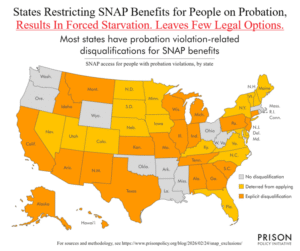 Federal law disqualifies some individuals with drug convictions from receiving SNAP, but states can opt out of these rules. Unfortunately, many have chosen to retain disqualifications for probation violations. These restrictions harm individuals directly and deter many eligible people from applying altogether.
Food insecurity is widespread in the U.S., affecting 41.7 million people, with 2.9 million on probation—many of whom rely on SNAP. Over half of those on probation earn less than $20,000 annually, which is below the SNAP income eligibility threshold. This issue disproportionately affects women, particularly Black women, on probation.
States vary in their approach to disqualifications, with 11 states having no related restrictions and 39 enforcing them. Among these, 21 states apply statutory disqualifications, while 18 merely inquire about probation violations on applications without a legal basis.
Addressing these barriers is essential not only for food security but also for public safety, providing the environment to seek work, as advocates work to expand SNAP access for individuals on probation. Food security could keep someone from breaking the law in order to feed themselves.
l
><
FEDERAL LEGAL NEWS (FLN)
March 2, 2026
Under U.S.C. § 3624(g)(1)(A), federal prisoners can qualify for prerelease custody or supervised release if they earn First Step Act (FSA) time credits equal to their remaining prison term. The Bureau of Prisons (BOP) can facilitate early transfer to halfway houses, home confinement, or supervised release. Prisoners earn 10 days of credit for every 30 days in evidence-based recidivism-reduction programs or productive activities, and those with low- or minimum-risk status can earn up to 15 days of credit. Eligibility also requires a low- or minimum-risk assessment from the last two evaluations, as per §3624(g)(1)(D).
These are in ADDITION to the 54-day Good Time (GTC) or Second Chance Act Credits,
- If your sentence is > 60 mo. (5 yrs) = last 6 mo. on home confinement.
- If your sentence is < 60 mo. (5 yrs) = last 10% on home confinement.
“Stacking” all credits maximizes your sentence-reducing benefits, but there is a halfway house shortage of bed space.
- Halfway houses take a percentage of your wages for home confinement after you find a job, and up to five prisoners may share one bed.
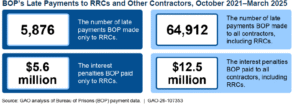
- Beyond bedspace shortages, the Feb 11, 2026 GAO Report makes many conclusions. One is that the BOP is constantly late in paying its bills, taking away any incentives for Halfway Houses to accept federal inmates.
Learned from the GAO Report, the BOP:
- Doesn’t know how many people are eligible to transfer to a halfway house, or who should have been transferred already.
- Doesn’t have the halfway-house capacity to accommodate all people who may be eligible to transfer.
- Paid their bills to contractors and halfway houses late about 70% of the time, spending millions of dollars on late fees.
- The Full GAO Report
- Late Payments, Massive Interest.
J
A
Although FSA is limited to “minimum” and “low prisoners,” the Warden’s Exception can be granted to “mediums” (and theoretically, at least, “highs”).
- The Warden’s Role: For transfers to prerelease custody (like home confinement or halfway houses) under the FSA, the Warden decides and can grant an “exception”.
- Criteria for Exception. Inmates may qualify if the warden determines they won’t be a danger to society, have actively participated in programs to reduce recidivism, and are unlikely to reoffend. This is supported by 18 U.S.C. § 3624(g)(1)(D)(i), which allows wardens to grant prerelease custody exceptions. We can help with this process.
- Federal Location Monitoring. Federal courts supervise many defendants and convicted offenders in the community, either before trial, after release from incarceration, or while serving sentences that do not require imprisonment.
V
The BOP population has decreased to 155,000 from 158,000 last year. About 5,000, or 3%, are over 65 and mostly suffer from chronic illnesses that the BOP struggles to address. Reviewing their cases for home confinement or release could save the agency hundreds of millions, as they pose little threat to the community.
- Additionally, the US Parole Commission appears unnecessary, primarily serving as a patronage position. Only 150 to 183 “old law” federal inmates, eligible for parole since before November 1, 1987, remain, and many do not qualify for compassionate release under current guidelines.
- From Alderson, following a visit from the BOP Director: “We can’t access our funds on the computers; everyone shows a zero balance, and we were told this issue is BOP-wide, though outsiders dispute that. We were informed that the central office will be here all week. Our funds seem to be frozen or missing, leaving us unable to make phone calls or use computers.”
G
Derek Gilna, Director of Research, JD, (De Paul Law School, 1975), MARJ, (Vermont Law School, 2020), Federal Legal Center, 133 W. Market, #171, Indianapolis, IN 46204; dgilna1948@yahoo.com.
l
><
THE BOP IS FINALLY LOOKING INTO BODY CAMERAS
d
3-1-2026
CONTRABAND And LOUSY FOOD
February 27, 2026
BOP Director Marshall has proven himself to be a very different director.
l
In the last 10 months, BOP staff have administered Narcan in over 500 overdose incidents. Seized contraband includes fentanyl, methamphetamine, marijuana, Suboxone strips, and vapes. The BOP intercepted 228 drone drops, confiscated nearly 17,000 cell phones, and found 4,300 weapons, along with nearly 50 lbs. of meth. Additionally, contraband investigations have involved 260 staff members, including a case in Texas where a staff member smuggled tobacco.
l
He is the director who looked at a plate of expired dining hall food being served to an inmate during a facility visit last summer and asked a
warden, “Would you eat that? If the answer is ‘no,’ then don’t serve it. Period. That’s` not just about food safety, that’s about human decency”).
j
@federalprisontips Federal Prison Director Billy Marshall says in video to “Do The Right Thing” after experiencing an inmate in federal prison who said he was served expired food at mainline in federal prison
♬ original sound – FederalPrisonTips
“We are prosecuting anyone who tries to bring contraband into our facilities. This approach sends a strong message that criminal activity in federal prisons will not be tolerated, and offenders will be held accountable.”
He’s making hard and humane choices in difficult times, to an agency that has been difficult to adapt to new leadership. Dr. MB
William Marshall, Growing Threat of Contraband in the Bureau of Prisons (February 17, 2026)
Forbes, “Would You Eat That? A Leadership Question at the Bureau of Prisons (February 11, 2026)
~ Thomas L. Root
><
m
Bipartisan Legislation To Modernize Federal Criminal Code: ‘The Proposed Bill.’
February 23, 2026
g
U.S. Senator Peter Welch (D-Vt.), Ranking Member of the Senate Judiciary Subcommittee on the Constitution
- The Senate’s only former public defender
U.S. Senators Mike Lee (R-Utah)
- “Our federal criminal code is massively over-inflated, with thousands of crimes making it impossible for anyone to fully understand the criminal liability they face,”
Chris Coons (D-Del.)
- “This bipartisan, commonsense bill will create a database of all federal crimes, so lawmakers can determine the reforms needed to make the law fairer, saner, and more effective.”
Joining are;
- Sens. Ted Cruz (R-Texas), Cory Booker (D-N.J.), and Roger Wicker (R-Mo.).
p
p
><
THE FEDS ENFORCEMENT RETREAT – A WIN FOR WHITE-COLLAR DEFENDANTS.
L
j
y
><
2/25/2026. FOOD FOR THOUGHT.
Government officials indicated that changes could enable intelligence agencies to access a database with hundreds of millions of documents, including FBI files, banking records, and investigations involving law-abiding Americans.
f
d
><
d
f
g
f
P
11th Circuit Defines “Available Caregiver” for Compassionate Release
P
L
P
A compelling reason for compassionate release under 18 USC 3582(c)(1) is if the prisoner is the “only available caregiver” for an incapacitated loved one, such as a child, sibling, or parent, who needs care. This requirement applies (except in the case of a spouse). Issue: What constitutes the “only available caregiver?”
P
The 11th Circuit became the first appellate court to weigh in on the question.
Rufino Robelo-Galo argued that he was the “only available caregiver” for his incapacitated father.
The 11th Circuit noted several factors district courts should consider in assessing whether an alternative caregiver is qualified and available. These include:
- Legal barriers (e.g., immigration status, active military duty) that may hinder caregiving;
- Physical or logistical barriers, such as geographic distance, can limit caregiving ability.
- Knowledge or capability barriers, such as language skills or specialized training;
- Familial dynamics or relationship history, including estrangement or abuse; and
- Economic or employment-related barriers affecting availability.
H
Rufus asserted that none of his five children could care for their grandfather. One child was deceased, another was missing, two in the U.S. couldn’t move to Honduras, and Elmer, who lived four hours away, was unable to help due to lack of transportation, space constraints, and the need to support his own children.
The district court found that Rufino’s son, Elmer, was available to care for their incapacitated father, so the compassionate release motion was denied. Last week, the 11th Circuit upheld this denial, ruling that to qualify for compassionate release under USSC 1B1.13(b)(3)(C), an inmate must show that no other qualified person is available to provide care.
The District Court overlooked that Elmer couldn’t care for his grandfather due to a lack of transportation, space limitations at his home, and the inability to relocate without jeopardizing his job and supporting his own children.
United States v. Robelo-Galo, Case No. 24-12128, 2026 U.S.App. LEXIS 4650 (11th Cir. February 17, 2026)
~ Thomas L. Root
l
Who Wants to Be A Prison Guard?
February 25, 2026
g
A recent Congressional Research Service report last week highlighted that non-competitive pay and challenging working conditions are the primary reasons for the Bureau of Prisons’ (BOP) longstanding understaffing. Vacancy rates at the BOP have surged from 10-12% before the pandemic to 22-25% afterward. Despite recruitment incentives and other efforts, the number of correctional officers has decreased significantly, leading to a doubling of overtime costs to $275 million in recent years.
The Federal News Network report noted that compensation for federal correctional officers may not be competitive with that of other federal agencies, such as CBP and ICE, which have recently offered larger incentives. As a result, some qualified candidates may opt for positions in those agencies. The House Judiciary Committee has raised alarms about this staffing crisis, asserting it hampers the BOP’s ability to ensure public safety.
In March 2025, BOP cut frontline officer pay by up to 25% and froze hiring, despite receiving $3 billion in additional funding. Unions have supported H.R. 7033, the bipartisan Federal Correctional Officer Paycheck Protection Act of 2026, which aims to increase pay for BOP staff by up to 35%.
- FEDWeek, Report Lays Out Causes, Effects of Bureau Understaffing (February 19, 2026)
- Federal News Network, House Democrats Press Bureau of Prisons leadership on staffing ‘crisis’ (February 20, 2026)
- Letter from Jamie Raskin to William K. Marshall III, February 20, 2026
- HR 7033, Federal Correctional Officer Paycheck Protection Act of 2026
- Corrections1, Union backs bill proposing 35 pct base pay increase for federal correctional officers (February 20, 2026)
~ Thomas L. Root
o
o
P
><
FEDERAL LEGAL NEWS (FLN)
2-23-2026
Case Managers are still unable to process computer-generated Team papers, leading to late halfway house referrals.
- According to the GAO Report, the BOP consistently pays its bills to RRC (or HH) late. Why should the RRC consider the BOP a reliable partner if their payments are consistently late?
- Regarding Home Confinement, there appears to be no clear coordination with the agency for supervising home confinement through the alternative Federal Location Monitoring program to ensure they have the staff to supervise new inmates placed under their custody.
From Danbury Women’s Prison, “Case managers are not giving the correct FSA time, leaving many women who should have been released last year still waiting. They’re being told there are no halfway house beds available?”
FREEDOM. OPM Director Scott Kupor said in an interview. “When conscientious objection becomes sabotage or trying to find ways to thwart the objectives of the administration—that is not allowed.”
l
Since the new Administration took office a year ago,
- DOJ prosecutions have increased, with a Focus on Immigration cases.
While the number of White-Collar Prosecutions has fallen steadily,
- Drug, continuing the ten-year decline,
- Fraud/Theft/Embezzlement cases have fallen from 9000 in 2015 to 5000 in 2025.
H
The Director stated in a video message that contraband remains a significant issue in federal institutions, with a larger amount introduced by prison employees than by drones.
The outdated Bureau of Prisons (BOP) computer systems suffered a major data breach, and while efforts to update them are ongoing, replacing the obsolete DOS-based system will take months or even years. Last year, over 320 GB of data was compromised.
d
In DUBIN v. UNITED STATES, No. 22–10 (Fifth Circuit 2023), David Dubin was convicted of healthcare fraud for overbilling Medicaid through a company he managed. The issue was whether he also committed “[a]ggravated identity theft” under §1028A(a)(1), which applies when someone knowingly uses another person’s identification during a predicate offense. The government argued that Dubin’s billing included a patient’s Medicaid number, qualifying as a “means of identification.” The District Court upheld Dubin’s conviction for identity theft, despite viewing the case as primarily about fraud, following Fifth Circuit precedent.
The Fifth Circuit, in a divided decision, affirmed the ruling, with some judges noting that the government’s interpretation did not align with the term “identity theft.” The court concluded that a defendant “uses” another person’s means of identification in relation to a crime when that use is central to the criminal conduct.
“Seriousness of the offense” and § 3553(a) factors:
- Even where terminal illness is conceded, federal prosecutors regularly argue that sentencing factors weigh against release.
- In the Neba case at FMC Carswell, federal prosecutors fought a terminally ill prisoner’s compassionate release request.
- “Not dying fast enough”: In the case of Steve Alan Brittner, diagnosed with brain cancer, the BOP denied his release request.
h
FINALLY, HUMAN WATCH
The Department of Justice (DOJ) maintains that prisoners should serve sentences close to those imposed by the court, with few exceptions. They also warn that broadening compassionate release guidelines could lead to an increase in lawsuits from prisoners.
L
><

CONVICTED OF A LARGE DRUG OFFENSE – SEE IF YOU TOO CAN GET SPECIAL TREATMENT.
d
DOES THIS SOUND LIKE YOUR CASE? MAYBE, YOU TOO COULD ALSO SLEEP AT THE WALDORF…
- Sentenced to 45 years in prison for taking bribes and allowing traffickers to export more than 400 tons of cocaine to the U.S.
- Trump pardoned the former president after he served less than four of those 45 years.

- Trump’s Federal Bureau of Prisons scrambled to get his immigration detainer removed so he could walk free.
- Next, despite persistent budget and staffing shortages, prison officials paid a Specialized Tactical Team Overtime to drive Hernández from a high-security facility in West Virginia to the famed five-star Waldorf Astoria Hotel in New York City… Nice!
- Before he left, Hernández was allowed to use the captain’s government phone to talk to the federal prison system’s deputy director, Joshua Smith…
Fd
><
s
2-22-2026
l
l
D
K
P
The criminal legal system is deeply rooted in structural racism. While many acknowledge this, few grasp its extent. This month, we will focus on research highlighting biases in policing and prosecution, illustrating how the system disproportionately targets and punishes Black and Latinx individuals.
L
Policing: Many interactions with the criminal justice system begin with arrests, revealing where over-representation starts.
d
QUALIFIED IMMUNITY?
Clarence Jamison wasn’t jaywalking.
- He wasn’t outside playing with a toy gun.
- He didn’t look like a “suspicious person.”
- He wasn’t suspected of “selling loose, untaxed cigarettes.”
- He wasn’t suspected of passing a counterfeit $20 bill.
- He didn’t look like anyone suspected of a crime.
- He wasn’t mentally ill and in need of help.
He wasn’t assisting an autistic patient who had wandered away from a group home. - He wasn’t walking home from an after-school job.
- He wasn’t walking back from a restaurant.
- He wasn’t hanging out on a college campus.
- He wasn’t standing outside his apartment.
He wasn’t inside his apartment eating ice cream. - He wasn’t sleeping in his bed.
- He wasn’t sleeping in his car.
- He didn’t make an “improper lane change.”
- He didn’t have a broken taillight.
- He wasn’t driving over the speed limit.
- He wasn’t driving under the speed limit.
No,
Clarence Jamison was a Black man driving a Mercedes convertible home he had just bought, with his bill of sale.
d
D
- Data from 2022 shows Black drivers were searched or arrested during traffic stops at more than double the rate of other racial groups. Public trust in law enforcement is eroded along racial lines, as shown by a 2024 Boston survey highlighting racial disparities in reports of police harassment.
- Law enforcement surveillance is growing, and police have long used databases that profile Black and Latinx youth as gang members, increasing their chances of arrest, conviction, or deportation.
Prosecution: Prosecutors and judges can help mitigate racial disparities by dismissing low-level cases and referring individuals to diversion programs rather than imprisonment.
- However, research indicates that in progressive areas like Philadelphia, Black and Latinx individuals face higher charges and sentences than white individuals, even when accounting for crime and prior records. In Manhattan, a 2022 analysis revealed that Black individuals are convicted of felonies and misdemeanors at a rate 21 times greater than white individuals, the highest disparity in New York. Additionally, diversion programs often exclude Black and Latinx individuals, as they are more likely to have disqualifying charges or criminal records.
— Leah Wang, Senior Research Analyst, February 18, 2026
s
><
j
l
I. Shocking News from GAO – BOP Has Messed Up FSA Placement! Who’d Have Guessed?
l
February 17, 2026
p
GAO PAINTS PICTURE OF DEADBEAT BOP’S CHAOTIC HALFWAY HOUSE MANAGEMENT
o

Writing in Forbes last week, Walter Pavlo said, “Lawmakers understood what correctional professionals have long known. The last months of a sentence should focus on reconnecting people to jobs, housing, and families, not warehousing them in prison.”
Reality. The GAO (Below) reports that, among other issues, the BOP does not even know how many people are eligible for and entitled to placement. Why? Because the dates individuals are eligible to transfer are not readily available?

The Report noted that “BOP does not know the full extent of this shortage due to a lack of comprehensive assessments of its capacity and budgetary needs, which affects timely transfers of incarcerated individuals and opportunities to increase revenue and reduce federal costs.”
Late Payments. It’s not surprising that halfway houses are losing interest in working with the BOP to expand their businesses.
Home Confinement Eligibility Date. Still, for those eligible for Home Confinement, managed by the US Probation Office instead of halfway house staff. That is, if the US Probation offices nationwide are prepared to absorb these transfers.
k
Government Accountability Office, Bureau of Prisons: Actions Needed to Better Achieve Financial and Other Benefits of Moving Individuals to Halfway Houses on Time (February 11, 2026)
Forbes, GAO Critical of Bureau of Prisons Use of Halfway Houses (February 12, 2026)
~ Thomas L. Root
d
II. Pardon and Punishment
February 19, 2026
 Pardons for the Right People: President Trump last Thursday pardoned five former professional football players — including Super Bowl champions, a Hall of Famer, and a Heisman Trophy winner — for crimes ranging from perjury to drug trafficking. These included ex-NFL players Joe Klecko, Nate Newton, Jamal Lewis, Travis Henry and the late Billy Cannon.
The action that exempts NFL players from prior criminal conduct highlights how Trump’s clemency favors those with fame, fortune, or political ties, sidelining countless others serving sentences for drug and violent crimes.
Writing in his Sentencing Law and Policy blog, Ohio State law professor Doug Berman was a bit puzzled, as he did not seek to get attention by issuing these pardons prior to the Super Bowl.
o
 Punishment for the Wrong People: A year after commuting 37 federal death sentences to life without parole, President Trump ordered that the men be confined under the harshest possible conditions, calling for treatment consistent with “the monstrosity of their crimes.” The administration moved to transfer them to the supermax at ADX Florence.
U.S. District Judge Timothy J. Kelly blocked the plan, ruling that Bureau of Prisons policy permits placement at ADX only when specific security criteria are met. He found evidence that public statements by Trump and Attorney General Pam Bondi suggested the outcome was predetermined, making the required administrative review process appear meaningless.
d
III. SAVING THE BEST FOR LAST
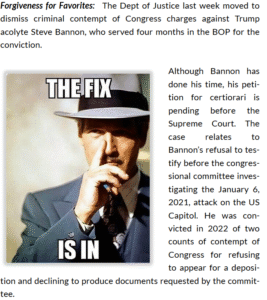
The DOJ wrote in its motion to dismiss the case, that “[t]he government has determined in its prosecutorial discretion that dismissal of this criminal case is in the interests of justice.”
The New York Times, Trump Pardons Klecko, Jamal Lewis and Other Former N.F.L. Players (February 12, 2026)
Politico, Judge halts transfer of former federal death inmates to ‘supermax’ prison (February 11, 2026)
Memorandum Opinion, Taylor v. Trump, Case No 25-cv-3742 (DDC, February 11, 2026)
Associated Press, Trump pardons five former NFL players for crimes ranging from perjury to drug trafficking (February 13, 2026)
Brief for the United States, Bannon v United States, Case No. 25-453 (Supreme Court, filed February 9, 2026).
~ Thomas L. Root
H
><
K
Growing Threat of Contraband in the Bureau of Prisons
Contraband is one of the greatest threats facing our federal institutions today.
o
February 17, 2026
BOP Director William K. Marshall III addressed the escalating threat of contraband—drugs, weapons, and cell phones—entering federal prisons and details the steps underway to safeguard staff, incarcerated individuals, and the public.
J
><
k
The GAO Learned That,
The BOP:
- Doesn’t know how many people are eligible for transfer to a halfway house, or who should have been transferred already.
- Doesn’t have the halfway-house capacity to accommodate all people who may be eligible to transfer.
- Paid their bills to contractors and halfway houses late about 70% of the time, spending millions of dollars in late fees.
- Late Payments, Massive Interest.
d
h
><
O
FEDERAL LEGAL NEWS (FLN)
2/16/2026
This Week, A Partial Overview;
Sentencing Commission Hears Final Comments – FLN Predictions,
- Methamphetamine purity (downward) revisions
- Increased penalties for fentanyl offenders
- The DOJ is objecting to the loss-table revisions, noting an estimated 37% reduction in the length of sentences.
- Ideal for white-collar offenders currently incarcerated. Long sentences for a million-dollar fraud are hard to justify, especially given recent unpunished billion-dollar schemes.
- DOGE has obtained Medicare and Medicaid claims data suggesting potential fraud. The Department of Health and Human Services aims to recover these funds by offering citizens bonuses of up to 30% of the collected amounts.
- DOGE technology could also analyze procurement data for the Bureau of Prisons (BOP) to detect fraud and waste, and reveal inefficiencies in medical programs that deny care and track unnecessary expenses for elderly and chronically ill prisoners who do not pose a threat to society.
p
Supreme Court to Hear Argument on Non-Citizen Removal;
- Federal courts are handling habeas corpus cases from non-citizen offenders seeking early release to home confinement based on sentence credits under the First Step Act. Despite efforts to reduce the prison population, non-violent offenders, including those with permanent residency and U.S. citizen spouses, have not benefited, and many have been transferred to immigration detention.
- The Second Circuit stated that there must be “clear and convincing evidence” of an individual’s removability and that the government must prove a violation of green card terms. A negative ruling could put all accused green card holders at risk of deportation, while a positive decision might offer additional options for detained individuals to secure bond and challenge their deportation.
l
With Expansion of FSA Credits, Is RDAP Even Worth It?
- The Federal Bureau of Prisons still denies up to one year off RDAP for non-violent prisoners with firearm convictions, despite Congress’s intent—an exclusion only the United States Court of Appeals for the Ninth Circuit has rejected.
- The majority of drug offenders struggle with substance addiction, and the MAT program has consistently failed to meet expectations. Many classes meet only once and allow attendees to sign an attendance roster to satisfy the requirement.
l
Halfway House Shortage Should Not Be an Excuse for Keeping Prisoners in Prison Longer.
- The Bureau of Prisons (BOP) has poorly managed releases, often neglecting U.S. Probation supervision and home confinement options. While some halfway houses offer support, many are unsafe and experience drug use issues. Prisoners who have completed their sentences should be released, as judges often reject the BOP’s claim of “full halfway houses” as grounds for delaying releases.
F
2-15-2026
L
(BOP) – Facilities Management Strike Teams are delivering results.
H
F
><
k
Mass incarceration persists because federal policy continues to expand punishment despite historically low crime rates. Sentencing laws remain severe, the Bureau of Prisons continues to grow, and supervised release has become a second sentence that pulls thousands back into custody for technical violations. These choices reveal a system driven more by politics and institutional momentum than by public safety—one that demands urgent reform.
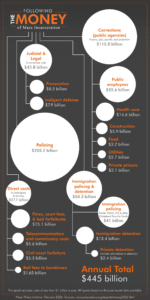
h
This benefits not only private prison corporations, but also public agencies, and employees also gain significantly. Furthermore, there are lesser-known players in this criminalization system.
j
1- Bail bond companies collect $1.65 billion in nonrefundable fees from defendants and families and often oppose reforms that reduce wealth-based pretrial detention while maintaining public safety.
2- Commissary vendors and telecommunications companies generate $5.6 billion annually by selling goods and services to incarcerated individuals reliant on support from loved ones.
3- Correctional health care providers also face criticism for high costs and inadequate services for inmates.
l
l
l
k
j
><
o
TOP NEWS FROM LAW 360
Sentencing Commission’s Reform Ideas May Cut Prison Time
FEBRUARY 10, 2026
By Stewart Bishop
Proposed new amendments to the federal sentencing guidelines could lead to shorter prison terms for many offenders, including by revising loss calculations for financial crimes and providing a first-of-its-kind path to reward defendants for post-offense, pre-sentence rehabilitative efforts.
F
><
s
FEDERAL LEGAL NEWS (FLN)
2/9/2026
The federal government operates a computer system called “Relativity,” accessible in real-time by authorized personnel. It collects extensive data, including emails, phone records, and financial documents. This reform has reduced individual wardens to act as unaccountable “little emperors,” treating Central Office directives and policies as “optional.”
p
k
j
The federal government operates a real-time computer system called “Relativity,” which collects data, including emails and phone records, for authorized personnel, limiting the authority of individual wardens to ensure compliance with Central Office policies.
In Michelin v. Warden Moshannon Valley Correctional Center (3rd Cir.: February 2, 2026), two foreign nationals, a Nigerian and a Jamaican, faced prolonged detention in U.S. immigration facilities post-sentence. They filed for habeas corpus in Pennsylvania, arguing that their detention without bond hearings violated their Fifth Amendment rights. The court granted their petitions, ordered bond hearings, and released them on bond.
Prisoners contend with a broken medical system. At Devens FMC, the Unit Team has informed us that because we have homes to go to and there are no halfway house options, we won’t receive a “Second Chance” and will remain until our home confinement dates. Essentially, those who can support themselves post-incarceration end up staying longer because they don’t need halfway house services.
USSC. “The Commission has prioritized examining if the guidelines adequately adjust for good behavior by May 1, 2026. While §3E1.1 (Acceptance of Responsibility) and §5K1.1 (Substantial Assistance to Authorities) account for some positive post-offense conduct, there are recommendations to consider additional positive behavior. The proposed amendment would introduce a new adjustment at §3E1.2 (Post-Offense Rehabilitation) to provide reductions for demonstrable rehabilitative efforts.”
p
GAO 1/2026 REPORT TO CONGRESS.
l
COST TO TAXPAYERS: PER REPORT PAGE 3 Attached, March 31, 2024–December 31, 2024:
[9 Months] Approx. 273 days (x) 16,000 inmates (x) $129/day = $563,472,000
r
><
Legal Case Short – BOP Medical Neglect Settlement / Malpractice Cases are Possible.
2-5-2026

George Thacker reported to the FCI Edgefield camp on December 9, 2022, to serve a 33-month sentence. On Christmas Day, he was in severe, disabling pain, yet medical staff provided only ibuprofen and no examination or testing. He died the next day from a perforated duodenal ulcer.
His daughter, as executor, sued the Bureau of Prisons under the Federal Tort Claims Act for medical malpractice. Last week, the U.S. Attorney’s Office for South Carolina agreed to a $750,000 settlement, now pending court approval.
Another reminder that failure to deliver basic correctional healthcare continues to create avoidable tragedies—and significant federal liability.
Motion to Approve Settlement and Legal Fees, Docket Entry 28, Wesolowski v. United States, Case No 6:25-cv-6675 (January 27, 2026)
Chattanooga Times Free Press, $750K settlement pending in former Rhea County executive’s 2022 death (January 29, 2026)
><

Last week, multiple reports underscored deepening dysfunction in the Bureau of Prisons. The Marshall Project found that only one in five federal prisons had fully staffed psychology departments; dozens operated at less than half strength, and some had one or no psychologists at all—levels a retired BOP psychologist called “catastrophic.” One  clinician who left a 700-person facility said providing ethical care was impossible.
The same day, DOJ’s Inspector General told Congress that staffing shortages, crumbling facilities, contraband, inadequate healthcare, and staff sexual abuse remain unresolved despite more than 100 oversight reports over two decades. Forbes noted the problems are “systemic and long-standing.”
A Government Accountability Office review noted that the BOP is failing to meet its duties under the First Step Act: as of late 2024, 70% of eligible inmates had not received all earned time credits, and over half received no prerelease custody credit. GAO urged Congress to require continued annual FSA reporting to ensure accountability.
The Marshall Project, Amid ‘Catastrophic’ Shortage, Psychologists Flee Federal Prisons in Droves (January 26, 2026)
DOJ Inspector General, Top Management and Performance Challenges Facing the Department of Justice | 2025 (January 26, 2026)
Forbes, The Bureau Of Prisons: When OIG Warnings Meet GAO Reality (January 28, 2026)
GAO, Federal Prisons: Improvements Needed to the System Used to Assess and Mitigate Incarcerated People’s Recidivism Risk, GAO-26-107268 (January 27, 2026)
~ Thomas L. Root
><
p
MEDICAL CARE IN PRISON: 2026
2/7/2026
p

p
TOPICS
- YOUR MEDICAL RECORD.
- The PRESENTENCE REPORT (PSR), CAN BE YOUR MEDICAL REFERRAL.
- PATIENT CARE.
- CATEGORIES AND SCOPE OF CARE
- STEEL TOE SAFETY BOOTS IN PRISONS | NIH: Shear-Reducing Insoles Prevent Foot Ulceration
- THE NEEDS OF AN AGING PRISON POPULATION
- MENTAL HEALTH PROGRAMS HAVE LIMITED LOCATIONS NATIONWIDE
- PSYCHOLOGY PROGRAMS.
- MEDICATION AVAILABILITY.
- DOJ-OIG REPORTS.
- THE DARK SIDE of MEDICAL CARE IN PRISON.
- COMPASSIONATE RELEASE – BRIEF OF AMICI CURIAE
- WHERE JUDGES HAD TO INTERVENE
- MENTAL HEALTH – PREVENTABLE DEATHS.
- MEASLES: Checklist for Correctional Facilities.
- THE BOP ENCOURAGES INMATES TO USE THE ADMINISTRATIVE REMEDY PROGRAM FOR GRIEVANCES.
NEXT, PREPARATION FOR YOUR INTERVIEW (PSI)
As early as possible, before your Presentence Interview, if you need to continue your current medical treatments, start preparing to obtain copies of all your records.
When it comes to providing medical care to individuals with unique medical conditions while in the Bureau of Prisons (BOP), it is crucial to have a comprehensive medical history that includes all medical records, including reports of surgeries (including pathology reports), diagnostic: X-rays, CT, MRI, ultrasounds, EEGs, EKGs, and PET scans (Reports on CD or Thumb Drives). Any and all physician (specialty) office records and notes, including prescriptions.
- All recent blood tests, prescriptions (Drugs and Medical Devices), hospital records, and treatment plans from their treating physician.
- To ensure that the patient/inmate receives appropriate care, it is essential to obtain all relevant documentation and contact information for physicians, including their name, phone number, email address, and address.
- It is advisable to prepare thoroughly for the Presentence Interview, especially if there are concerns regarding the patient’s medical care, as raised by the patient’s attorney or the treating physician. Doing so enables strategic planning and ensures that the patient-inmate receives the necessary care during their time in the BOP. Still, remember that there are no guarantees once incarcerated, so attention to detail at the outset is in your long-term interest.
Your Comprehensive Autobiographical Narrative should include your entire Medical Record. If you use a CPAP, have Tinnitus, balance issues, take medications, or have other medical concerns, you need your physicians’ chart notes and treatments reflecting your medical ineligibility for an Upper Bunk.
l
IN YOUR PSR: NO TOP BUNK – PHYSICIAN DOCUMENTED
o

j
OUTSIDE OF PRISON – AT HOME. If you’re not well, experience severe pain, and cannot walk, you would seek urgent medical care. Doctors will assess the injury, possibly using X-rays or a CT scan. Depending on the severity of the injury, you might be admitted to the hospital or transferred to a specialized center.
It’s important to note that in prison, access to specialists may be delayed or denied, underscoring the importance of prevention.
k
Recognize that you’re going into a place where you have no control.
You do not want an upper bunk if you have muscle weakness, an unstable gait due to degenerative joint disease, sciatica (or neuritis), are older, or have other medical conditions that could contribute to an unstable equilibrium.
Your Presentence Report should provide documentation from your surgeon, family practitioner, internal medicine doctor, or other physician stating that a top bunk is out of the question and why!
BOP OUTSIDE MEDICAL SPECIALISTS. Getting medical care inside is not like what you are used to. Expect not to have specialty care provided, and even if you have that second opinion (after 2-3 years), your facility’s Clinical Director (CD) is Not Obligated to follow those recommendations. This is another reason a comprehensive Presentence Report could be essential.
j

Consider a Comprehensive Presentence Report like Insurance; you hope you don’t need it – until you do.
p
The PRESENTENCE REPORT (PSR) CAN BE YOUR MEDICAL REFERRAL.
l
l
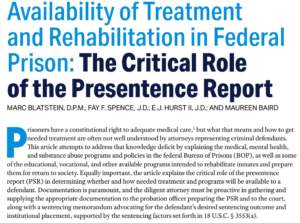
l
PATIENT CARE
k
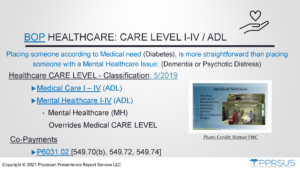
p
p
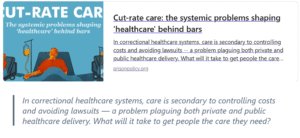
p
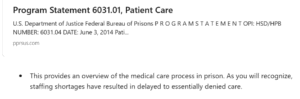
p
p
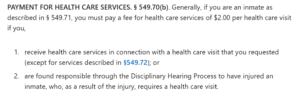
o
p
CATEGORIES AND SCOPE OF CARE
I. Life-Threatening Conditions
Life-threatening conditions require immediate attention to sustain life or critical bodily functions. The BOP classifies these as “Medically Necessary–Acute or Emergent,” including heart attacks, severe trauma (like head injuries), hemorrhage, stroke, detached retina, sudden vision loss, and complications of pregnancy or labor.
p
II. Medically Necessary but Not Urgent,
■ Serious deterioration leading to premature death. ■ Significant reduction in the possibility of repair later without present treatment. ■ Significant pain or discomfort which impairs the inmate’s participation in activities of daily living.
While not immediately life-threatening, without treatment, the person’s overall health and, or ADL may not be maintained.
p
III. Medically Appropriate but Not Necessary; to improve the person’s quality of life
■ Joint replacement. ■ Reconstruction of the anterior cruciate ligament of the knee. ■ Treatment of non-cancerous skin conditions (e.g., skin tags, lipomas)
These always require review by the Institution Utilization Review regarding,
■ The risks and benefits of the treatment. ■ Available resources. ■ Natural history of the condition. ■ The effect of the intervention on the inmate’s functioning in his/her activities of daily living.
These are considered elective procedures to improve an inmate’s quality of life and may be permitted.
l
IV. Limited Medical Value.
■ Minor conditions that are self-limiting. ■ Cosmetic procedures (e.g., blepharoplasty). ■ Removal of non-cancerous skin lesions (if you have a history of skin cancer, two issues are present: (1) hope that the prison healthcare provider has this type of training to recognize Cancer, and (2) that your Presentence Report has your history reported in detail).
l
V. Extraordinary.
■ Organ transplant or Donor, or ■ Those Considered Investigational
l
l
Steel Toe Safety Boots In Prisons | NIH: Shear-Reducing Insoles Prevent Foot Ulceration
o
- Medicine is both an art and a science. While the implementation of steel-toe safety boots protects the institution and the majority of incarcerated persons, a small but significant portion of the population may be harmed, however rare that may be.
o
The Bureau states in Program Statement 6031.01, Patient Care (Page 58), that it isresponsible for providing each inmate with one pair of safety shoes suitable for their job assignment.
y
- They would make custom shoes (not safety shoes) or orthotic devices available, if medically necessary, to accommodate a significant foot deformity or reduce the risk of foot injury in individuals with impaired sensation.
- The caveat here is that in a large bureaucratic institution, the patient/inmate may have to either pay their co-pay in order to be seen immediately for an unscheduled visit or wait for staff to provide a referral – either way, once prescribed, the wait time can be expected to be at best, “a while.”
- The headline image I have chosen was for several reasons. Safety boots with a steel-toe box provide protection, but after 30+ years of practice in this field, other forces are of greater concern. To start, the inner sole at the bottom of the boot has to have significant padding to cushion (or protect) the foot from shear forces that, over time, could wear down the skin’s protective padding. In 2006, the boots had none.
Patient Care Page 58
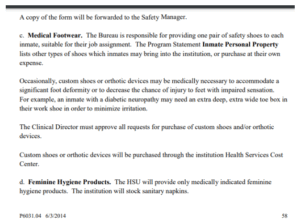
p
p
HCPCS Code for For diabetics, fitting (including follow-up), custom preparation and supply of off-the-shelf depth-inlay shoe manufactured to accommodate multi-density insert(s), per shoe A5500.
Therapeutic Shoes for Persons with Diabetes – Policy Article, A52501
- Then there is the steel toe, and while available in widths, new boots, being what they are, take time to break in. During that period, a person’s toe rubbing against the hard, leather-steel binding is a recipe for potential problems, no matter how rare. Over time, with wear, the foot, through normal gait, could again rub against the steel toe box, no matter how rare.
Management of Diabetes
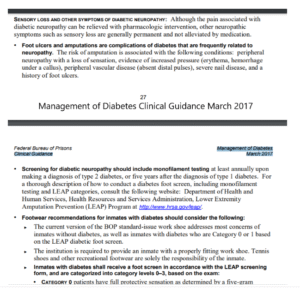
l
- The patient/inmate does not have to be a controlled or out-of-control Diabetic. They could be pre-diabetic, have Peripheral Vascular Disease (PVD), or Raynaud’s, just to mention a few. Therefore, for those who slip through the CARE LEVEL cracks, some may need to have a toe or two amputated due to infection.
- Here, Murphy’s Law presents itself (as one amputation turns into multiple, more aggressive procedures) – some of which could have been avoided with prevention.
l
THE NEEDS OF AN AGING PRISON POPULATION
- CAN THEY PARTICIPATE IN ACTIVITIES OF DAILY LIVING (ADL)? IN SOME LOCATIONS THERE ARE INMATE COMPANIONS TO ASSIST WHERE NEEDED.
- EXTREME HEAT CAN BE DEADLY, YOUNG OR OLD, BUT AFFECTS SENIORS AND THE IMMUNOCOMPROMISED MOST.
- CLIMATE CHANGE. Prison Policy Initiative: A combination of heatwaves and extreme weather events is now becoming more commonplace, and while states like Texas (and others in the South) are seeing staggering high temperatures (increasing at night) along with the unusual increase in severity of normally experienced weather events, it’s those states in the Northeast that are experiencing higher mortality rates.
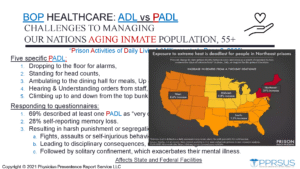
l
l
k
MENTAL HEALTH PROGRAMS HAVE LIMITED LOCATIONS NATIONWIDE
u
FEMALE INTEGRATED TREATMENT PROGRAM (FIT). The Female Integrated Treatment (FIT) Program supports female inmates with PTSD, mental illness, and substance abuse by providing comprehensive treatment and access to the RDAP Program in a therapeutic community setting. Located in low-security institutions, the program serves about 200 inmates and is staffed by three psychologists, four treatment specialists, a social worker, and a unit team.
SKILLS PROGRAM RESIDENTIAL, For those inmates with a documented history of Neurological deficits from Acquired brain damage, Fetal Alcohol Syndrome (CDC), Autism Spectrum Disorder (ASD), and/or remarkable social skills deficits. ASD is a brain development disorder that affects social communication and interaction. It also includes limited, repetitive behaviors, which can lead to confusion and hostility among inmates and correctional staff.
STAGES PROGRAM RESIDENTIAL, The STAGES program is for inmates with Borderline Personality Disorder, typically characterized by: 1. prolonged restricted housing placements, 2. multiple incident reports and/or suicide watches, 3. a pattern of disruptive behavior, and 4. a willingness to engage with treatment staff.
- Borderline Personality Disorder is a mental illness that severely impacts a person’s ability to regulate their emotions. Treatments and Therapies range from talk therapy to medications to treat specific symptoms or co-occurring mental disorders, such as mood swings or depression. The National Institute of Mental Health (NIMH)/(NIH)
- National Education Alliance for Borderline Personality Disorder (NEABPD) – Recommended Treatments, Video Series Professionals, Video Series Families.
Skills Program: A program for inmates with intellectual disabilities, neurological deficits, and social deficiencies (i.e., Autistic). The staff works closely with psychiatry to ensure participants receive appropriate medication and have the opportunity to build a positive relationship with the psychiatrist. The Mental Health Step Down program is delivered by Psychology Services staff.
BRAVE Program**, Bureau Rehabilitation and Value Enhancement Program to facilitate a favorable institutional adjustment. Participants interact in groups and attend community meetings while living in a housing unit separate from the general population. The BRAVE is only delivered by Psychology Services staff.
The Life Connections Program (LCP) is endorsed by the BOP and addresses religious beliefs and value systems. The LCP uses agency chaplains, mentor coordinators, contracted spiritual guides, community mentors, and volunteers to work in small groups and one-on-one with program participants. This gives participants the opportunity to learn from others. Upon release, the LCP connects them with ongoing community mentoring and faith group support.
p
PSYCHOLOGY PROGRAMS
- I) BRAVE Program**, Bureau Rehabilitation and Value Enhancement Program: A first-timer young male offender 32 years of age or younger, facing a sentence of 60 months or more
- II) Challenge: A male inmate facing a high-security penitentiary with a current diagnosis of either Mood, Anxiety, Schizophrenia, Delusion, and/or Substance-induced Psychotic Disorders

- III) Mental Health Step Down Program: A male or female who lacks the skills to function in a general population prison setting and is willing to work with Psychiatry Services.
- IV) Resolve A male or female with a current diagnosis of a mental illness related to physical, mental, and/or intimate domestic violence or traumatic PTSD
- V) Skills Program, A program for inmates with intellectual disabilities, neurological deficits, and social deficiencies (i.e., Autistic). Participation can be at the beginning of their incarceration, but is available at any time and can be ongoing.
- VI) STAGES Program, Residential, A male inmate with a serious mental illness and a primary diagnosis of Borderline Personality Disorder, along with a history of unfavorable institutional adjustment.
The BOP assigns them to higher-security facilities as needed, particularly for general-population placement. Upon arrival, new sex offenders are frequently asked about their offenses by bunkmates, which leads to potential isolation or violence once their crime is revealed. This may result in most of their time spent in solitary confinement. Therefore, safety considerations suggest placing them in facilities with a Sex Offender Management Program (Page 35 {Below}, SOMP) or at least in a camp when appropriate.

- VII) Sex Offender Treatment Program, Residential (SOTP-R), Single Sex Crime; or first-time Internet Sex Offense
- VIII) Sex Offender Treatment Program Non-Residential (SOTP-NR) has a history of a single sexual offense, and many may be first-time offenders serving a sentence for an Internet-based sexual crime.
- IX) FCC Butner Psychology Doctoral Internship Program is considered for sexually dangerous persons with the possibility of criminal recidivism
- X) Female Integrated Treatment (FIT) Program is for females with substance abuse (RDAP Eligibility Possible), trauma-related disorders, and other mental illnesses. (FIT) Program
p
MEDICATION AVAILABILITY
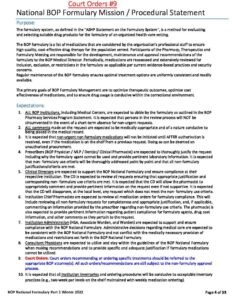
Falls into Three Tiers:
o

l
The BOP has a 3-tier formulary of approximately 3,500 medications, designed to support cost containment. The 2020 Drug Formulary helps defense teams identify medications for their clients before the PSR and PSI.
j

l
It’s crucial to inform clients that generic medications may differ in color, size, or shape from those they received prior to incarceration, which can help ease their concerns and prevent interruptions in care.
j
l
Tier I: On Formulary, available but you still may not get it. Include all meds in your PSR.
p
p
Tier II: Non-Formulary (Requires a lengthy preauthorization process, and usually is denied)
p
p
Tier III: Not Available
The BOP third tier allows for the BOP to prescribe therapeutically equivalent but chemically different drugs to “reduce costs, increase efficiency, enhance access, and improve inventory management.” Collaborating with your client’s physician and reviewing the BOP’s medication list may or may not yield options.
- By this point, the legal team and current treating physician may have to begin to address in your defense strategy why this medication is needed to maintain continuity of care and quality of life.
u
DOJ-OIG REPORTS
o
p

i
- The Department of Justice Office of the Inspector General (DOJ OIG) identified serious issues at the Federal Detention Center (FDC) SeaTac, including inadequate inmate healthcare, staffing shortages, and contraband control problems. The shortage of healthcare staff and Correctional Officers—common issues across many Bureau of Prisons (BOP) facilities—has created significant operational challenges that affect the health and safety of employees and inmates.
o
o
o
o
o
Should your client be denied medical care once they have either self-surrendered, been remanded, or are still incarcerated, do they know what to do? Was their medical record comprehensive when provided to their Probation Officer (PSI)? While this is hopefully rare, it does happen, as you have read in recent cases.
l
THE DARK SIDE of MEDICAL CARE IN PRISON
WOMEN
Women are twice as likely as men to experience PTSD, according to the World Health Organization. A woman’s chances of experiencing trauma are higher — 10% of women will experience PTSD versus 4% of men. “It’s tough to say there are sure symptoms of PTSD since no two people will have the same experience,” Pereau says.
h

l
o
COMPASSIONATE RELEASE – BRIEF OF AMICI CURIAE
l

- QUESTION PRESENTED. Whether the court of appeals correctly determined that the petitioner had failed to identify “extraordinary and compelling reasons” that supported reducing his sentence under 18 U.S.C. 3582(c)(1)(A)(i), where his motion relied on a statutory sentencing amendment to 18 U.S.C. 924(c) that specifically does not apply to preexisting sentences.
l
WHERE JUDGES HAD TO INTERVENE AND ORDER RELEASE
j
p
p

l
- …the prison “arbitrarily reduced” the dosage of one of his blood pressure medications, and gave him a different medication that led to severe symptoms, including dizziness and at least one, or possibly two, transient ischemic attacks, commonly referred to as mini-strokes.
l
MENTAL HEALTH – PREVENTABLE DEATHS
u

k
The “Exposing Parchman” documentary at the Mississippi State Prison
p
p
As unnatural deaths in federal prisons require an autopsy, most deaths in federal prisons are classified as ‘natural.’
o

p
pp
NPR found cases where medical neglect, poor prison conditions, and a lack of resources contributed to these deaths. Families were given little information. NPR found that the CDC says natural deaths happen mostly due to disease or old age. Yet 70% of the inmates who died in federal prison in the last 13 years were under the age of 65.
Examples of “natural” deaths include an inmate at BOP FMC Springfield, Mo., who died after weeks of untreated digestive bleeding, and another in Missouri who experienced respiratory failure, later deemed a homicide. In another case, a prisoner collapsed while running and was hospitalized. His family, not informed by the prison, called multiple hospitals before locating him. The BOP contacted them two days later, assuring them that they need not worry. Two weeks after his collapse, he died, labeled as a natural death.
l
FROM THE CDC: MEASLES IS SERIOUS. IT IS IMPOSSIBLE TO QUARANTINE PERSONS IN A PRISON.
k
l
l
THE BOP ENCOURAGES INMATES TO USE THE ADMINISTRATIVE REMEDY PROGRAM FOR GRIEVANCES.
Most of this is to be initiated by the inmate and each step must be followed as there are a finite number of days – exceed that number and it will be voided by the BOP. The Exception is a medical care concern that after the BP-9, can jump directly to the §2241 (going directly to the court).
o
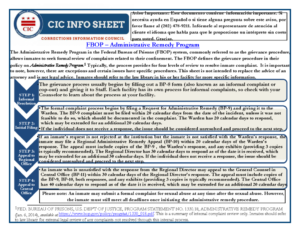
j
BP: 8, 9, 10, 11. THEN §2241(going directly to the court).
r
2-1-2026
*
*
A Short Rocket – Update for January 29, 2026
*
Money, That’s What I Want – Bipartisan bills S.3626 and H.R.7033 have been introduced to address staffing shortages at federal prisons by offering a 35% salary increase for Bureau of Prisons correctional staff. Sponsors include Sen. Jeanne Shaheen (D-NH) and David McCormick (R-PA) in the Senate, and Reps. Dan Goldman (D-NY) and Rob Bresnahan (R-PA) in the House.
S.3626, A bill to amend title 5, United States Code, to improve recruitment and retention of Federal correctional officers (January 13, 2026)
H.R.7033 – Federal Correctional Officer Paycheck Protection Act of 2026 (January 13, 2026)
FedWeek, Bills Proposed to Boost Bureau of Prisons Pay by 35% (January 20, 2026)
p
The Plot Thickens – Last week, I reported on several clemencies granted to a mix of offenders, including a commutation for James Womack, whose 96-month meth distribution sentence was reduced after a couple of years. Initially, his case didn’t seem to align with the “clemency for the rich and famous” theme from the White House. However, it was revealed that his father, Rep. Steve Womack (R-AR), is a close Trump ally. Additionally, the White House cited Jim’s mother’s cancer diagnosis as a reason for the commutation. Jim was released on January 15, but his mother passed away just three days later.
Daily Beast, Trump Frees MAGA Rep’s Meth Dealer Son in Pardon Spree (January 17, 2026)
KATV, Terri Womack, wife of Arkansas Congressman Steve Womack, dies at 68 (January 20, 2026)
h
a
Danny Howell, an Indiana prisoner, was denied leave to proceed in forma pauperis (IFP) because he had “repeatedly abused this Court’s process.” This ruling means he cannot file additional petitions without prepaying the $300 fee, following the 1992 decision in Martin v DC Court of Appeals.
Martin was noted for submitting 54 IFP filings in 10 years, raising concerns among dissenters that this could lead to broader restrictions on court access. Justice Jackson highlighted that, unlike Danny Howell’s six filings over 14 years, the Court has frequently used the “Martin” precedent to bar indigent litigants after just a few petitions. He criticized this approach as a poor trade-off, arguing it restricts access to justice for indigent incarcerated individuals to avoid minor administrative burdens.
Indiana ex rel. Howell v. Circuit Court, Case No 25-5557, 2026 U.S. LEXIS 495 (Jan 20, 2026)
Martin v. District of Columbia Court of Appeals, 506 U.S. 1 (1992) (per curiam).
~ Thomas L. Root
.><
PLACING INMATES WITHIN 500 DRIVING MILES: A DOJ-OIG REPORT
s
a
FSA amends 18 U.S.C. § 3621(b), requiring the Federal Bureau of Prisons (BOP) to place inmates in facilities as close to their primary residence as possible.
18 U.S.C. § 3621(b) Placing inmates close to home during incarceration reduces recidivism, eases the harm to family members, and strengthens family ties. Use the interactive dashboard available online at oig.justice.gov, in the attachment below.
H
The BOP’s mileage calculations were based on a straight-line distance method, not driving miles.
G
The BOP must consider multiple factors when placing, or “designating,” an inmate to a facility. These factors include;
- Bed availability,
- Security level,
- Program needs,
- Faith-based requests,
- Sentencing court recommendations, and other BOP security concerns
- Medical Care
- The BOP classifies inmates into four care levels and places them in facilities that meet their medical and mental health needs. Lower care levels are for those whose medical and mental healthcare needs are minimal
- Inmates classified at higher care levels require higher levels of care, but the number of facilities that can meet these needs decreases.
- When a mental healthcare need is greater than the medical care requirement, placement is based on their mental healthcare needs.
g
The FSA mandated that the Attorney General report to Congress from 2020 to 2025 on progress made, including the number of inmates located more than 500 miles from their release residences.
d
OIG RECOMMENDATIONS
- Ensure that the mileage calculation process accurately records driving miles as required by the FSA.
- Make sure that every inmate placement decision is thoroughly supported by the necessary documentation.
- Implement controls, including address standardization and verification, to guarantee that each inmate’s legal address is accurate at all times.
p
><
GAO 1/2026 REPORT TO CONGRESS.
l
COST TO TAXPAYERS: PER REPORT PAGE 3 Attached, March 31, 2024–December 31, 2024:
[9 Months] Approx. 273 days (x) 16,000 inmates (x) $129/day = $563,472,000, that You And I are paying for.
Leaving eligible persons in prison.
s
d
Just A Bit Of What The GAO Found – Not Great.
*
FSA Elements (Page 12)
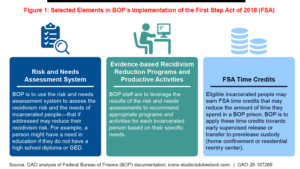
L
p
BOP did not complete all assessments within the
required time frames (28 days for initial and 90 or 180 days for reassessments), and provided explanations for the delays. Page 28
lo
L
Program and Activity Attendance.
- BOP does not have accurate data. Staff used different methods to record when an incarcerated person declined to participate in a recommended program.
- GAO found that BOP generally applied all time credits toward supervised release but not for prerelease custody.
- Delayed Implementation
- In 2023, we added “Strengthening Management of the Federal Prison System” to our high-risk list due to ongoing staffing and infrastructure issues, leadership changes, and other challenges.
s
PATTERN
- The DOJ’s risk assessment tool that BOP staff are to use to measure an incarcerated person’s risk of recidivism.
- Static vs Dynamic Factors. Page 14
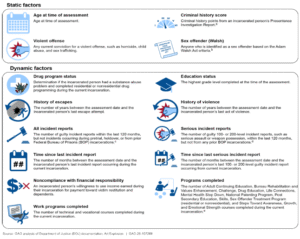
s
><
h
REASONS TO HAVE GREAT LEGAL REPRESENTATION
STATE OR FEDERAL,
TRACKING MISCONDUCT, POLICE, OR NOTICING PERSECUTORS’ CHARGES THAT ARE BEYOND THE PALE; BOTH ARE IMPORTANT REASONS FOR GREAT REPRESENTATION.
These efforts are crucial as the federal government is eliminating police accountability initiatives and suppressing evidence. For instance, last year, the Trump administration deleted the National Law Enforcement Accountability Database, which tracked misconduct among federal law enforcement, including employees of U.S. Customs and Border Protection and the Bureau of Prisons.
This briefing highlights select projects demonstrating how public records can be leveraged to investigate and track police misconduct, discipline, and employment—and how that transparency can pressure law enforcement agencies to improve policies and decision-making.
L
G
1-24-2026
Rick Stover, Special Assistant to the Director and a subject-matter expert on the First Step Act, Q&A.
J
D
SUMMARY.
Calculations of Time Credits were a Software Issue.
-
Now, FSA Time Credits are being done correctly.
-
Reentry Services: Moving inmates to RRC and or HC isn’t great – But improving.
Designation and Sentencing Computation Center started a Triage Team to work with the Reentry Services Division. Two points:
-
Addressed ETC for those in RRC, and moved those eligible to HC.
-
FSA staff lack training; they made an Online Slide tutorial for staff to use. This covers FSA ETC Calculations.
Earned Time Credits (ETC), The Law. “These have to be ‘earned’ before they can be applied.”
-
“Opt-In,” while in the institution. OLD WAY: Case Managers would wait until the program was completed – and then provide the credits.
-
This was flawed because months had passed by the time that the referral was approved, and now, beyond the date for the amount of time credits that the inmate earned.
-
The language under FSA is very definitive: it’s ‘will’ and ‘shall’. These credits will and shall be applied.
-
The BOP feels that even though you’re placed, LATE, into the RRC – and you still have your sentence to serve: the BOP has the discretionary authority here.
Conditional placement dates.
-
You have to be serving a time for an offense that is not disqualifying, and a pattern score that is a minimum or low.
-
As we were calculating these dates, there should be no expectation on the part of the inmates that this was a guarantee.
-
We are now absolutely, positively calculating FSA dates correctly. Now, those calculations run every day. Every day.
To the case managers out there. We do not want case managers doing manual calculations.
-
If inmates are going to the staff, saying, “I did a manual calculation. Can you verify this?” We’re not going to do that. We’re not in the business of doing the manual calculations. We’ve got the formula working right. The program is working right. (opps, Dr MJB).
June 17th memo – SCA:
-
Inmates who need HH go there; those who don’t and are eligible go to HC.
-
Place inmates at the end of their sentence into the community for up to 12 months, six months, or 10%, whichever is less.
-
The five factors are the Law and discretion.
DOESN’T THE BUCK STOP HERE?
It’s really not an FSA problem. It’s a problem of two separate laws. (opps.).
-
FSA, if you’re eligible, essentially places you in the community for a much longer time than was allowable under the Second Chance Act. So the easiest way to describe it is, for every 30 days, you get 15 days in the community, or 15 days are either off your sentence. That would be the first 365 days; anything beyond that, you don’t get it off your sentence, but you do get it towards your community placement, either in an RC or home confinement.
If a HH has open beds, from the BOP Perspective: we’re dealing with contracts and contract quotas- not open beds? Why? Their empty beds may be contracted to a state, jail, or other facility.
><

Restitution Under the MVRA Is a Criminal Penalty
There May Now Be Hope.
1/20/2026
The Supreme Court unanimously ruled that mandatory restitution under the Mandatory Victims Restitution Act (MVRA) is a form of criminal punishment, subject to constitutional limits such as the Ex Post Facto Clause. In Ellingburg v. United States, the Court determined that MVRA restitution is tied to criminal sentencing and offenses, enforcing it as criminal. Consequently, governments cannot retroactively increase past restitution orders with compounded interest under new laws, treating it like other criminal penalties.
K

The ruling was short, simple, unanimous, and transpicuous to any federal defendant: last week, the Supreme Court ruled that restitution is a criminal penalty and not just some random civil judgment.
Ellingburg v. United States, Case No 24-482, 2026 U.S. LEXIS 504 (January 20, 2026)
Substack, Punishment by Another Name (October 13, 2025)
~ Thomas L. Root, LISA FOUNDATION
Important Features of the Ruling:
Criminal, Not Civil: The Court clarified that, despite its goal of victim compensation, MVRA restitution serves as a criminal penalty.
Ex Post Facto Clause: Due to its criminal nature, it is subject to the Constitution’s prohibition on applying harsher penalties retroactively, which affects cases with accumulating interest.
Statutory: The MVRA states that restitution serves punitive purposes and is included in Title 18. “Crimes and Criminal Procedure“.
Implications: This ruling may affect many defendants with older restitution orders, preventing governments from significantly increasing their financial obligations long after their offenses.
v
><
d
*
Supreme Court Separates 924(c) and (j)
January 15, 2026
THE ACT. Dwayne and his gang, the “Crew,” carried out at least eight robberies where they targeted convenience stores and illegal cigarette vendors selling untaxed, smuggled cigarettes, as these victims often couldn’t file police reports.
THEN THE UNEXPECTED (?) HAPPENED. During one robbery, Dwayne and his Crew shot Mr. Dafalla to death after he threw $10,000 in sales proceeds out of the moving vehicle. Dwayne was convicted of Hobbs Act robbery and conspiracy, as well as several 18 USC §924(c) counts for using guns to commit the robberies (crimes of violence under § 924(c)).
Sentenced to 90 years in prison, was later reduced to 50 years based on three Hobbs Act robbery counts. The § 924(j) – believing that § 924(c) and § 924(j) were not separate offenses that could be punished cumulatively – merged into the § 924(c) conviction.
Double Jeopardy. Treating § 924(c) and § 924(j) as the same offense. The Second Circuit, however, rejected the District Court’s position that the Double Jeopardy. The 5th Amendment’s Double Jeopardy Clause provides that no person shall “be subject for the same offence to be twice put in jeopardy
 Gorsuch argued in his concurrence that the Supreme Court has been inconsistent about double jeopardy. He noted that the Court has stated the clause “protects against multiple punishments for the same offense,” suggesting Congress shouldn’t allow multiple convictions for the same offense in concurrent prosecutions. However, he pointed out that the Court has also indicated that in such contexts, the clause directs courts to accurately determine statutory meaning.
..the court will someday need to resolve that “tension.”
Barrett v. United States, Case No. 24-5774, 2026 U.S. LEXIS 433 (January 14, 2026)
Blockburger v. United States, 284 U.S. 299 (1932)
The National News Desk, Supreme Court limits dual charges in overlapping gun statutes (January 14, 2026)
~ Thomas L. Root
l
><
o

WATCH THE 3-MINUTE VIDEO. Lockdowns are increasing nationwide, causing anxiety for families with incarcerated loved ones. These lockdowns can last weeks or months, leading to uncertainty and fear. During a lockdown, conditions mirror solitary confinement, with individuals confined to their cells for up to 23 hours daily. They lose access to medical care, exercise, programming, and communication with family. Lockdowns have been linked to higher rates of drug use, sexual abuse, and suicide. Many prison systems lack oversight and reporting requirements, leaving families in the dark during lockdowns.
K
l
><
H
IMMIGRATION DETENTION – OUT OF CONTROL
YOU’RE NOT SAFE: IMMIGRANT, GREEN CARD, OR US CITIZEN
1-14-2026
><
j
FEDERAL LEGAL NEWS (FLN)
1-19-2026
Presidential Pardons;
- Still, many case managers cite “full” halfway houses as justification to deny home confinement, keeping people incarcerated past their eligibility dates, despite the fact that they have a US Probation-approved address to release to.
- The BOP’s medication-assisted treatment Program is unreliable, making expectations of access a false hope for those entering prison. Staff sometimes chose to place people in the program mere weeks before their release date, forcing addicts to self-medicate for years before that time.
- Supreme Court Delivers Justice to Battered Woman Prosecuted by DOJ; then(FCI) Dublin in California, a low-security women’s prison known as the “rape club,” closed.
Drug Use and Illicit Cell Phones
FLN has credible evidence of employee involvement in the drug trade at certain women’s facilities, but this has been overlooked. Instead, the prison system has implemented mail photocopying and scanning, either on-site or through a third-party vendor.
d
“Restorative Justice”
Restorative justice addresses harm, including criminal offenses, by promoting accountability and repair instead of punishment and isolation. Many programs currently focus on low-level, nonviolent offenses, which increases criminal surveillance for minor issues. This approach neglects research showing that restorative justice is more effective and necessary in cases of serious harm.
Derek Gilna, Director of Research, JD, (De Paul Law School, 1975), MARJ, (Vermont Law School, 2020), Federal Legal Center, 133 W. Market, #171, Indianapolis, IN 46204; dgilna1948@yahoo.com
J
*
1-19-2026
*
2026 FIRST STEP ACT EARLY SUCCESSES
I) SEAN DIDDY COMBS
Jan 8, 2026

CAN DIDDY STAY OUT OF TROUBLE?
FIRST, THERE WAS ALCOHOL ALLEGATIONS.
THEN, 3-WAY CALLS – A VERY BIG ‘NO.’
L
II) FETTY WAP
Thank You, First Step Act …For Early Prison Release!
J


Fetty was released 3 years early from his 6-year prison sentence for drug trafficking, crediting the First Step Act signed by President Trump in 2018, which allows federal inmates to earn time credits to reduce their sentences.
L
FOR BOTH DIDDY AND FETTY, THEY ARE NOT OUT FROM UNDER THE BOP, UNTIL THEY’RE OFF SUPERVISED RELEASE.
k
><
FEDERAL LEGAL NEWS (FLN)
1-12-2026 (Summary)
In a 5–4 decision, the U.S. Supreme Court expanded post-judgment relief for prisoners by broadening access to second or successive §2255 motions seeking sentence reductions. In Bowe v. United States, the Court examined Michael Bowe’s 24-year sentence, which included a mandatory consecutive 10-year term under §924(c) for using a firearm during a “crime of violence.”
Subsequent Supreme Court decisions cast doubt on whether Bowe’s underlying offenses qualify as crimes of violence. United States v. Davis invalidated §924(c)’s residual clause as unconstitutionally vague, and United States v. Taylor held that attempted Hobbs Act robbery does not qualify under the elements clause—undermining the legal basis for Bowe’s §924(c) conviction.
Under AEDPA, prisoners must obtain appellate authorization for second or successive §2255 relief. Bowe’s 2016 challenge to §924(c)’s residual clause was denied. After the decisions in Davis and Taylor (2022), he sought authorization again, arguing that his convictions were no longer valid “crimes of violence.” The Eleventh Circuit denied him relief, prompting Bowe to seek certiorari. The Supreme Court ruled that AEDPA does not bar a second §2255 motion on this basis, but the petitioner must still show entitlement to relief. The Court’s reasoning indicates that Bowe’s claim has merit. Bowe v. United States, No. 24-5438 (2025).
The Sentencing Commission aims to eliminate the distinction between “actual” methamphetamine and mixtures, as most meth is now uniformly pure, which could aid compassionate release arguments. The First Step Implementation Act focuses on making sentencing reforms retroactive, expanding judicial discretion, allowing expungement of nonviolent juvenile records, and improving record accuracy. Additionally, the Safer Detention Act seeks to revive elderly home detention and clarify compassionate release.
Criminologist Emily Widra argues that federal prisons neglect meaningful drug treatment and healthcare, primarily focusing on punishment instead. Despite significant funding, addiction rates remain high, with limited drug testing and minimized acknowledgment of systemic issues. The punitive approach to addiction fails to address the needs of those incarcerated, leading to untreated individuals reoffending and perpetuating a cycle that benefits the incarceration system. Advocates believe this cycle fuels the growth of law enforcement and the prison system, highlighting the need for a review of the Bureau of Prisons’ ineffective Medication-Assisted Treatment (MAT) program.
Separately, in United States v. Ferguson, No. 24-2178 (8th Cir. Jan. 6, 2026), the Eighth Circuit held that an Arkansas cocaine-delivery conviction does not qualify as a “serious drug offense” under the Armed Career Criminal Act because the state statute criminalizes a broader range of cocaine isomers than federal law. Applying the categorical approach, the court vacated Ferguson’s 180-month ACCA-enhanced sentence and remanded for resentencing without the enhancement.
First Step Act Reform Coming Around Again in the Senate? – Update
Senate Committee on the Judiciary, Durbin, Grassley Introduce Criminal Justice Reform Bills (December 16, 2025)
First Act Implementation Act of 2025 (S. —) (submitted December 16, 2025)
Safer Detention Act (S. —) (submitted December 16, 2025)
Prohibiting Punishment of Acquitted Conduct Act of 2025 (S. —), (submitted December 16, 2025)
~ Thomas L. Root
Derek Gilna, Director of Research, JD, (De Paul Law School, 1975), MARJ, (Vermont Law School, 2020), Federal Legal Center, 133 W. Market, #171, Indianapolis, IN 46204; dgilna1948@yahoo.com
j
1-11-2026
*
V
I. DOJ-OIG REPORT: FAILURE OF THE BOP TO PROVIDE BASIC MEDICAL CARE, WHILE WILLFULLY IGNORING COURT ORDERS.
1-6-2026
- EXPECTED: MEDICAL CARE THAT IS USUAL AND CUSTOMARY AND WITHIN THE STANDARD OF CARE FOR PHYSICIANS IN YOUR COMMUNITY.
- BOP STAFF DROPS OFF PATIENT-INMATE, TAKING HIS WHEELCHAIR, LEAVES HIM ON A BENCH AT DALLAS FORT-WORTH AIRPORT.
- COMPASSIONATE RELEASE ORDER: SLOW TO FOLLOW, OR AT WORST, IGNORED.

L
PAGE 1-2: OIG-DOJ REPORT REVIEW.
PAGE 3-16: JUDGES’ ORDER FOR IMMEDIATE RELEASE.
- UNDERSTAFFED OR COVID-19 (AS WAS REFERENCED) IS NOT AN EXCUSE.
REQUESTS FOR COMPASSIONATE RELEASE.
- The Government stated that Mr. Bardell was examined on December 18, 2020, and found “no evidence of malignancy.”
- The Court granted Mr. Bardell’s motion, directing his attorney, Kimberly Copeland, Esq., to work with the U.S. Probation Office on a release plan. The BOP was ordered to release him after approval, but they ignored the Release Order.
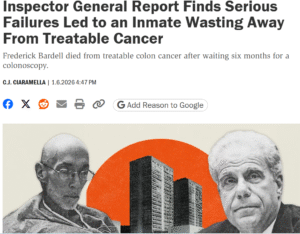
FINALLY, THE JUDGE WAS IRATE:
- The BOP released Mr. Bardell without a release plan, disregarding the Court’s Order. They contacted his parents, who paid nearly $500 for a flight to bring their dying son home.
- Mr. Bardell was unexpectedly released from prison in a wheelchair, but the Bureau of Prisons wouldn’t allow him to keep it for travel. He was subsequently left on the curb of the Dallas/Fort Worth airport to fend for himself.
Don’t assume that the BOP will provide medical care, follow court orders, or create an environment where the inmate will walk out of prison and not have to be taken out in a pine box. A judge’s sentence is not meant to be a Death Sentence.
- 11-23-2024: THE BOP CONVINCES JUDGES THEY CAN PROVIDE ALL MEDICAL CARE: DON’T BE FOOLED…
- 2-27-2025: OIG: BOP STAFFING SHORTAGES RESULT IN DELAYED ⇒ DENIED ‘MEDICAL CARE.’
- 3-13-2025: WHAT TO DO WHEN MEDICAL CARE IS NOT PROVIDED.
U.S. District Judge Roy Dalton held the Federal Bureau of Prisons in contempt in 2022, stating they should be “deeply ashamed” of their treatment of deceased inmate Frederick Bardell.
C
g
g
II. WHITE-COLLAR CASES ARE NO LONGER A TOP PRIORITY
F
PRESIDENT’S EPIC CLEMENCY PARADE, A PEEK BEHIND THE CURTAIN.
Individuals seeking presidential clemency have reportedly paid substantial sums—often approaching $1 million—to lobbyists with access to Donald Trump, sometimes accompanied by additional six- or seven-figure “success fees” if a pardon is granted. In one widely reported example, Donald Trump Jr. introduced lobbyist Ches McDowell to Trump during McDowell’s efforts to secure clemency for Changpeng Zhao, the founder of Binance. Binance reportedly paid McDowell approximately $800,000 and discussed a contingent success fee of more than $5 million upon the granting of a pardon.
k

David Schoen, a former Trump impeachment lawyer, is pursuing the same pardon strategy that has benefited the president’s allies and been fueled by political retribution.
Schoen is seeking clemency for two mobsters serving life sentences since 1992, arguing in a Christmas Eve letter to Trump that they were unfairly prosecuted by Andrew Weissmann—a Trump adversary and former leader of Robert Mueller’s special counsel team investigating Russian interference in the 2016 election.
Wall Street Journal, A Visual Breakdown of Trump’s Pardon Spree (December 10, 2025)
Fox News, Deal-making clemency: Inside Trump’s most disputed pardons of 2025 (December 30, 2025)
~ Thomas L. Root
B
l
Showing Some Compassion: 18 USC §3582(c)(1)(A)(i)
The conversation started to succeed with the FSA

The First Step Act expanded compassionate release by allowing defendants to seek relief directly from the courts, rather than limiting such motions to the Bureau of Prisons and its wardens, when extraordinary and compelling reasons are present.
Many courts have concluded that U.S.S.G. § 1B1.13—drafted when only the BOP could file compassionate-release motions—is outdated and therefore nonbinding. This divergence in interpretation has produced significant disparities among district courts.
In United States v. Brooker (also known as United States v. Zullo), the Second Circuit held that district courts possess broad discretion to determine what constitutes an “extraordinary and compelling reason” under § 3582(c)(1)(A), and that Guideline § 1B1.13 applies only to motions brought by the BOP, which are now infrequent.
United States v. McCoy, Case No 20-6821, 2020 U.S. App. LEXIS 37661 (4th Cir., Dec. 2, 2020)
– Thomas L. Root
><
m
DECREASE IN WHITE-COLLAR PROSECUTIONS
><

m
After Trump granted clemency to Trevor Milton, Mark Watson, and others, the SEC dropped its civil fraud cases, forfeiting a chance to recover money for investors. Lawyers said they didn’t want to appear to challenge Trump’s view of justice.
The move reflects a broader pullback at the SEC. Under Trump, the agency brought just four enforcement actions against public companies in nine months, compared with 52 in the final three months of the Biden administration. SEC Chair Paul Atkins has urged restraint, saying enforcement should not be measured by case counts alone.
><
R
III. MISSING YOUR COURT DATE…
F
Individuals charged with a crime, along with their attorneys and witnesses, including police officers, have a legal obligation to appear in court. However, missed court dates, often due to scheduling issues, are common, particularly among police officers, who miss hearings at rates nearly double those of defendants.
Defendants often face severe penalties, like jail time, for failing to appear in court. However, courts can adopt effective solutions to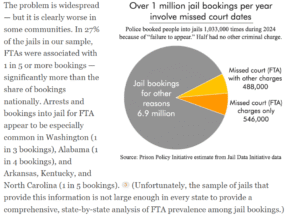
Defendants often face severe penalties, like jail time, for failing to appear in court. However, courts can adopt effective solutions to reduce non-appearance, such as mailed notices, automated reminders, grace periods for unavoidable absences, and options to reschedule hearings rather than issue warrants.
Jury trials are now rare, as prosecutors wield significant power to secure guilty pleas. When individuals miss court, they often miss crucial hearings on witness testimony and evidence discussions.
A missed court date shouldn’t lead to severe consequences that complicate an already difficult experience in the criminal justice system. Individuals may have valid reasons for their absence, like work conflicts, childcare issues, or transportation problems. Arresting them is unjust and counterproductive. We need to change our approach and create accommodations for those who genuinely want to participate in court proceedings.
j
><
IV. FEDERAL LEGAL NEWS (FLN)
1-5-2026
The new Director has been in his position for barely six months and has made steady progress in reducing waste, eliminating corruption, and lowering headcount at the federal Bureau of Prisons.
D
Case: Bailey v. Federal Bureau of Prisons
In April 2024, an advocate for federal prison reform filed a lawsuit against the Federal Bureau of Prisons (BOP). The plaintiff, along with her non-profit, More Than Our Crimes (MTOC), had been publishing critical articles about the BOP since 2020. She alleged that the Bureau cut off her access to information and retaliated against her sources, violating the First and Fifth Amendments.
Bailey claimed that seven BOP facilities—FCI Ray Brook, USP Big Sandy, FCI Hazelton, USP Marion, FCI Pekin, FCI Florence, and USP Beaumont—started blocking her messaging access in 2022. Other non-profits have also faced restrictions on emailing more than one inmate at a time.
Judge Friedman wrote, “The Court will also prohibit the BOP from blocking Ms. Bailey from using TRULINCS.”
D
The FSA allows Wardens to grant “exception” authority for Federal Time Credits (FTC) to inmates who don’t meet standard low-risk criteria. Wardens can approve transfers to prerelease custody for “Medium” or “High” risk inmates if they assess the individual as non-threatening, actively participating in recidivism reduction, and unlikely to reoffend.
D
q
Lenity,
The rule of lenity is a long-standing legal principle in criminal law that requires courts to interpret ambiguous or unclear criminal statutes in the most favorable way to the defendant.
Recent discussions among the Supreme Court justices highlight the instability of the lenity doctrine. In Wooden v. United States, Justices Gorsuch and Kavanaugh debated the proper scope of the ruling. Gorsuch argued that lenity is a constitutional rule tied to due process, asserting that if traditional interpretation tools fail, judges should turn to lenity.
Kavanaugh argued that lenity should be applied only at the end of the interpretive process and infrequently. He highlighted the uncertainty created by Congress’s broad criminal laws, with lenity serving as a crucial check to ensure punishments have clear legislative backing. Gorsuch noted, “Under our rule of law, punishments should never be products of judicial conjecture.”
s
The Elderly Offender Program,
As part of the FSA, it was initiated in 2018 and ended in 2023 due to BOP’s disinterest and management issues. However, it still holds statutory authority and could be reinstated through an Executive Order or BOP directive.
The program required participants to be at least 60 years old, have served two-thirds of their sentence, and have no history of violent crimes or attempts to escape. Reintroducing this program could alleviate pressure on the criticized BOP medical system. While Congress is considering Senate Bill 3485 to revive it, a Presidential Order would strengthen efforts to release eligible elderly and chronically ill inmates to their families or care facilities. There is little public safety justification for holding them back. Reviving lenity.
o
1-4-2026
TOPICS
- LAW 360: THE FIGHT FOR EQUAL JUSTICE. CRIMINAL AND CIVIL DEFENSE IS NOT JUST FOR THOSE WHO CAN AFFORD IT.
- THE SENTENCING PROJECT
- LISA LEGAL FOUNDATION
- SOLITARY WATCH.ORG
- FEDERAL LEGAL NEWS (FLN)
- BOP IN THE NEWS
- ABOVE THE LAW
- MEDICAL
L
LAW360: AN ATTACK ON ACCESS.
The Showdown Over Birthright Citizenship
- This year, the Supreme Court will decide whether the 14th Amendment guarantees a right to U.S. citizenship to all children born on U.S. soil.
Funding and Access for Legal Aid, Now Uncertain
- WITHOUT LEGAL AID (PUBLIC AND FEDERAL DEFENDER). Established by Congress in 1974 to ensure equal access to justice by providing civil legal aid to people who can’t afford lawyers — low-income Americans lack legal help for 92% of their substantial civil legal problems.
Right to Counsel
- For tenants facing eviction, the problem has continued to expand geographically in 2025, with Los Angeles adopting the tenant’s right to counsel and Bozeman, Montana, joining the list, bringing the total to 27 jurisdictions.
j
P
*
*
Top Trends in Criminal Legal Reform, 2025
O
The United States has one of the highest incarceration rates globally, far exceeding other industrialized nations. In 2025, some state legislatures embraced criminal legal reforms, while others used punitive rhetoric to stoke fears of crime.
J
Second Look and Rehabilitation-Based Release Policies
Second Look, Prison Policy Initiative
Second Look Act-2025 The Sentencing Project
a
**Look and Rehabilitation-Based Release Policies Summary**
- **Delaware:** Senate Bill 10, also known as the Richard “Mouse” Smith Compassionate Release Act, allows sentence reviews for individuals rehabilitated after serving 25 years, or for those over 60 after 15 years. Previously, only individuals under 18 who served 20 years qualified.
- **Georgia:** House Bill 582, the Georgia Survivors Justice Act, permits courts to waive mandatory minimums when abuse is a significant factor in an offense and allows incarcerated survivors of domestic violence or child abuse to seek reduced sentences influenced by their experiences.
- **Maryland:** House Bill 853 introduces a “second look” policy for individuals aged 18–25 after 20 years, excluding certain violent offenses. House Bill 1123 establishes medical and geriatric parole for those chronically debilitated and allows geriatric parole for individuals 65 and older after 20 years served.
Scaling Back State Cocaine Sentencing Disparities
In 2025, Arizona and Virginia became the latest states to address the crack-powder sentencing disparity.
- Lawmakers in Arizona passed House Bill 2720. The law change removed the lower quantity threshold for “hydrolyzed cocaine” (including crack cocaine), aligning it with the nine-gram threshold for powdered cocaine, so both are now punished equally.
- Virginia policymakers passed Senate Bill 888 in 2025. The new law removes the legal distinction between crack and powder cocaine for purposes of sentencing.
- The Feds Pardon: 400 Tons delivered by the ex-president of Honduras, vs everyone else?
Expunging Certain Criminal Convictions
Illinois lawmakers authorized expungement of certain criminal convictions with the passage of House Bill 1836. The Illinois Clean Slate Act, effective in 2029, will automatically seal eligible misdemeanor and certain felony records. Illinois joins 12 states and Washington, DC in having clean slate laws.
Emerging Developments in the Criminal Legal System
In 2025, proposals such as Maryland’s Senate Bill 925 to raise minimum penalties for drug offenses, Nebraska’s Legislative Bill 556 to charge youths as adults at 12, and Maine’s Question 1 on voter ID for incarcerated individuals highlighted the challenges of reforming the criminal legal system. Although these measures failed, they show ongoing obstacles. Additionally, states like Arkansas, Colorado, Illinois, Montana, and South Dakota are planning or expanding prisons, with Arkansas and Montana reaching peak imprisonment levels in 2023.
- In Arkansas, officials are planning a 3,000-bed facility with a $750 million budget for 2025. Illinois lawmakers are closing two older prisons while allocating $900 million for two new 1,500-bed prisons. Montana approved an additional $436 million for new prison beds and construction. Oregon requested $3 million for a feasibility study to replace an aging prison. South Dakota lawmakers backed a $650 million plan for a new 1,500-bed men’s prison.
H
><
*
*
Another Circuit Invalidates Felon-in-Possession in Nonviolent Case
In Ed’s case, he had fully paid his child support debt when found with a firearm. The 5th Circuit ruled there was no justification to disarm him, emphasizing that the focus should be on the nature of the predicate offense rather than his broader criminal history or individual traits, despite past arrests for assault.
The ruling aligns with the Third Circuit’s decision in *Range v. Attorney General * and the Sixth Circuit’s decision in *United States v. Williams*. However, it contradicts the decisions of the Eighth, Ninth, and Tenth Circuits. Notably, the Tenth Circuit case—*Vincent v. United States*—is currently on its third relist at the Supreme Court.
United States v. Cockerham, Case No. 24-60401, 2025 U.S. App. LEXIS 33001 (5th Cir., December 17, 2025)
~ Thomas L. Root
Promising pending case regarding 922g, in Duarte v. United States, Docket No.25-425, asks, “Whether 18 U.S.C. § 922(g)(1)’s [near the bottom of the list] categorical ban on the possession of firearms by felons is unconstitutional as applied to a defendant with non-violent predicate offenses underlying his conviction.”
O
o
L
Incarceration Ain’t Cheap–
The Imperfect numbers that the BOP Published [t he Annual COIF Cost of Incarceration Fee], with commentary.
Costs for a Federal inmate,
- Housed in a Bureau or non-Bureau facility in FY 2024, the amount was $47,162 ($129.21 per day).
- Of course, the costs of being housed in a SuperMax aren’t the same as a Minimum Camp…
- Housed in a Residential Reentry Center for FY 2024 was $43,703 ($119.73 per day).
- Home confinement supervision costs $4,742 a year ($12.96 per day).
BOP, Annual Determination of Average Cost of Incarceration Fee (COIF) (December 15, 2025)
Administrative Office of US Courts, The Public Costs of Supervision Versus Detention (June 5, 2025)
~ Thomas L. Root
o
o
o
Who Runs The Courtroom?
s
Carrying guns can be dangerous for drug dealers because it carries a mandatory additional sentence of at least five years under 18 USC § 924(c), more if you “brandish” it, and even more if you fire it.
Charges include possession with intent to distribute meth under 21 USC § 841 and an 18 U.S.C. § 924(c) offense. The § 841 offense carried a minimum sentence of five years, and the § 924(c) gun offense added another five.
g
SMARTLY SHE CHOSE TO COOPERATE: ERIKA DAY.
- 18 USC § 3553(e), rewards a cooperator with a motion to depart from a statutorily mandated sentence for substantial assistance. The U.S. Attorney moved to depart below the statutory minimum for the meth offense but not for the gun offense. The district court granted the motion but sentenced Erika below the statutory minimum for both offenses, with time served on the § 841 count, and a single day on the Count 2 gun charge.
The Government, arguing that she had to get at least five years on the § 841 count, appealed.
During her pretrial release, Erika successfully completed drug rehabilitation and became a mentor. She managed two jobs, paid off her fines, and obtained her driver’s license after twelve years. With her newfound independence, she bought a vehicle, found stable housing, and worked on rebuilding her relationships with her daughters.
“Judge Kidd noted that rarely does a district court see how a defendant would act with a second chance. Due to Day’s cooperation, the court observed his rehabilitation over a two-year period. However, only one opinion mattered: the United States Attorney’s. She had the authority to allow the district court to impose a just sentence but chose not to, and today’s opinion confirms her power in this decision.”
United States v. Day, Case No. 24-13312, 2025 U.S.App. LEXIS 33634 (11th Cir. Dec 23, 2025)
~ Thomas L. Root
s
Presidential Clemencies Bring Little Hope for Most Federal Prisoners
*

a
The Examiner then listed Trump’s five most controversial clemency actions. Trump prioritized several high-profile pardons after taking office.
- First on the list was Ross Ulbricht, the drug black market operator whom Trump promised to pardon at the Libertarian Party convention in 2024.
- Next was Changpeng Zhao, the founder of Binance, who was pardoned after serving four months for money laundering.
- Former congressman George Santos, convicted of fraud, was pardoned after about four months in prison. The list also included,
- …former Honduran president Juan Orlando Hernandez pardoned. He was serving a 45-year sentence for drug trafficking 400 tons of cocaine, which some reports linked to Trump’s influence in the Honduran presidential election.
D
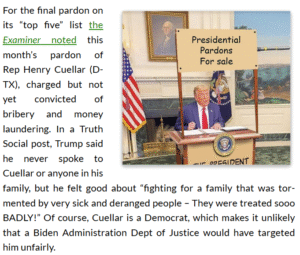
Trump reacted angrily after Cuellar opted to run as a Democrat instead of switching to the Republican Party out of “loyalty” to him.
The Washington Post reported that at least 20 people pardoned by Trump this year had large restitution obligations, often more burdensome than their sentences.
For example, Paul Walczak, who failed to pay over $4 million in taxes, was pardoned before serving any time, clearing his IRS restitution. Many of Trump’s clemencies involved those with political connections to him. Walczak’s pardon followed $1M contributions from his mother, who also attempted to undermine Biden’s 2020 campaign.
Trevor Milton, who was convicted of defrauding investors of Nikola, received a four-year sentence but was pardoned by Trump, who noted Milton’s early support for his presidential campaign.
The transactional nature of Trump’s presidency was highlighted recently by former Pardon Attorney Elizabeth Oyer. You might remember that the Obama Administration launched a major fraud case against FIFA and over 30 other defendants, which is now before the Supreme Court on petitions for certiorari.
- But earlier this month, FIFA announced a new “peace prize” for those promoting global unity and awarded its inaugural prize to President Trump on December 5.
g
 Washington Examiner, Trump’s five most controversial pardons of 2025 (December 25, 2025)
Washington Post, Trump’s pardons wipe out payments to defrauded victims (December 19, 2025)
New York Times, Trump Pardoned Tax Cheat After Mother Attended $1 Million Dinner (May 27, 2025)
CNN, What is the FIFA Peace Prize and why did Donald Trump win? (December 5, 2025)
Facebook, Days after FIFA gave him a medal, Trump’s DOJ started dismantling a major corruption prosecution (December 22, 2025)
~ Thomas L. Root
s
CONTINUING THE TOPIC OF PRESIDENTIAL PARDONS…
As a non-attorney, I may be mistaken. Nevertheless, courts routinely consider sentences imposed in comparable cases when determining an appropriate sentence. In January 6-related cases, many defendants—including some involved in violence—received no prison time or were later pardoned.
- Such outcomes raise concerns about consistency and fairness, particularly where more serious conduct results in lesser punishment. Principles of equal justice—rightly or wrongly—presume that similarly situated defendants are treated alike.
- Comparable disparities appear in drug cases as well, here too referring to the pardon of the former Honduran president despite large-scale cocaine (400 Tons) trafficking. These examples raise legitimate questions about accountability and fairness when similarly situated cases are treated differently, or when outcomes appear influenced by status or connections.
- Below are links to helpful tools when determining one’s sentence.
Z
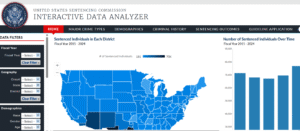
ll
d
><
o

Op-ed: It’s Time to Talk About Prison Food
- Surprise inspections of federal prison kitchens by the Department of Justice found rotting food, insect-infested storage, and broken refrigerators. Additionally, 36 states permit using food as punishment, often in the form of a tasteless “loaf” used as a replacement for those in solitary confinement. Although considered “edible humiliation,” courts have upheld its use since it meets minimum nutritional standards.
- CONSIDER THE 2025 DOJ-OIG FOOD INSPECTION REPORT
p
- After the Biden administration commuted the sentences of 37 men on federal death row, President Trump pledged to impose severe punishments upon his return. A year later, many have been transferred to ADX Florence in Colorado, where inmates are kept in constant solitary confinement. At least one recently transferred man has attempted suicide. The Trump administration has ignored federal guidelines on housing assignments that consider medical, mental health, and faith needs alongside security risk to facilitate these transfers.
Dec. 23, 2025
- CBS officials decided not to air an investigative segment on the controversial El Salvador prison CECOT, despite it being cleared by their lawyers. Deported migrants reported experiencing sexual abuse and solitary confinement there. The decision not to broadcast the segment has led to accusations that it was pulled to avoid portraying the Trump administration negatively, raising concerns about CBS’s journalistic integrity.

The news segment critical of the Trump administration’s immigration policy was pulled from “60 Minutes” but is now circulating online. CBS officials decided not to air an investigative segment on the controversial El Salvador prison CECOT, despite it being cleared by their lawyers.
Deported migrants reported experiencing sexual abuse and solitary confinement there. The decision not to broadcast the segment has led to accusations that it was pulled to avoid portraying the Trump administration negatively, raising concerns about CBS’s journalistic integrity.
WATCH: The 60 Minutes CECOT Segment
- The segment aired on the Global TV app in Canada. Someone sent me a link to a recorded version. Let’s see if we can figure out whether Bari Weiss’ decision to spike it was editorial or political.
l
><
FEDERAL LEGAL NEWS (FLN)
12/19/2025
Humane Incarceration, Meaningful Rehabilitation.
Resistance to new initiatives, waste, mismanagement of government programs, and criminal behavior hinder the new appointees’ important efforts.
The positive impact of Director Marshall’s June 17, 2025, Memo, “To Fully Implement First Step Act and Second Chance Act.” That FSA and SCA sentence-reduction benefits should be “stacked, “and “Conditional Placement Dates” should “drive timely referrals, not bureaucratic inertia.” Although improvements in the process have occurred, it could take another 18 months to achieve, in My Opinion.
STAFF REORGANIZATION: virtually all Regional Directors have been, or are being replaced. Another Positive: the new administration’s more aggressive, results-driven leadership has encouraged reporting the worst abuses, and the absence of union obstacles to staff discipline or dismissal will accelerate the pace of reform.
CONTINUED: POOR MEDICAL CARE. To start, when an outside specialist recommends care, the BOP Clinical Director is not obligated to follow their recommendations. There are no immediate legal remedies to redress the most egregious personal injuries and deaths, such as;
- failure of prison staff to maintain medical alert systems in units, especially for night or weekend medical emergencies,
- failure of staff to timely respond when medical emergencies arise,
- failure to have emergency plans for medical crisis, not to mention
- the deliberate understatement of chronic medical problems,
- falsification of medical charts (in clear violation of federal law),
- lack of supervision of medical personnel, and outright medical errors.
Then, depending on the BP 9-11 Administration Process to address these concerns in a timely fashion.
y
From FCI Thomson in western Illinois, medical staff are lowering care levels to keep inmates at the facility. In the past two months, there have been two deaths, and three more inmates are expected to die after being transferred. Due to the limited Care 3 bed space, everyone is being moved to Care 2, hindering their access to necessary “Timely or Adequate Health” care.
Letters to FLN from Thompson:
- 8 inmates with advanced Prostate Cancer receiving no treatment, and
- Over 25 with large hernias, some experiencing vascular issues and discoloration, just managing their conditions without care.
Healthcare staffing crisis, with only
- Two nurse practitioners and two doctors for 2,100 inmates.
- Medication distribution is often delayed due to budget constraints, and
- Essential medical supplies, like wipes and catheters, are lacking.
Prisoners face additional misery due to a system that appears to punish them for seeking essential medical treatment, such as a colonoscopy. This prisoner’s story,
- I was placed in the Security Housing Unit (SHU) for a cleaning procedure, enduring two days in a cell with temperatures around 80 degrees Fahrenheit and no sleep.
- Then the bus trip for treatment, with 10 to 17 inmates, was shackled together.
- We arrived at the hospital around 5 or 6 AM, but didn’t return until 5 to 7:30 PM. Our meals consisted of a peanut butter sandwich, a stale bag of chips, and a bottle of water for the entire day.
- We weren’t allowed to use the restroom or even blow our noses during the trip.
h
SNIPPETS FROM THE OIG REPORT
- The BOP’s Response to Medical Emergencies Was Often Insufficient Due to a Lack of Clear Communication, Urgency, or Proper Equipment
l
For other legal information, use the information below.
Derek Gilna, Director of Research, JD, (De Paul Law School, 1975), MARJ, (Vermont Law School, 2020), Federal Legal Center, 133 W. Market, #171, Indianapolis, IN 46204; dgilna1948@yahoo.com
><
BOP IN THE NEWS
H
BOP National Resource Team
December 10, 2025
The initiative launched at FCC Victorville began with the USP as its first site. The Deputy Director engaged inmates by asking what could eliminate prison politics. Suggestions included state-of-the-art tablets, more leadership support, and expanded programming. Inmates raised concerns about the accuracy and timeliness of their FSA time credits. The Deputy Director advised leadership to apply credits at the warden’s discretion, resulting in immediate changes in security designations, extended RRC placements, and some immediate releases.
L
D
Highlights from the 2025 Corrections Leadership Summit
December 30, 2025
The Summit emphasized the importance of personal accountability, servant leadership, and the power of influence, highlighting a key truth: great leaders create great institutions. The insights and momentum gained from these two days will continue to shape our leadership development efforts across the agency in the coming months.
s
*
ABOVE THE LAW, BEST OF 2025
Georgetown Law to Ed Martin: F All The Way Off
It’s a good day to be a Hoya. By Kathryn Rubino, March 07, 2025
- In March 2025, Ed Martin, the Interim U.S. Attorney for the District of Columbia, sent a threatening letter to Georgetown Law Dean William Treanor, demanding that the law school halt all diversity, equity, and inclusion efforts or risk his office not considering Georgetown candidates for hiring.
- Below is Dean Treanor’s reply,
Nothing more needs to be said.
><
l
MEDICAL:
AUTISM RESOURCES: MISSED OR MISDIAGNOSED.
From the VA Board of Medicine to the State Physicians, continuing Education is recommended.
G
m
Hepatitis C Virus Is Associated With Increased Mortality Among Incarcerated Hospitalized Persons in Massachusetts
Access to HCV treatments in carceral settings is limited.
h
*