


DOJ $14.6 BILLION IN HEALTHCARE CONVICTIONS. LESSONS LEARNED, PREVENTION.
Protecting Yourself In The Era of Healthcare Fraud Enforcement.
l
g
Federal healthcare enforcement is changing rapidly. Investigations are larger, faster, and increasingly driven by AI and Data Analytics. For physicians, clinic owners, and healthcare executives, that means routine practices—from billing decisions to clinical judgment—can quickly become the focus of federal scrutiny.
f
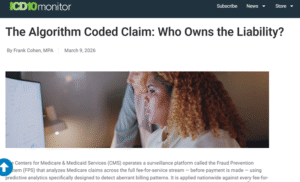
Are Your Claims Al Coded? If Yes – You Are Still Liable.
CMS already analyzes every Medicare fee-for-service claim through its Fraud Prevention System, using predictive analytics to detect unusual billing patterns before payment is made.
- That matters as autonomous coding—AI systems that automatically assign procedure codes, modifiers, and diagnoses—moves into mainstream healthcare billing.
- Traditional coding errors create statistical “noise.” But when an algorithm makes a mistake across thousands of encounters, it creates a pattern—exactly what government analytics systems are designed to detect. Even a small flaw in coding logic can scale into thousands of problematic claims.
- The legal framework is already in place. Under the False Claims Act, organizations can face liability not only for intentional fraud but also for reckless disregard of billing accuracy. Regulators have also made clear that using a vendor’s algorithm does not shift responsibility for the claims it produces.
- Traditional compliance tools—small chart samples and retrospective reviews—were built for human coders, not algorithms operating at scale. Effective oversight requires monitoring coding behavior across the entire claim population.
- Autonomous coding is not going away. But automation without governance can turn small coding errors into large compliance risks.
g
*
Kansas Doctor Sentenced to 3 Years in Prison for $8 Million Medicare Fraud
K
Real-Time Monitoring
h
 The Department of Justice is no longer relying primarily on patient complaints or whistleblowers. Federal agencies now use advanced analytics and centralized monitoring systems to track billing patterns nationwide.
Algorithms can detect irregular claims before payments are even issued. In one recent enforcement effort, Operation Gold Rush (AG Bondi’s $14 Billion Healthcare Takedown), AI Machine-Learning tools identified billions in suspicious claims, leading to arrests across multiple jurisdictions.
For providers, compliance programs built for yesterday’s regulatory environment may no longer be enough.
L
Where Medical Judgment Is Challenged
Some of the most controversial cases arise from disputes over medical decision-making.  Addiction treatment providers, for example, have faced allegations that hundreds of millions of dollars in billed services lacked medical value.
These cases often turn on competing expert opinions and evolving standards of care. Even good-faith clinical decisions can come under scrutiny when viewed through billing data and regulatory interpretation.
l
Owner and Operations Manager of Wholesale Drug Distributor Admit Conspiring to Divert Nearly $50m of Cancer Medication to Sell Illegally For Profit
L
Telemedicine and Opioid Prescribing
Telehealth expansion during the pandemic created new enforcement risks. Federal prosecutors have charged dozens of defendants in telemedicine cases involving more than $1 billion in claims.
Pain management practices also remain a major focus. Investigators now rely on data analytics to identify outlier prescribing patterns, often triggering investigations into opioid prescribing practices.
p
Over $12 Million Medicaid Fraud Scheme Leads to 14 Years of Prison for Substance Abuse Facility, Owner, Compliance Officer, and Office Manager
L
Enforcement Is Increasingly Global
Healthcare fraud investigations frequently involve international companies, marketing groups, and cross-border financial transactions. Charges often include conspiracy, money laundering, and racketeering, reflecting the global reach of modern healthcare enforcement.
L
Financial Risks
Federal prosecutors can freeze or seize assets connected to alleged fraud before a case is  resolved. In recent enforcement actions, authorities seized hundreds of millions of dollars in cash, property, and cryptocurrency.
For healthcare professionals, that can mean bank accounts frozen, practices disrupted, and personal assets at risk based solely on allegations.
P
p
 Steps Healthcare Professionals Could Take to Reduce Their Risk:
- Maintain clear documentation supporting all clinical and billing decisions.
- Implement modern, technology-driven compliance programs.
- Review telemedicine protocols and prescribing practices.
- Verify marketing partners and foreign vendors.
- Consult experienced counsel at the first sign of an investigation.
g
THE DOJ IS ALSO TARGETING
Employee at High-End Car Dealerships Sentenced for Tax Fraud
New Federal Prosecutor Targets Social Security, Other Government Frauds
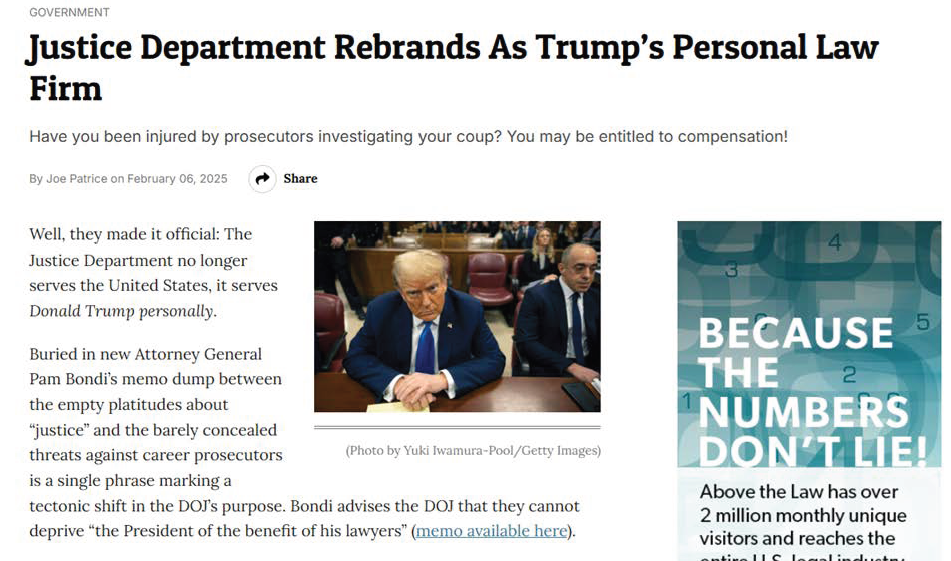
AG BONDI REBRANDES DOJ: “NOW IT’S HIS LAW FIRM.”
M
M
WHAT DOES IT TAKE TO QUALIFY FOR A TRUMP PARDON?
H
Trump pardons wipe nearly $2 billion in victim repayment and taxpayer recovery for Medicare and tax fraud, and more.
March 5, 2026
Pardon Industry Offers Rich Offenders a Path to Trump – The New York Times
March 5, 2026
p
Choosing the Right Legal Representation For You
Healthcare fraud cases are prosecuted under federal law and follow the same procedures in federal courts nationwide. Because of this, experienced federal defense attorneys often represent clients across the country through pro hac vice admission while working with local counsel.
In federal cases, the most important factor is not the lawyer’s location but their experience handling complex healthcare investigations and federal prosecutions.
L
My Takeaway
Healthcare enforcement has entered a new era defined by data analytics, global investigations, and aggressive prosecution strategies. Here are just a few. bbbb

- Medicare False Claims
- Medicare Advantage: The Largest Target in the Room,
Kaiser Permanente Affiliates Pay $556M to Resolve False Claims Act Allegations
- Managed Care Fact Sheet—is now DOJ’s most aggressive FCA battleground.
- PPP Loan Fraud
- Wound Care: Where Civil and Criminal Converge
nd Care: Where Civil and Criminal Converge
For medical professionals, the message is clear: strong compliance and experienced legal counsel are essential. In many cases, by the time an investigation becomes visible, it may already be well underway. Proactive steps include both the legal and non-legal.