

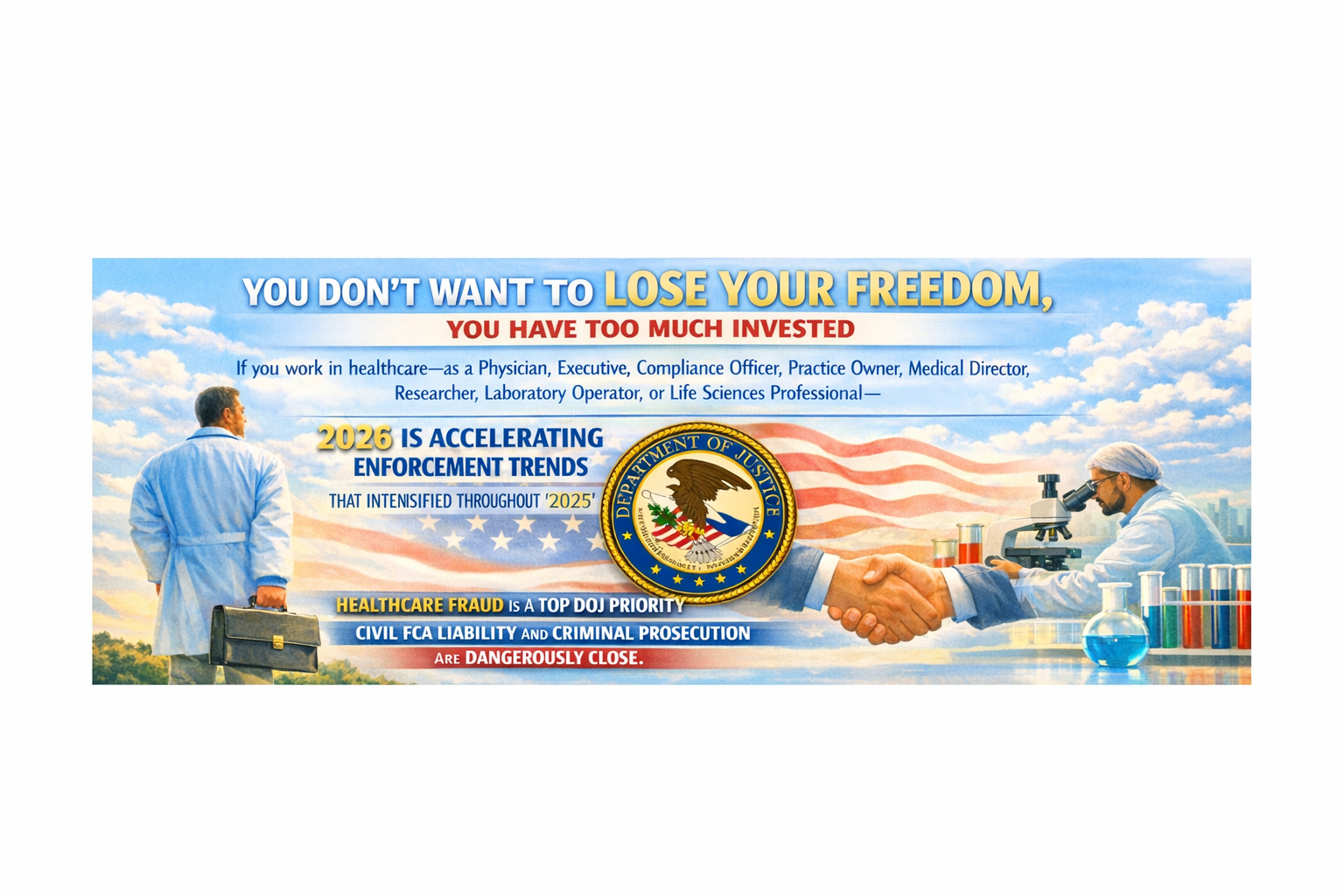
CIVIL ($ Losses) vs. CRIMINAL (Prison): FCA, DEI, TARIFF TAX AVOIDANCE.
THE DOJ CONTINUES TO TARGET HEALTHCARE.
*
Physicians, Executives, Medical Directors, Research and Life Sciences Professionals May Face Civil (FCA) or Criminal Exposure. Is Your Organization Prepared?
*
You’ve worked too hard for too long to let a procedural oversight compromise the career you love. Here is the reality check: The Department of Justice measures success in convictions, not good intentions. An “imperfect” system isn’t just a risk—it’s an invitation. Don’t give them that option.
-
Be fiercely diligent and proactive so you can continue to serve in the specialty you love—without ever putting your career, your reputation, or your family at risk.
V
I. The Line Between Civil Liability and Criminal Prosecution Is Rapidly Disappearing
- If you work in healthcare—as a physician, executive, compliance officer, practice owner, medical director, researcher, laboratory operator, or life sciences professional—2026 is accelerating the enforcement trends that intensified throughout 2025.
- The Department of Justice (DOJ) has made healthcare fraud one of its highest national enforcement priorities. Increasingly, the distinction between civil False Claims Act (FCA) liability and criminal prosecution is becoming dangerously narrow.
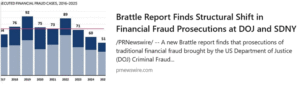
Enforcement priorities have shifted from the Foreign Corrupt Practices Act (FCPA) and public corruption to national security, public funds, and consumer protection cases.
What once resulted in audits, repayments, or civil settlements can now lead to parallel criminal investigations, professional exclusion, asset forfeiture, reputational damage, and exposure to prison. You’ve worked too hard to lose your career and freedom.
- Healthcare organizations are no longer being evaluated solely on outcomes. They are being scrutinized for intent, financial relationships, coding behavior, documentation practices, compensation structures, and increasingly, their use of artificial intelligence.
V
DOJ, HHS, and OIG Enforcement Is Accelerating
- Recent actions by the DOJ and OIG-HHS demonstrate the extraordinary breadth of current enforcement activity across the healthcare industry.
C
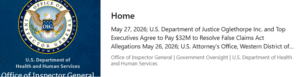
II. CIVIL ($ LOSS)
- While just financial, losing financial resources does hurt. You’ll need great legal representation, and hopefully, there isn’t a Criminal Charge to follow.
C
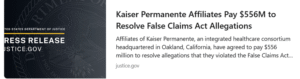
III. CRIMINAL (Prison)
- Again, legal representation is a must, and they should have experience in defending cases similar to yours. Ask questions (here are 14) to see if they are a great fit for you. This is your future, your life.


F
IV. Physician Compensation and Medical Director Agreements: A Major Enforcement Trigger
The DOJ continues to focus aggressively on physician compensation arrangements that may function as improper referral inducements, including:
- Medical director agreements.
- Independent contractor relationships.
- Productivity-based compensation models.
- Referral-linked consulting arrangements.
A Hospital Warning

In the Riverside Hospital matter, DOJ alleged that the hospital paid a physician more than $450,000 through medical director agreements intended to induce referrals that generated millions in Medicare reimbursements.
- According to the allegations, internal communications directly linked compensation to referral activity.
The Exposure
- If physician compensation tracks referrals—explicitly or implicitly—organizations may face exposure under:

- What is the Anti-Kickback Law in Healthcare?
- The Anti-Kickback Statute (AKS)
V. Medicare Advantage: DOJ’s Largest FCA Battleground
- Medicare Advantage (MA) enforcement has emerged as one of the DOJ’s most aggressive healthcare fraud priorities.

L
- Next came Medicare Advantage plans. Their lower costs made them popular, but many consumers assumed they were traditional Medicare. Snowbirds heading to Florida or Arizona often learned otherwise, as some of these practices did not participate in their Medicare Advantage Plans.

- Broker payouts skyrocket 159% over eight years.
D
P

H
L
H
VI. Wound Care: Where Civil and Criminal Liability Increasingly Converge

Recent Cases
- Vohra Wound Physicians Management LLC — $45 million.
- Oroville Hospital — $10.25 million.
Common DOJ Red Flags
- Telemedicine-driven prescribing.
- Volume-based compensation
- Minimal patient examinations/encounters.
- Poor documentation.
- Improper allograft utilization.
P
VII. Telehealth, Pharma, and Opioid Enforcement Remains Aggressive
- The Fourth Temporary Telemedicine Rule extends certain controlled-substance prescribing flexibility through December 31, 2026.
Recent Enforcement Actions
- Teva Pharmaceuticals — $425 million
- Omnicare/CVS — $948.8 million judgment
DOJ investigators continue to aggressively scrutinize:
- Prescribing rationale
- Documentation quality
- Financial relationships
- Telehealth workflows
C
VIII. Artificial Intelligence: The Next FCA FORCE Multiplier
- Artificial intelligence is no longer hypothetical.
C
C
- Three medical leaders propose a six-step plan to license clinical AI to work alongside physicians, suggesting this approach can effectively regulate the technology without limiting its capabilities.

C
 C
C
C
The Evolution of Private Plans in Medicare (Medicare Advantage).

- I remember in the early 1980s, when HMO’s began Capitation and Pre-payment, for private and hospital-based medical groups. Providers received a fixed monthly payment per patient, regardless of whether care was needed. Challenges grew as procedures were also assumed to be included in those fixed payments.
- Next came Medicare Advantage plans. Their lower costs made them popular, but many consumers assumed they were traditional Medicare. Snowbirds heading to Florida or Arizona often learned otherwise when doctors accepted Medicare but not Medicare Advantage.
L
IX. Whistleblowers Continue to Drive Enforcement
- False Claims Act enforcement remains heavily driven by insiders.
- Qui tam filings are at record levels, and healthcare fraud continues to generate some of the DOJ’s largest recoveries.
Assume Everything Is Discoverable.
Your:
- Emails
- Internal chats
- Compensation agreements
- Text messages
- Documentation
- Compliance discussions
- May ultimately become government exhibits.
P
X. The Reality for Healthcare Professionals in 2026

C
Next, the enforcement environment has fundamentally changed.
Today:
- DOJ uses advanced data analytics, AI, and interagency coordination
- Civil and criminal investigations increasingly run in parallel
- Physicians and executives face growing personal exposure
- Compliance failures are frequently re-framed as fraud allegations
C
DOJ Warns That AI and Algorithmic Pricing Tools Can Trigger Criminal Antitrust Liability
- On May 14, Acting Deputy Assistant AG for Criminal Enforcement Daniel Glad stated at the Antitrust West Coast Conference in San Francisco that AI-driven pricing tools do not change antitrust laws or lessen the consequences of collusion.
- Acting Deputy Assistant Attorney General for Criminal Enforcement Daniel Glad Delivers Remarks at the Antitrust West Coast Conference, “[I]f your company is deploying AI or algorithmic tools in competitively sensitive areas, then antitrust review cannot be ceremonial. It must be real.”
- DOJ is no longer simply targeting “the industry.”
- Increasingly, it is targeting individuals.
XI. Prevention May Save Your Organization Financially — And May Keep Others Out of Prison
- Healthcare Risk Management Is No Longer Optional
V
Proactive review of the following areas is now essential:
- Physician compensation structures
- Coding and billing practices
C

XII. TARIFFS:
- INTENTINAL TARIFF AVOIDANCE MAY RESULT IN THE DOJ MOVING FROM FCA TO CRIMINAL EXPOSURE.
XIII. Expecting an Investigation or Indictment? What You Do First Matters
C
L
The earliest decisions made during a federal healthcare investigation may significantly affect your:
- Criminal exposure
- Sentencing outcomes
- Asset preservation
- Licensing consequences
- Cooperation strategy
- Long-term defense options
C
Early preparation, experienced legal guidance, and accurate documentation can materially influence the outcome of both civil and criminal proceedings.