

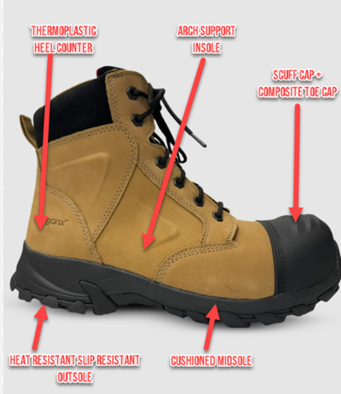
Steel Toe Safety Boots: Width And Shear-Reducing Insoles Help Prevent Progressive Foot Amputations
Steel Toe Safety Boots In Prisons | NIH: Shear-Reducing Insoles Prevent Foot Ulceration
o
- Medicine is both an art and a science. While the implementation of steel-toe safety boots protects the institution and the majority of incarcerated persons, a small but significant portion of the population may be harmed, however rare that may be.
- Steel toe caps may result in harm to those with medical concerns.
o
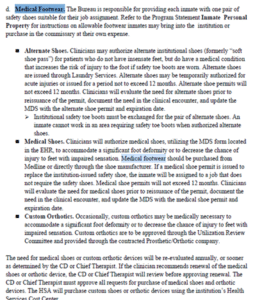
The Bureau states in Program Statement 6031.01, Patient Care (Page 58), that it is responsible for providing each inmate with one pair of safety shoes suitable for their job assignment.
y
- They would make custom shoes (not safety shoes) or orthotic devices available, if medically necessary, to accommodate a significant foot deformity or reduce the risk of foot injury in individuals with impaired sensation.
- The caveat here is that in a large bureaucratic institution, the patient/inmate may have to either pay their co-pay in order to be seen immediately for an unscheduled visit or wait for staff to provide a referral – either way, once prescribed, the wait time can be expected to be at best, “a while.”
- The headline image I have chosen was for several reasons. Safety boots with a steel-toe box provide protection, but after 30+ years of practice in this field, other forces are of greater concern. To start, the inner sole at the bottom of the boot has to have significant padding to cushion (or protect) the foot from shear forces that, over time, could wear down the skin’s protective padding. In 2006, the boots had none.
Patient Care Page 30
p
HCPCS Code for For diabetics, fitting (including follow-up), custom preparation and supply of off-the-shelf depth-inlay shoe manufactured to accommodate multi-density insert(s), per shoe A5500.
Therapeutic Shoes for Persons with Diabetes – Policy Article, A52501
- Then there is the steel toe, and while available in widths, new boots, being what they are, take time to break in. During that period, a person’s toe rubbing against the hard, leather-steel binding is a recipe for potential problems, no matter how rare. Over time, with wear, the foot, through normal gait, could again rub against the steel toe box, no matter how rare.
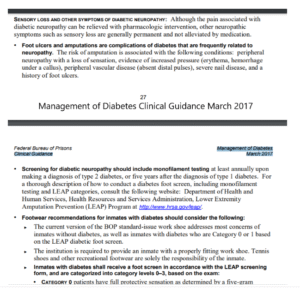
Management of Diabetes
l
- The patient/inmate does not have to be a controlled or out-of-control Diabetic. They could be pre-diabetic, have Peripheral Vascular Disease (PVD), or Raynaud’s, just to mention a few. Therefore, for those who slip through the CARE LEVEL cracks, some may need to have a toe or two amputated due to infection.
Here, Murphy’s Law presents itself (as one amputation turns into multiple, more aggressive procedures) – some of which could have been avoided with prevention.