

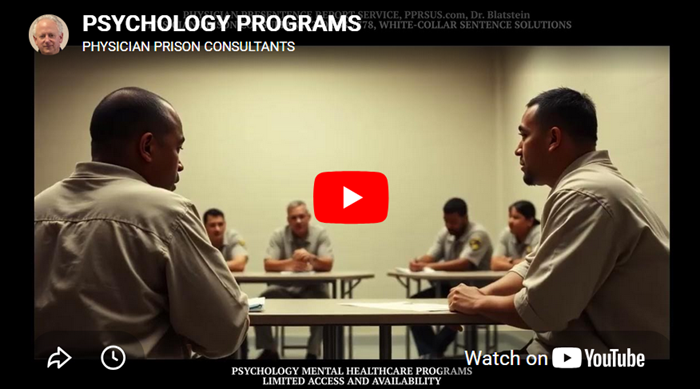
PSYCHOLOGY PROGRAM LOCATIONS AND ACCESS IN FEDERAL PRISON.
*
PRESENTENCE INTERVIEW PREPARATION INCLUDES:
- MEDICATION ACCESS,
- MEDICAL AND MENTAL HEALTHCARE PLACEMENT WHERE POSSIBLE.
⇓ VIDEO DOCUMENTATION BELOW ⇓
*
MENTAL HEALTH PROGRAMS HAVE LIMITED LOCATIONS NATIONWIDE
u
FEMALE INTEGRATED TREATMENT PROGRAM (FIT). The Female Integrated Treatment (FIT) Program supports female inmates with PTSD, mental illness, and substance abuse by providing comprehensive treatment and access to the RDAP Program in a therapeutic community setting. Located in low-security institutions, the program serves about 200 inmates and is staffed by three psychologists, four treatment specialists, a social worker, and a unit team.
SKILLS PROGRAM RESIDENTIAL, for those inmates with a documented history of Neurological deficits from Acquired brain damage, Fetal Alcohol Syndrome (CDC), Autism Spectrum Disorder (ASD), and/or remarkable social skills deficits. ASD is a brain development disorder that affects social communication and interaction. It also includes limited, repetitive behaviors, which can lead to confusion and hostility among inmates and correctional staff.
STAGES PROGRAM RESIDENTIAL: The STAGES program is for inmates with Borderline Personality Disorder, typically characterized by: 1. prolonged restricted housing placements, 2. multiple incident reports and/or suicide watches, 3. a pattern of disruptive behavior, and 4. a willingness to engage with treatment staff.
- Borderline Personality Disorder is a mental illness that severely impacts a person’s ability to regulate their emotions. Treatments and Therapies range from talk therapy to medications to treat specific symptoms or co-occurring mental disorders, such as mood swings or depression. The National Institute of Mental Health (NIMH)/(NIH)
- National Education Alliance for Borderline Personality Disorder (NEABPD) – Recommended Treatments, Video Series Professionals, Video Series Families.
Skills Program: A program for inmates with intellectual disabilities, neurological deficits, and social deficiencies (i.e., Autistic). The staff works closely with psychiatry to ensure participants receive appropriate medication and have the opportunity to build a positive relationship with the psychiatrist. The Mental Health Step Down program is delivered by Psychology Services staff.
BRAVE Program**, Bureau Rehabilitation and Value Enhancement Program to facilitate a favorable institutional adjustment. Participants interact in groups and attend community meetings while living in a housing unit separate from the general population. The BRAVE is only delivered by Psychology Services staff.
The Life Connections Program (LCP) is endorsed by the BOP and addresses religious beliefs and value systems. The LCP uses agency chaplains, mentor coordinators, contracted spiritual guides, community mentors, and volunteers to work in small groups and one-on-one with program participants. This gives participants the opportunity to learn from others. Upon release, the LCP connects them with ongoing community mentoring and faith group support.
p
PSYCHOLOGY PROGRAMS
- I) BRAVE Program**, Bureau Rehabilitation and Value Enhancement Program: A first-timer young male offender 32 years of age or younger, facing a sentence of 60 months or more
- II) Challenge: A male inmate facing a high-security penitentiary with a current diagnosis of either Mood, Anxiety, Schizophrenia, Delusion, and/or Substance-induced Psychotic Disorders

- III) Mental Health Step Down Program: A male or female who lacks the skills to function in a general population prison setting and is willing to work with Psychiatry Services.
- IV) Resolve: A male or female with a current diagnosis of a mental illness related to physical, mental, and/or intimate domestic violence or traumatic PTSD
- V) Skills Program, A program for inmates with intellectual disabilities, neurological deficits, and social deficiencies (i.e., Autistic). Participation can be at the beginning of their incarceration, but is available at any time and can be ongoing.
- VI) STAGES Program, Residential, A male inmate with a serious mental illness and a primary diagnosis of Borderline Personality Disorder, along with a history of unfavorable institutional adjustment.
The BOP assigns them to higher-security facilities as needed, particularly for general-population placement. Upon arrival, new sex offenders are frequently asked about their offenses by bunkmates, which leads to potential isolation or violence once their crime is revealed. This may result in most of their time being spent in solitary confinement. Therefore, safety considerations suggest placing them in facilities with a Sex Offender Management Program (Page 35 {Below}, SOMP) or at least in a camp when appropriate.

- VII) Sex Offender Treatment Program, Residential (SOTP-R), Single Sex Crime; or first-time Internet Sex Offense
- VIII) Sex Offender Treatment Program Non-Residential (SOTP-NR) has a history of a single sexual offense, and many may be first-time offenders serving a sentence for an Internet-based sexual crime.
- IX) FCC Butner Psychology Doctoral Internship Program is considered for sexually dangerous persons with the possibility of criminal recidivism
- X) Female Integrated Treatment (FIT) Program is for females with substance abuse (RDAP Eligibility Possible), trauma-related disorders, and other mental illnesses. (FIT) Program