

Upgrades To First Step Act, September 30, 2026.
BOP Rule Change Expands First Step Act Time Credits Starting September 30, 2026
Proposed Change to First Step Act Earned Time Credits
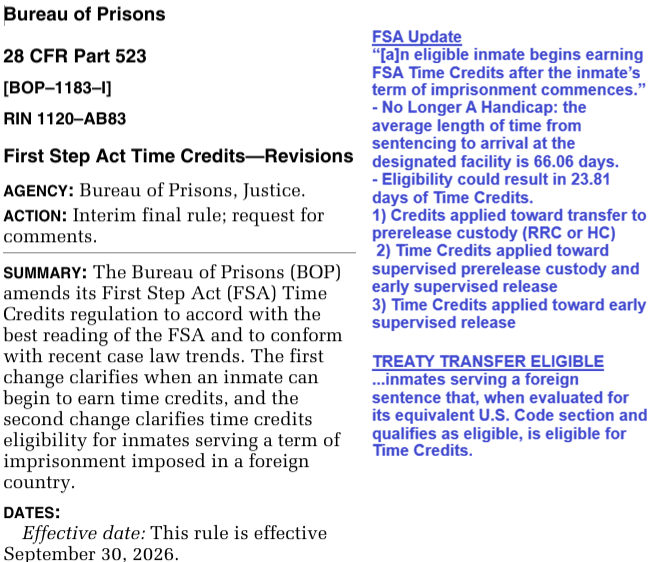
The Bureau of Prisons (BOP) is proposing a change to how it calculates First Step Act (FSA) Earned Time Credits. The proposal would allow eligible federal inmates to begin earning FSA credits once their federal sentence begins—even if they are temporarily held in a local jail or other detention facility while awaiting transfer to their designated BOP institution.
Under the current policy, eligible inmates generally begin earning FSA Time Credits when they arrive or voluntarily surrender at their designated BOP facility. This can create a significant gap for individuals who remain in local custody after sentencing while waiting for transportation to federal prison.
According to the analysis supporting the proposed rule, the average transfer delay is approximately 66 days. For an eligible inmate, that delay could represent about 23.81 days of FSA Time Credits that the inmate could have earned.
The proposed change is based on the statutory language governing when a federal sentence begins. The BOP’s position is that the regulations should more closely reflect the rule that a sentence commences when a defendant is received into custody to begin serving the sentence, including while awaiting transportation to the designated federal facility.
If adopted, the change could allow eligible federal prisoners to begin accumulating First Step Act Earned Time Credits earlier, potentially affecting eligibility for Residential Reentry Center (RRC) placement, home confinement, and other community-based placement opportunities.
In Summary,
Previously, many inmates spent weeks or months in local jails or detention centers awaiting transfer to a BOP facility without earning FSA credits. Under the new rule, eligible prisoners can earn credits from the date their federal sentence officially begins, provided they successfully participate in approved programs and activities.
The BOP estimates that the average 66-day wait between sentencing and prison designation could add nearly 24 days of First Step Act credits for qualifying inmates, helping them transition sooner to halfway houses, home confinement, or supervised release.
How First Step Act Credits Work
Eligible prisoners can earn:
- 10 days of credit for every 30 days of successful participation in approved programs.
- 15 days of credit per 30 days for inmates classified as minimum or low risk who maintain or reduce their risk level over consecutive assessments.
These credits can accelerate placement in prerelease custody and, in some cases, reduce time spent in prison by up to one year.
Benefits for Families and Taxpayers
For families, even a few weeks of earlier release can mean being home for important milestones, holidays, or medical events. The BOP also projects the rule will save taxpayers approximately $54 million annually through reduced incarceration costs.
Additional Update for Treaty-Transfer Prisoners
The new rule also clarifies that eligible U.S. citizens transferred from foreign prisons to serve their sentences in the United States may qualify for First Step Act Time Credits when their sentence has been converted to an equivalent U.S. sentence.
Bottom Line
Although technical, the September 2026 BOP rule is expected to meaningfully affect thousands of eligible federal prisoners, helping them earn additional First Step Act credits, return to their communities sooner, and reduce federal incarceration costs.
PPRSUS will continue to monitor this proposed change and its potential impact on federal inmates and FSA Time Credit eligibility.